
The gift of blood
Trending
LAURIUM -- Local hospitals are always in need of blood, but the winter months are particularly critical.
"You can't buy blood," said Christina Asiala, the Upper Peninsula Regional Director of Laboratory Services for Aspirus. "The only way we can provide blood to our patients is through donations."
During the winter months, flu season reduces the potential donors. The holidays can also be so hectic that people neglect to donate. Finally, many hospitals experience an increase in accidents over the winter that makes the require more blood.
"Typically in the wintertime we do need blood more critically than usual," said Asiala. "December, January, February are usually critical."
Aspirus clinics and other local hospitals rely on blood collected by the Upper Peninsula Regional Blood Center. Last year, 2,549 patients at Aspirus hospitals in Laurium, Ontonagon, Ironwood, and Iron River received transfusions of blood donated through the UPRBC according to an Aspirus news release shared with the Gazette.
"With just one hour of your time, your blood donation can save up to three lives. How often do you get to say, 'I saved three people today,'" said Asiala. "If you donate blood regularly, that's twenty people in a year."
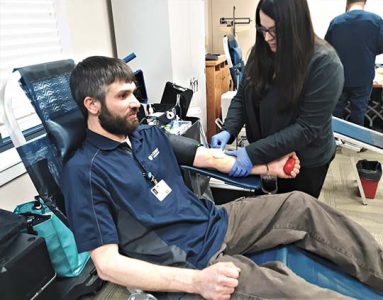
The full blood donation process involves the donor answering a brief questionnaire about their health, as well as a "mini physical." During this process, the donor's blood pressure, pulse, and hemoglobin levels are taken. Hemoglobin is one of the key components of blood - the iron-rich molecule that allows blood to carry oxygen.
Blood donors can only give blood every eight weeks in order to give their bodies time to replace the blood that they donate. While many people are squeamish or nervous around needles or blood, there is nothing to be anxious about.
"There's really nothing to be nervous about," said Asiala. "You can look away; you don't need to see the needle. All of the donor techs have been thoroughly trained and have been doing this for a long time."
Once the process is over for the blood donor, the blood goes through another process. The blood is stored in a cooler and taken to Marquette where it is separated into its main constituents. This allows the blood to remain viable for longer, as well as to be used be more people for more varied uses. The blood is also tested to make sure that it is safe to give to a recipient. Finally, the blood is brought from the center in Marquette to the thirteen area hospitals served by the UPRBC.
Hancock, Escanaba, and Iron Mountain all have locations dedicated to blood donation. However, blood drives are regularly taking place all around the U.P.
For more information on giving blood, to find a donation center near you, or to plan on attending the next drive in your area, visit the UPRBC online at mgh.org/our-services/all-services/regional-blood-donation, or call (906)449-1450 or 1-800-491-4483.