Horizons is microcosm of American education system
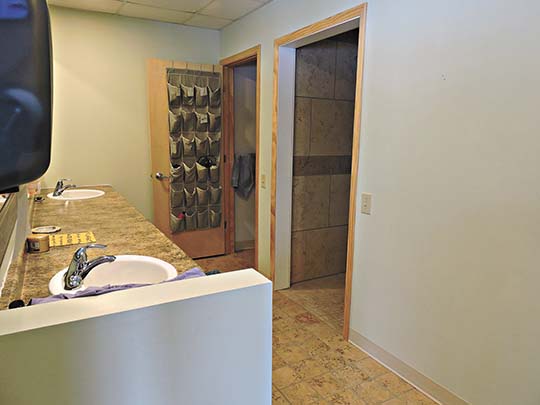
Graham Jaehnig/Daily Mining Gazette The private bathroom facilities are kept stocked by donations and frequent visits from 31 Backpacks, and kept immaculate by the students, who take complete control over keeping the facilities clean.
Editor’s note: In publishing the series on Horizons Alternative School, the Daily Mining Gazette does not place blame on parents, families, students, or on anyone. This series is not intended to pigeonhole the school’s students or families. In fact, many of the challenges confronting students at Horizons are not unique to the communities in which they live, or even to the Upper Peninsula alone. Nor are the issues new.
MOHAWK — In many ways, the Horizons Alternative School acts as a microcosm of issues that continue to fall through the cracks of the American educational system. No one group, the students, the parents, the teachers, or the administrators are to blame. Some children have learning styles that do not fit in the traditional classroom setting, and that is why a place like Horizons exists.
In fact, to cite just one example, in October 2017, the American Academy of Child and Adolescent Psychiatry (AACAP) released report on “Home Alone Children,” or those who became known as “latch key kids.”
Every day, children arrive home from school to an empty house. Every week, parents make decisions to leave children home alone while they go to work, run errands, or for social engagements, the Facts For Families (FFF No. 46) stated.
“It is estimated over 40% of children are left home at some time, though rarely overnight,” the FFF reported. “In more extreme situations, some children spend so much time without their parents that these children are labeled “latch key children,” referring to the house or apartment key strung visibly around their neck.”
At the same time, the Richard M. Fairbanks Foundation also released a brief that focused on an Ohio public school district, the brief reported that fewer than 255 of elementary and middle school students passed both the English and math ISTEP+ tests.
“These numbers should serve as a call to action to support struggling students and schools,” the brief went on to state. “Unfortunately, they’ve also raised a common refrain used to push back against efforts to improve educational outcomes for low-income students.”
The brief focused on Marion County, where “31% of children under 18 live in poverty, and 66% of public school students qualify for free and reduced-price lunches. With low income comes a variety of other challenges like hunger, higher likelihood of exposure to violence, and poorer health due to lower access to preventative healthcare.” The report then ask whether, given these challenges, is it even possible for efforts in the classroom to have an impact on the academic performance of low-income students? In other words, can poor students perform well in school?
The report answered its own question:
“In short, yes,” it replied. “While low-income students certainly face a number of barriers that play a contributing role to low academic achievement, there are several examples of educational interventions that have been shown to work at raising both academic and non-academic outcomes for low-income students.”
Those familiar with Horizons Alternative School agree. Many have put their money on the table to argue the point — and have proved that yes, struggling students can indeed succeed. And Horizons does not concern itself with the nature of the struggles; they are there to meet any challenge a student may face — far beyond academics. In addition to classrooms, and even a student lounge, generous donors, such as the Hortons, Kirkish Furniture, McGann’s Building Supply, 31 Backpacks,and Paul Hyrkas Construction, took an idea of a shower, and laundry facility, and made it a reality.
The facilities includes a private toilet, private shower and closet and changing room, while the laundry room, is equipped with a washer and dryer, donated by Hyrkas Construction, cabinets and doors, donated by McGann’s, and tile and grout donated by Kirkish Furniture. The entire setup was designed to look as though it is located in a modern, upscale home.
“31 Backpacks donated the towels, laundry detergents, hair dryers, shampoo, they donated all that,” said Horizons Principal Joel Asiala. “Toothpaste, toothbrushes, deodorant, personal hygiene stuff. The come up here and make sure everything is taken care of that way, so that’s been a huge help, as well, and they’ve done so much for this school as well, and that’s been a huge part of this program as we move forward.”
The idea behind the shower/laundry facility was to provide students those amenities that may be lacking at home. But it provided the partners a surprise in return. The students maintain and police it themselves.
“The students know that people are out there, doing this stuff for them. They take personal pride in it and they take care of it,” Asiala said. “We don’t come and clean it; the kids take care of it, everything here, and that’s because they know that people have donated and worked hard to make sure that this happened. Our kids have been amazing with this, and it’s helped them grow, as well.”
Former Calumet-Laurium-Keweenaw Schools Superintendent Darryl Pierce remarked on the condition of the rooms, saying they are spotless.
Asiala and Pierce both commended the students on their care of, not only the laundry room, but the entire school, calling their care life skills.
“The kids take ownership of this school,” Pierce said, to which Asiala agreed, also pointing to the weight room.
“We don’t clean this,” he said. “I mean, our janitor, Debbie, is just phenomenal, but the kids take care of it. The kids put it back together. It looks like they don’t use it, but it’s used every single day. It’s absolutely amazing, because the know that people worked hard to make this happen.”
For countless students across the U.S., their school is far more than a place of academic learning, and that includes the CLK School District. And as with students across the state, Gov. Gretchen Whitmer’s three-week “pause” to curb the spread of the coronavirus, Pierce and Asiala acknowledge the negative impact it has on CLK students, with the school being closed.
“This is their safe haven,” Pierce remarked. “One thing I wanted to do, before I retired, was I wanted to initiate a year-round school year, mainly for kids like this, so they can be here year-round. Even at the main campus, at seven o’clock, the same kids are there at Seven. They’re there ’til 5:50. Then they have to go home. At school, they get a good breakfast, they get a good lunch, and they’re loved, taken care of — so, I wanted to make it year-round, but I retired before I could make that happen.