Wells dug, WUPHD approvals waiting on state filing
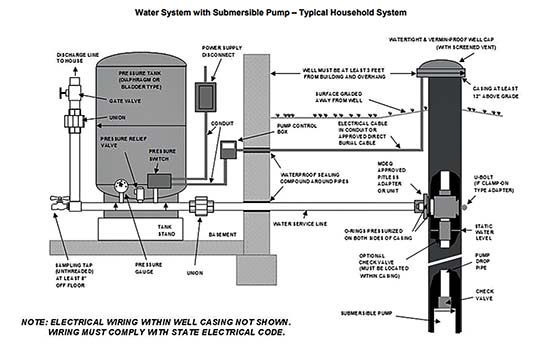
michigan.gov Standard well construction diagram from the State of Michigan’s well digging manual.
Eight new wells adorn the yards of Cole’s Creek Road residents, but some homeowners are still waiting for approval letters from the Western Upper Peninsula Health Department after more than a month.
“They have never called me back after I left a message two weeks ago,” Sheila Peltier said in a text message on Tuesday.
Her water has been hooked up to the house for weeks, and she has resumed using it for many things, but not drinking.
“It’s easy enough to buy bottled water,” she said.
Chris Woodry received testing results from the health department on Tuesday. The sample date was Nov. 6. They did not include a final approval letter, though the test results stated the well met EPA standards.
“At this point we’re drinking it,” Woodry said, “and cooking with it, too.”
He said he and his girlfriend are still using some bottled water as well. He said part of the reason they are frustrated with the slow results is needing to plan for other filtration equipment, if necessary.
“They had no problem looking at our well, improperly assuming how it worked, then telling us we can’t drink it based off that improper assumption,” Woodry said. “Yet you want to sit on my results for over a month?”
In September, WUPHD was contacted and inspected the water source Woodry, Peltier and his neighbors had been using and immediately labeled it undrinkable based on its construction and condition.
“It’s just not suitable for drinking water purposes,” Tanya Rule, Director of Environmental Health at WUPHD, said at the time.
The water line feeding Woodry’s house was removed by contractors working for the Houghton County Road Commission the next day. A test sample drawn from one of the homes returned a result positive for coliform bacteria the day after.
Test results on Woodry’s new well, from the Michigan Department of Environment, Great Lakes, and Energy as well as White Water Associates, show that both tests were completed in mid-November. The email from WUPHD with the test results stated they would receive the approval letter after the department was able to approve the well log. The log is filed with the state by the driller, who has up to 60 days to file after the well is dug.
Woodry said he is not concerned about the approval letter for much, now that he has the test information.
“We knew what we had before, but we don’t know anything about the new water without those tests,” he said.
WUPHD officials did not immediately return calls for an interview.
In a previous story, the Gazette quoted a source saying that 2.8 gpm from a well was “awful”, but Lani Siirtola from Siirtola Well and Pump told the Gazette she disagrees.
“Different wells are different, but a well that provides good quality water for your home, and adequate amount for inside your house is a good well,” she said.
While a family home can easily use more water than 2.8 gpm, that doesn’t mean a well has to be able to produce that much. In a deep well, the water will often rise to within a few feet of the surface.
“So then you have about a gallon and a half of water stored per foot in a six inch casing,” Siirtola said.
So a 240 foot deep well would have well over 300 gallons of water storage available. According to the EPA, a standard shower head uses 2.5 gpm. Since the well is also continually recharging at 2.8 gpm, it would take two standard showers running for about 140 minutes to run the well dry. Even discounting the recharge rate, the simultaneous showers could run for an hour.
“So yeah, deeper wells access a reservoir and that’s why they’re just as good for household use as a shallower well with more water,” Siirtola said.
She also said the cost ranges quoted in the Gazette weren’t accurate to the area.
“Theoretically, you could get a well in the Copper Country for $2,140 plus tax,” she said. “But I don’t know that we’ve ever done one.”
That would be for a well of minimum allowed depth that immediately had good water. She said the average well they dig is between $3,000 and $7,000, though they have done two wells in the last four years that were 500 feet deep and ran $12,000 to $14,000.
The wells dug along Cole’s Creek Road range from 35 feet to 245 feet deep. Siirtola said she expects them all to work well for the residents, but didn’t want to get into specifics of construction of the individual wells.
She said there’s a huge amount of diversity in the geology in Copper Country, and consequently well construction, too. However she said it isn’t very often they are unable to dig a usable well.
Front Page
Long-awaited flag pole installed on Quincy Shafthouse

County Board to keep same meeting times
Teens’ reading and math scores have stagnated, US test results show
WASHINGTON — Younger students have regained ground academically after the pandemic's disruptions while older ...

Jacobetti veterans home to be considered for housing

Overdose rates drop