State is cracking down on indoor dining
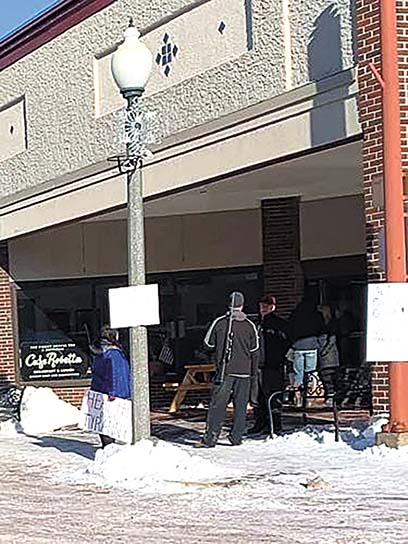
Photo courtesy of Michael Newman Supporters of Cafe Rosetta’s case against the state of Michigan stand outside the business over the weekend.
HOUGHTON — As the state of Michigan continues its crackdown on establishments for violating the public health order to ban bars and restaurants from indoor service due to COVID-19, the State Emergency Operations Center (SEOC) Tuesday released a list establishments that were fined by the Michigan Department of Health and Human Services (MDHHS) throughout the month of December, with penalties of up to $1,000 for each violation or day that a violation continues. Of the 13 businesses named, two, Café Rosetta, in Calumet, and the Rockhouse Grill and Tavern, in Houghton, are in the Upper Peninsula, and both are in Houghton County.
Houghton County, states MDHHS and the Centers for Disease Control and Prevention (CDC), currently has the third highest number of positive COVID-19 cases in the Upper Peninsula, with 1,636 as of Wednesday. Marquette County ranks the highest, with 3,181 confirmed cases.
According to the SEOC release, Café Rosetta was issued a $4,000 fine on Dec. 2. On Dec. 4, the Rockhouse Grill and Tavern, Houghton, was issued a $1,000 fine. By comparison, these fines are low. Spangler’s Family Restaurant, in downstate Jonesville, received a fine for $11,000 on Dec. 16.
Information was received by MDHHS from local health departments and local law enforcement regarding non-compliance with the order. The civil fines are due within 30 days of receipt of the citations.
MDHHS Director Robert Gordon said he thanks the vast majority of restaurant and bar owners for “helping us contain the spread of COVID-19 by temporarily closing their indoor service.”
On Sept. 11, 2020, the CDC released the findings of a study that found that a case-control investigation of symptomatic outpatients from 11 U.S. health care facilities found that close contact with persons with known COVID-19 or going to locations that offer on-site eating and drinking options were associated with COVID-19 positivity. Adults with positive SARS-CoV-2 test results were approximately twice as likely to have reported dining at a restaurant than were those with negative SARS-CoV-2 test results.
The report goes on to state that eating and drinking on-site at locations that offer such options might be important risk factors associated with SARS-CoV-2 infection. Efforts to reduce possible exposures where mask use and social distancing are difficult to maintain, such as when eating and drinking, should be considered to protect customers, employees, and communities.
MDHHS Chief Medical Executive and Chief Deputy for Health at MDHHS, Joneigh Khaldun said in the SEOC report that the number of cases, the positivity rate, and hospital capacity have declined in recent weeks, taking stress off Michigan hospitals and health care workers.
“We will continue to monitor the data and assess for any potential surges in cases after the holidays,” said Khaldun. “Most food service establishments like restaurants and bars have helped play a critical role in the existing decline by following the order.”
Recent results of studies conducted independently of the CDC have found similar findings to those of the CDC.
On Nov. 10, 2020, statnews.com published a report stating that by using cellphone data from 1 in 3 Americans, researchers have identified the indoor public places most responsible for the spread of COVID-19 in the spring, and they argue that sharply limiting the occupancy of these locales — chiefly restaurants, gyms, cafes, hotels, and houses of worship — could control the raging pandemic without resorting to lockdowns.
The report goes on to state that mining mobile phone data, scientists tracked 98 million people’s hourly movements from March 1 to May 2 to places they visited regularly, and then mapped their movements to nearly 533,000 locations onto models of infectious disease spread. The simulated transmission rates accurately predicted actual daily case counts in neighborhoods of 10 large metropolitan areas, including Chicago, New York City, and San Francisco. That allowed them to identify which “super spreader” venues pose the greatest risk, which socioeconomic factors matter, and what works to diminish the danger.
The Stanford University-led team’s study, released in the journal “Nature,” merged demographic data, epidemiological estimates and anonymous cellphone location information, and appears to confirm that most COVID-19 transmissions occur at “super spreader” sites, like full-service restaurants, fitness centers and cafes, where people remain in close quarters for extended periods. The researchers say their model’s specificity could serve as a tool for officials to help minimize the spread of COVID-19 as they reopen businesses by revealing the tradeoffs between new infections and lost sales if establishments open, say, at 20 percent or 50 percent of capacity, statnews reported (the full report can be found at https://www.nature.com/articles/s41586-020-2923-3).
Front Page

Public Safety Day recognizes 10th anniversary

Heart of copper made gold

Warm start to summer favored for UP region
SWP to fund planting of 100,000 trees in Marquette County
MARQUETTE — The Superior Watershed Partnership and the Land Conservancy has announced the launch of its Great ...

Miscowaubik Club to host open house