
Burdened: Michigan residents work to support their government
Trending
HOUGHTON -- A Tax Burden by State report for 2021 ranked Michigan 24th of 50 states. The personal finance website WalletHub released its report on Wednesday.
In order to determine which states tax their residents most aggressively, WalletHub compared the 50 states based on the three components of state tax burden -- property taxes, individual income taxes, and sales and excise taxes -- as a share of total personal income.
New York, not surprisingly, ranked first, at 12.79%, while Alaska ranked 50th at 5.10%.
Michigan, at 8.34%, tied with Washington for the 24th rank in the nation.
Michigan's neighboring states ranked in the following order:
In terms of Property Tax Burden, WalletHub found that Michigan ranks 19th, at 3.02%.
The extension of the tax filing deadline provides a convenience, but little more. Many taxpayers are undoubtedly wondering how this year's Tax Day will affect their finances, as a lot of people are struggling financially as a result of the pandemic, states the WalletHub report. Since the tax code is so complicated and has rules based on individual household characteristics, it's hard for the average person to tell how they will be impacted.
In its report, WalletHub included the following statistics:
• 79% of Americans don't know if they'll owe income taxes on their stimulus checks (they won't).
• Americans spend eight billion hours doing taxes each year. The average person spends 12 hours and $230 completing their 1040.
• 90% of tax returns are expected to be filed electronically. The average refund in 2021 is $3,021, as of Feb. 26, 2021.
• 30% of people say making a math mistake is their biggest Tax Day fear, and 29% worry most about not having enough money. That edges out identity theft (22%) and getting audited (19%).
• 38% of Americans would move to a different country and 27% would get an "IRS" tattoo for a tax-free future.
• 50% of people would rather do jury duty than their taxes. 1 in 4 would prefer talking to their kids about sex. More than 10% would swim with sharks, spend the night in jail and drink expired milk.
While WalletHub included some of the above data to present a bit of humor, studies show that the taxation system in the state of Michigan is becoming increasingly burdensome on its residents.
As far back as March 2017, the Citizens Research Council of Michigan's Report 395, "Counties in Michigan: An exercise in Regional Government," pointed out that state revenue sharing has been declining since the early 2000s. It may have a greater impact spread across 83 counties rather than 1,800 municipalities. The report also stated that if counties and municipalities are given access to more alternative local taxes, these should be levied at the regional level to make them less administratively burdensome and to limit negative externalities if one unit of government levies a tax and its neighbors do not. But where is the declining revenue sharing going?
The Michigan Department of Treasury claims on its website that:
"In accordance with the State Constitution of 1963, Article IX, Section 10, as amended, constitutional revenue sharing payments are based on 15% of the 4% portion of Michigan's 6% sales tax collections. Distributions are made to all Michigan cities, villages, and townships on a population basis on the last business day of the even numbered months (October, December, February, April, June, and August). The revenue sharing population is defined by the Glenn Steil State Revenue Sharing Act of 1971, 1971 Public Act 140, as amended (MCL 141.903(1)). For purposes of distributing revenue, population is based on the most recent census adjusted by 50% for any institutional population."
The Michigan Municipal League has called the revenue sharing system The Great Revenue Sharing Heist. A March/April 2014 Review Magazine article written by Anthony Minghine stated:
"There have been a lot of high profile robberies over the years. The Lufthansa robbery, D.B. Cooper highjacking, the Antwerp Diamond Caper…but these crimes look amateurish compared to the state of Michigan's Great Revenue Sharing Heist. The state has managed to pinch over $6 billion in revenue sharing from local government over the last several years."
Minghine went on to state that there are three major factors that have led communities to the financial brink: post retirement costs; a steep decline in property values; and a dramatic reduction in state revenue sharing.
Statutory revenue sharing has been unilaterally taken by the state to solve its budget issues, Minghine stated. Revenue sharing is paid from sales tax revenues, which have been a remarkably stable source of income, and have in recent years experienced significant growth.
From 2003-2013, sales tax revenues went from $6.6 billion to $7.72 billion. Over that same period, statutory revenue sharing declined from over $900 million annually to around $250 million. The state is now in an enviable position--revenues that exceeded expectations. It is posting large surpluses but has failed to take steps to restore local funding. There has been, and continues to be, a very good reason for that.
In 2014, when the article was published, the state of Michigan was advertising its sound fiscal management and admonishing local governments for not being as efficient, Minghine wrote.
"What the state fails to mention," he pointed out, "is that it balanced its own budget on the backs of local communities."
It does not stop there, unfortunately. The a steep decline in property values Minghie wrote about is largely due to Gov. Rick Snyder's Michigan Tax Tribunal, which responded to requests by the Michigan Chamber of Commerce to change how corporations pay property taxes in Michigan.
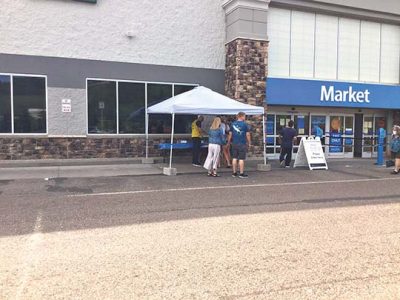
Large retailers, popularly known as "Big Box" stores, have convinced the Michigan Tax Tribunal to give them special treatment as it pertains to the market value of their property.
A report published by the Michigan Municipal League stated that prior to the Dark Store theory, Michigan big-box stores were assessed an average of $55 per square foot. After the Dark Store Theory was accepted, Michigan was compared to states where various big-box stores are located:
In Michigan, Lowes stores are assessed at $22.10 per square foot. In Lowes home state of North Carolina, the same stores are valued at $79.08 per square foot.
In Michigan, Menards and Target are valued at $24.97 per square foot. In Menards' home state of Wisconsin, the same stores are valued at $61.23 per square foot.
Sam's Club and Walmart now average around $25.68 per square foot in Michigan. Studies of those buildings in the home state of Arkansas are being done, but they are likely to be much higher than they are in Michigan.
In other words, the state has been robbing revenue sharing from the municipalities and counties for decades, which is continuing today, to support itself, and its special interest groups and Political Action Committees (PACs)
The Daily Mining Gazette will next look at some of those committees and the influence that have had in shifting the tax burden from the commercial corporations by reducing property taxes, to the private citizens.