
Fort Wilkins enjoys more visitors today than it saw during mineral rush
Trending
COPPER HARBOR -- Fort Wilkins State Park enjoyed one of the busiest seasons in its history during the pandemic last year, said Park Supervisor Bill Wild.
"We opened a little bit later last year," he said. "We opened in June, but from about the time we opened, it filled up pretty quickly and we stayed close to full through most of the season, and well into the fall, even."
At this point, the 2021 tourism and camping season does not show any indications of dropping below last year.
"All indications are looking like it will be at least a repeat of last year," said Wild, "maybe not in such a condensed timeline, but we should be seeing real good numbers again this year."
Wild said preliminary numbers for the 2021 season have already been up, and statewide parks and campgrounds are predicting an increase again, over last year's numbers.
Sadly, Battery D, 1st Michigan Light Artillery, a Civil War re-enactment group, will not be coming to Fort Wilkins this summer, which would have marked its 36th annual encampment.
"We pulled the plug on that early in the planning process. Events like that take quite a while to plan and put into play, so at the time we were doing the planning, it wouldn't have fit the (COVID) guidelines, so it's not happening this year."
Also on a sad note, there are no archaeological projects planned for this season, as there so often are during the summer months.
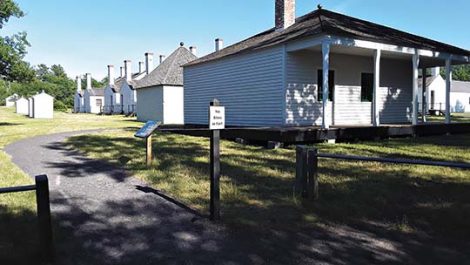
Fort Wilkins was established in May 1844, and was constructed under the authority of Capt. Robert Emery Clary, commanding Companies A and B, 5th United States Infantry. Its two primary purposes were to protect government-owned mineral lands from squatters entering them and mining on them illegally, and to assist with removal of the Indians in the region when the War Department issued the removal orders.
Neither reason for the garrison came to pass, and the fort was degarrisoned in 1845 and the troops sent to war in Mexico.
Twenty-two years later, from 1867-70, the Army regarrisoned the fort with troops of the Veterans Reserve Corps, soldiers who had been wounded in combat during the Civil War, and were too disabled to serve in frontline units.
Abandoned as a military post in 1870, Fort Wilkins eventually became a state park, and was reconstructructed or restored in the 1930s by the Work Projects Administration and the Civilian Conservation Corps.
Within the park are campgrounds offering modern amenities, the fort complex, a lighthouse erected in 1866 to replace an original light complex established in 1849, and the range lighthouse, built in the 1860s.
According to a 2016 report by Eric T. Pomber entitled "Archaeological Investigations and Historical Survey, Fort Wilkins State Park, Keweenaw County, Michigan," there are 14 archaeological sites between Fort Wilkins, the Copper Harbor Lighthouse and range light, as well as features associated with the Pittsburg and Boston Copper Harbor Mining Company, which mined between Fort Wilkins and Hays' Point, near the current lighthouse from 1844-1846, and three historic mining-related sites that were identified in 2013.
There was a fairly major waterline project scheduled for 2021, but it has been postponed, said Wild.
"It went out on bid, and the bids came back considerably higher than our estimates were," he explained. "We didn't have the budget to meet it, so we're going to go back to drawing board a little bit on that, and shoot for next year."
Part of that project, he added would have included some archaeological work that would pertain to the construction, he said.
No further renovations on the Copper Harbor Range Lighthouse are planned, either, Wild said. In 2016, an archaeological project focused on the privy (outhouse) hole at the range lighthouse, uncovering a wealth of items discarded by past range light keeper during the 19th and very early 20th centuries, and the exterior of the lighthouse has been restored.
"The exterior's been redone, nothing's been redone on the inside," said Wild. "We're not really moving forward with that until we complete our next General Management plan."