
Gilchrist visits Houghton on Thriving Cities tour
Trending
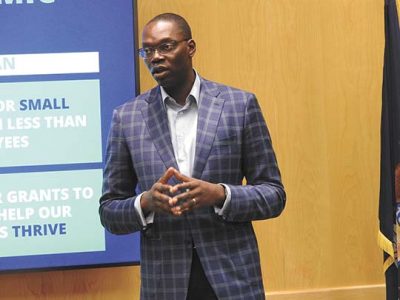
HOUGHTON -- Michigan Lt. Gov. Garlin Gilchrist came to Houghton Friday as part of the state's Thriving Cities tour.
Gilchrist spoke with local leaders at the Advanced Technology Development Complex Friday morning. Houghton is one of 24 cities on the tour, where Gilchrist talks about ways to improve quality of life in five areas: affordable housing, generational economic opportunity, environmental quality and justice, quality of life for kids in cities and access to transportation/mobility services.
"I'm proud to expand this to the Copper Country because all of those issues that I talked about and others are relevant and important to this city specifically and the region broadly," he said. "So we want folks to know our administration is here to listen, here to share our ideas and perspectives and to have those ideas be made a lot better by hearing directly from people about where we need to go."
This is the second iteration of the tour, following a 19-city run in 2019. What Gilchrist heard on that tour has shaped state policy since, he said. At each stop, residents brought up how important it is for people to be able to clear criminal records. Gilchrist prioritized working on that issue, culminating in Clean Slate laws last year that include automatically expunging misdemeanors seven years after sentencing and felonies 10 years after or upon release. Additions since then have covered juveniles or those sentenced on a first-time operating while intoxicated charge.
People in university cities brought up the difficulty of finding affordable housing. That led to a proposal from Gilchrist and Gov. Gretchen Whitmer to put $100 million in American Rescue Plan money into the state's community development fund, which is managed by the Michigan State Housing and Development Authority (MSHDA). That money will catalyse another 380 million in private investment to create more pathways to affordable housing in the state, from apartments to single-family homes, Gilchrist said.
The money will also help renters or homeowners with security deposits or to avoid foreclosures, he said.
"We're not saying the problem with affordable housing is merely a $100 million problem," he said. "…We can put a stake in the ground and say this is a priority for the present and the future of the state of Michigan to make this investment."
Many of those concerns -- child care and education, transportation or reliable internet access -- have become even more pressing during the pandemic, Gilchrist said. During his talk, he said improving broadband would allow the state to retain moe talent and create more entrepreneurs.
"We've focused on it even more heavily during the pandemic, and doubled down on these priorities in a way I think will lead to Michigan becoming a leader in some of these areas, a leader in internet access expansion, a leader in telehealth services and things like that," he said.
Gilchrist also touted Whitmer's $2.1 billion Economic Jumpstart plan, including $100,000 for restaurants and other place-based businesses, and $25 million for businesses with fewer than nine employees.
The recent budget also closes the funding gap between schools that had existed since Proposal A passed in 1994, resulting in an extra $589 per student in Houghton, Gilchrist said.
"For example, if you have a district that, due to its physical characteristics, requires higher transportation costs -- which is true for lots of districts in the Upper Peninsula -- this budget gives you the flexibility and the funding to be able to meet that need uniquely," he said.