
Residents mark Jan. 6 with vigil for democracy
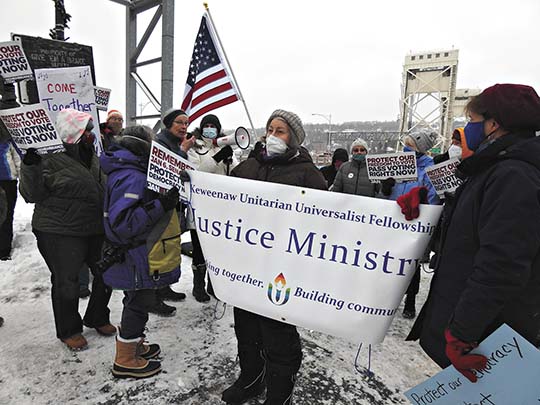
Garrett Neese/Daily Mining Gazette Beth Flynn of the Keweenaw Unitarian Universalist Fellowship Justice Ministry addresses the crowd during a vigil commemorating the Jan. 6, 2021, riot at the U.S. Capitol building. About 30 people participated in Thursday’s event, sponsored by the Keweenaw Unitarian Universalist Fellowship Justice Ministry.
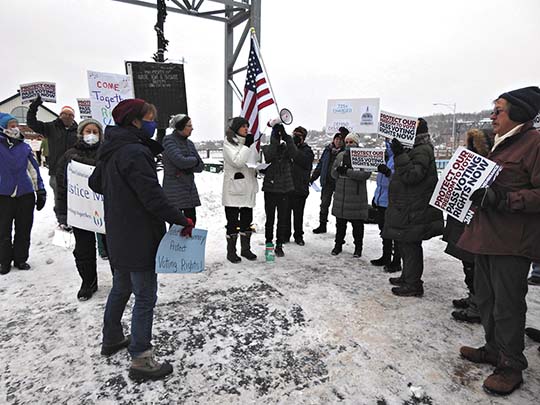
Garrett Neese/Daily Mining Gazette Valorie Troesch of the League of Women Voters of the Copper Country speaks during a vigil commemorating the Jan. 6, 2021, attack on the U.S. Capitol Thursday.
Garrett Neese/Daily Mining Gazette Beth Flynn of the Keweenaw Unitarian Universalist Fellowship Justice Ministry addresses the crowd during a vigil commemorating the Jan. 6, 2021, riot at the U.S. Capitol building. About 30 people participated in Thursday’s event, sponsored by the Keweenaw Unitarian Universalist Fellowship Justice Ministry.
Garrett Neese/Daily Mining Gazette Valorie Troesch of the League of Women Voters of the Copper Country speaks during a vigil commemorating the Jan. 6, 2021, attack on the U.S. Capitol Thursday.
Trending
HOUGHTON -- Copper Country residents marked the first anniversary of the storming of the U.S. Capitol on Jan. 6, 2021, with a vigil in Houghton to remember the attack and to promote federal voting rights bills that would guard against new voting restrictions, many proposed as a response to concerns over debunked claims of widespread voter fraud.
About 30 people participated in Thursday's event, sponsored by the Keweenaw Unitarian Universalist Fellowship Justice Ministry. It was one of more than 300 such protests nationally.
Last year's attack on the Capitol, which followed a speech by then-President Donald Trump to his followers, took place as Congress was meeting to certify the votes of the 2020 presidential election. After members reconvened, Biden was certified as the winner. Five people died in the incident, which also resulted in hundreds of millions of dollars of property damage.
More than 700 people have been charged in connection with Jan. 6, including 14 Michigan residents. Two Copper Country residents, Karl Dresch and Jeremy Sorvisto, were sentenced for their participation in the breach of the Capitol building. Dresch received time served after more than six months of detention, while Sorvisto received 30 days in jail.
"It was an attempt to overthrow the government because one individual said the election was fraudulent," said Horst Schmidt of the Justice Ministry, "and we know that in this country that all the elections that were held were actually well-run and honest ... I know the individuals in the county and municipality (electoral system), and so we're very interested in making sure that our electoral system stays as it is, rather than having all these voter suppression laws trying to fix something that doesn't exist."
Citing worries about election security, Republican state legislatures from around the country have introduced new limits, such as tightening voter ID requirements and curbing early voting. In 2021, more than 440 bills restricting voting access were introduced in 49 states, according to the Brennan Center. Thirty-four bills passed across 19 states.
"There's been such a backlash over the last year -- this thinking that the way that the other side can win is you've got to restrict the number of people that vote and make it easier to overturn elections," said Valorie Troesch, a member of the League of Women Voters of the Copper Country. "That's just wrong. So I think we need to look forward and expand voting rights ... everything since the Voting Rights Act of 1965 has been built on expanding the electorate, making sure that people who are eligible to vote can vote."
To counter the state actions, House Democrats have passed measures such as the Freedom to Vote Act, which would include a national standard for mail-in voting, and the John Lewis Voting Rights Advancement Act, which would restore former Voting Rights Act provisions requiring states with a history of voting discrimination to get preclearance before changing their election laws. However, the bills have stalled in the Senate due to a Republican filibuster.
Senate Minority Leader Mitch McConnell has signaled openness to changes to the Electoral Count Act, which governs the Congressional certification of the election. Among changes proposed by Republican Senators are requiring more members to instigate a challenge to certification: now, support from one member each of the House and Senate are enough to suspend the count. Another change would make it clear that the vice president cannot throw out a state's electoral vote, as Trump had urged Vice President Mike Pence to do prior to Jan. 6.
Democrats, including the Biden administration, have said changes to the Electoral Count Act would not do enough to ensure equal voting access.
Speakers Thursday frequently referred to "The Big Lie" -- the idea that Trump's loss was due to election tampering.
A series of investigations, recounts and lawsuits have failed to turn up widespread fraud.
An Associated Press review of voter fraud cases in six battleground states found only 475 cases of potential fraud, which would not have changed the outcome.
In Michigan, state Attorney General Dana Nessel announced voter fraud charges against three women in October. Two of them accounted for most of the 56 instances of possible voter fraud in the state, by forging signatures on absentee ballot applications. Those cases did not result in ballots being cast.
Arizona was another focus of voter fraud complaints after Biden's narrow win. An audit by the Cyber Ninjas firm hired by the Arizona State Senate reaffirmed -- and even added to -- Biden's margin, but flagged what it said were 53,000 questionable ballots in Maricopa County, the state's most populous. In a report released Wednesday, Arizona's Maricopa County found 87 cases out of 2.1 million votes -- 37 where a voter cast double ballots and 50 where a ballot was double-counted. The ballots did not affect the outcome of any races, the county found.
Those in attendance Thursday also warned about proposed ballot initiatives in Michigan, including Secure MI Vote, which includes stricter voter ID laws and would bar clerks from receiving assistance from nongovernmental groups.
Troesch is hopeful something can be done federally to protect and expand voting access. She also thinks groups such as LWV and Voters Not Politicians, the group behind 2018's no-reason absentee ballot initiative, will be able to counteract the Michigan proposals.
"Even if it doesn't succeed on a federal level -- and I'm hopeful it will -- there are things on a state level here in Michigan that can be done to protect voting rights here and probably will be done," she said.