Whitmer proposes school funding boost, bonuses and tax cuts
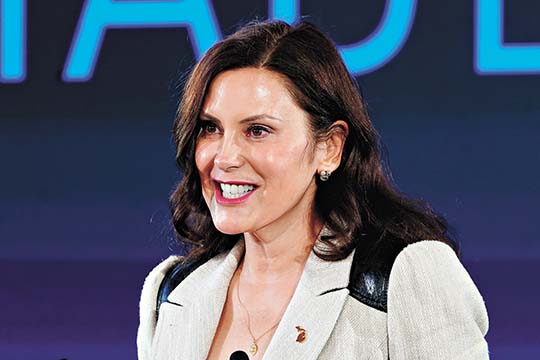
Paul Sancya/AP Photo Gov. Gretchen Whitmer speaks during a news conference in Lansing, Mich., Tuesday, Jan. 25, Whitmer has proposed a $74.1 billion state budget that would significantly boost education spending, pay bonuses to frontline workers and cut taxes for retirees and low-income families.
LANSING, Mich. — With the state awash in surplus revenue and unprecedented federal aid, Gov. Gretchen Whitmer on Wednesday proposed a $74.1 billion budget that would significantly boost education spending, pay bonuses to frontline pandemic workers and cut taxes for retirees and low-income families.
The election year plan, if approved by the Republican-controlled Legislature, would include a 5% increase in base aid for K-12 schools, universities and community colleges, and a 10% increase in revenue-sharing payments to municipalities. Road construction and other transportation spending would rise by $1 billion, or 20%, due to new federal infrastructure funding and a $280 million transfer of general funds.
The Democratic governor proposed “hero pay” for essential workers and first responders — up to $1,000 per employee — along with retention bonuses for school workers. She also formally unveiled previously announced tax relief plans. They include rolling back the taxation of retirement income over four years, increasing the state’s earned income tax credit and offering a $2,500 credit for the purchase of an electric vehicle and charging equipment.
“The biggest part of this budget is in our public education system. That’s where I think we’ve got the greatest need. It’s so critical to the success of our future,” Whitmer said while highlighting her plan at Grand Ledge High School near Lansing.
The budget would grow by 6% from the $69.9 billion that was initially enacted for this fiscal year.
Included is $361 million to expand mental health services for students, an increase of more than 25% — money that would be used in part to add up to 425 additional counselors and psychologists.
In addition to calling for larger-than-normal funding hikes, the governor proposed new initiatives. They include creating a $1 billion school infrastructure modernization fund — $170 million in grants would be dispersed in the next fiscal year — and spending $200 million to help universities and community colleges make infrastructure upgrades.
Whitmer requested $500 million to replenish a new fund that was recently used to award incentives for General Motors to convert a factory to make electric pickup tracks and to build a new battery cell plant in Michigan. She sought $325 million to build a new state psychiatric hospital as part of a $605 million plan to expand capacity to treat people with mental illnesses.
In building the proposal, her administration cited a $7 billion balance that was carried forward into the current fiscal year — a surplus experts have attributed largely to federal pandemic relief that helped to boost incomes and consumer spending despite COVID-19. The money would be directed toward “one-time” expenditures this budget year, next fiscal year and in future years.
Whitmer, for example, asked for $1.5 billion to give a $2,000 bonus to preK-12 educators and non-instructional staff in 2022 and 2023. Teachers and certified staff such as counselors, social workers and nurses would get $3,000 in 2024 and $4,000 in 2025 amid educator shortages.
She sought $600 million to award competitive college scholarships to would-be teachers, stipends to student teachers and grants to districts with plans to recruit, train and retain teachers from their own communities.
Lawmakers and the governor, who are up for reelection, will iron out the budget in coming months. Citing high inflation, Republicans favor broader tax relief than Whitmer’s targeted cuts, such as a reduction in the individual and corporate income tax rates.
The House plan “will focus more on tax relief and sustainable year-to-year spending than what the governor put before us today,” House Appropriations Committee Chair Thomas Albert, a Lowell Republican, said in a statement. “We are likely to share some common themes, but specifics may vary quite a bit.”
Senate Appropriations Committee Chair Jim Stamas, a Midland Republican, said there are many areas of general agreement, such as fixing the roads, supporting small businesses and ensuring that children can safely learn in person. But he said more information is needed.
Asked about the GOP push for a broader tax cut, Whitmer said there is “always room for negotiation.” But she noted that her proposals would reverse Republicans’ decision in 2011 to scale back the earned income tax credit and tax pensions, which helped to offset the impact of slashing business taxes.
“I’ve been fighting to make it right for many years,” she said. “In this budget, we can do it.”