
Trending
Courtesy of the Calumet Theatre
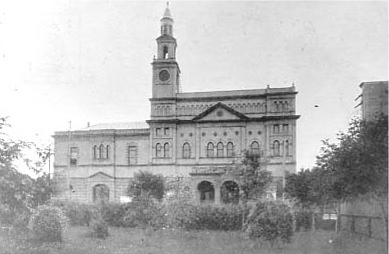
This photo from around 1900 shows the new roofline of the town hall/theater structure, showing major structural alterations to the Village Hall, including a new roofline and a completely redesigned first-floor entry.
Courtesy of the Calumet Theatre
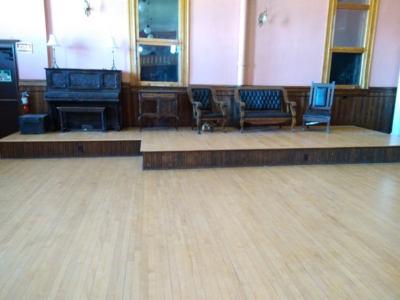
The Second-floor ballroom looking toward the remains of the 1886 stage at the front of the hall. Originally, a staircase led from the right side of the stage to an area above the hall.
Courtesy of the MTU Archives
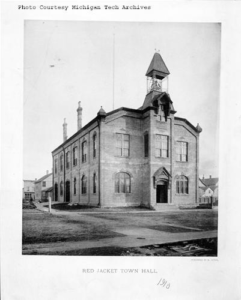
The original Red Jacket Village Hall as it appeared in 1886, before the 1899-1900 addition of the opera house
Board President Dan Jamison told the board that when he, along with Theatre Executive Director Jay Maki, and engineers with the U.P. Engineers and Architects, were inspecting the theatre building two weeks ago, they discovered throwbacks to the days when the Calumet Theatre Ballroom functioned as a public hall, equipped with a stage that featured theater stage curtains.
What was already known was that there is another story above the ballroom. On that level, directly above the stage area, is a dressing room in the event one was needed for events.
Jamison said that the ballroom, located on second floor of the Village Hall, had never served as an opera house or anything that elaborate.
"It was just a public ballroom with a stage," he said.
When the new opera house was constructed adjoining the village hall on the south in 1899, it required building a new roof spanning both the village hall and the opera house. However, the new roof was built over the old roof line, which was left intact beneath the new roof.
"When they did that," he said, "they left the dressing room in place."
They also left the sheaves in place that raised and lowered a stage curtain. The sheaves, he said, attached to a pipe from which the curtain was suspended, and were attached to the 1886 rafters.
Jamison said he had walked around up there a number of times over the years and was left confused over the presence of a dressing room in the attic.
"If they put the dressing room up here," he wondered, "how did they get from that dressing room to the theater? Well, they didn't."
Originally, there was a stairway leading from the front of the ballroom to the area above the stage, on what would have been stage-left, he said. The dressing room was in case one was needed for the original stage located at the end of the ballroom.
When the Red Jacket Village Hall was originally built in 1886, the structure had a projecting tower with an open belfry. The first floor of the building contained the village clerk's office, council chambers, a fire hall and a jail (the jail is still intact; it is now used for storage). The second floor housed the public hall.
The Village of Calumet Souvenir Centennial Book 1875-1975 twice implies that that ballroom was an original opera house, one of which states that the new opera house, opened in 1900, "was a successor to an operahouse built in 1887."
On the same page (15), it goes on to state that:
"For years local people had expressed musical, dramatic, and other cultural interests through church organizations and other societies, often utilizing St. Patrick’s Hall, the Italian Hall, or the Light Guard Armory as well as the old opera house."
Jamison, however, said the 1887 public hall was most likely used for civic events such as Christmas parties and privately hosted events.
In 1900, major alterations were made to the Village Hall when the opera house was constructed. Alterations included an entirely new roof that spanned both the original village hall and the new opera house.
Today, the ballroom is considered part of the property, along with the opera house, now the Calumet Theatre, under lease to the Calumet Theatre Co., which was organized in 1983, and is available to rent for private events.
The Calumet Theatre website states that the ballroom can accommodate up to 250 people and features a stage, small PA system, piano and kitchenette.