
POW and MIA service members honored with Vacant Table Ceremony
Trending
Many have left home and family to defend their country in times of need and war. Some of them have yet to return. And while their families continue their vigils and prayers, their brothers and sisters-in-arms continue to honor and remember those who are yet missing in action (MIA) and prisoners of war (POW) who are yet unaccounted for.
Referred to as the Vacant Table Ceremony, the Empty Chair Ceremony, the Defense Department refers to the ceremony performed by veterans groups across the nation as the The POW/MIA or Missing Man Table Ceremony, most refer to it either as the Empty Chair or the Vacant Table.
The remembrance ceremony is not commonly known to those who have not served in the Armed Forces, because it is most often conducted by veterans at veterans' events and the table is displayed in veteran organization posts, in dining areas on military bases and installations.
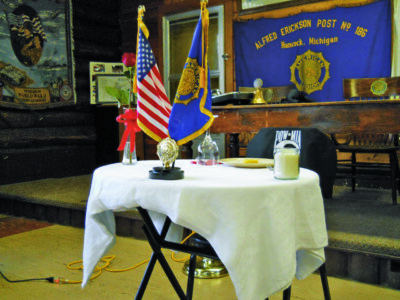
On Wed. Nov. 2, 2022, members of the Alfred Erickson Post 186 American Legion, in Hancock, conducted the somber ceremony at their annual Veterans Day Dinner, at which the table was present, prominently placed at the front of the room, and at which was one empty chair, over the back of which was the black POW/MIA flag, to honor and remember those who have not returned and are not yet accounted for.
Upon the table set for one, are items that are rich in symbolism. In fact, even the size and the shape of the table have special meaning.
The table is usually round, small and set with a with a white tablecloth. On the table is a red rose in a vase with a red ribbon, a lit candle ,with an inverted glass and salt and lemon on the plate. What is the significance of each of the items?
• The salt sprinkled on the plate is symbolic of the countless fallen tears of families.
• The inverted glass represents the fact that the missing and fallen cannot toast with their comrades at this time.
• The lit candle is reminiscent of the light of hope which lives in service member's hearts to illuminate their way home, away from their captors, to the open arms of a grateful nation.
•The empty chair reminds everyone that the missing and fallen are not present, but that there is a visible place for them in the veterans' ceremonies and celebrations.
• The American flag reminds all that many may never return -- and have paid the supreme sacrifice to insure this country's freedom.
"Those who have served, and those currently serving in the uniformed services of the United States," Post Commander Rod Gilbeau said, reciting the opening of the ceremony, "are ever mindful that the sweetness of enduring peace has always been tainted by the bitterness of personal sacrifice. We are compelled to never forget that while we enjoy our daily pleasures, there are others who have endured, and may still be enduring, the agonies of pain, deprivation, and imprisonment."
"We call your attention to this small table," Gilbeau continued, "which occupies a place of dignity and honor. It is set for one, symbolizing the fact that members of our Armed Forces are missing from our ranks."
"We call them comrades. They are unable to be with their loved ones and families, so we join to pay tribute to them, and bear witness to their continued absence."
The ceremony concluded with the bugle call, Taps and the removal of the POW/MIA flag from the back of the lone chair.
The history of the vacant table, and the ceremony, trace its origins back to concern for the POWs and MIAs of the Vietnam War. The Vacant Table has become a part of dining-in and dining-out services for all branches of the military over the last decades, according to the National League of POW/MIA Families.
The National League of POW/MIA Families states that following the Vietnam War there were 2,646 Americans unaccounted for in Vietnam, Laos, China, and Cambodia. As of August 1, 2012, 985 of these individuals had been repatriated and identified. Of the remaining 1,282 missing individuals in Vietnam, another 597 are categorized as "no further pursuit". Once a person has been categorized in this way it means that after an "rigorous investigation, we have conclusive evidence the individual perished, but do not believe it possible to recover his remains."
However, there are still thousands of Americans still missing from past wars. In October 2012, the Defense POW/Missing Personnel Office (DPMO) reported that there are still 83,411 people unaccounted for from past wars including World War II, the Korean War, the Cold War, the Vietnam War, and Iraq. To keep these individuals in the hearts and minds of the American people, there have been many groups, programs, and ceremonies developed to honor and remember those who are missing.
No matter the use behind the ceremony, wrote Victoria Voelkel for the National League of POW/MIA Families, it is a beautiful and emotional ceremony.