Labor of love
Able-bodied volunteers needed for weekend train track project
LAKE LINDEN — Moving toward the end of the first quarter of the 21st century, most people today can only imagine what life was like a hundred years ago, let alone experience it firsthand. Visiting historical museums or touring historical locations provides a feel of life in the 19th and early 20th century, but the Houghton County Historical Society, at its museum complex, in Lake Linden, is offering people the chance to step beyond visiting former places of work, and physically experience the work itself.
The HCHS is in the process of conducting extensive repairs to the track of its Lake Linden and Torch Lake Railroad and is seeking volunteers from noon to 4 p.m. this Saturday and Sunday to experience the actual work of those who were once referred to as “gandy dancers,” those railroad workers, officially referred to as section hands, who laid and maintained railroad tracks in the years before the work was done by machines.
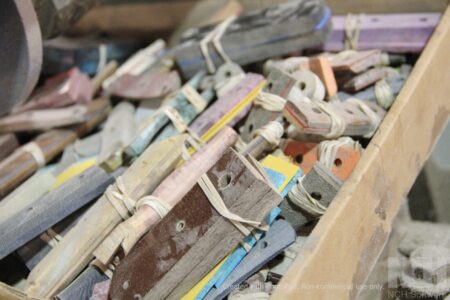
The project is replacing rotted railroad ties, and paying particular attention to the curves along the loop, and ensuring the proper elevations of the individual tracks. On curves, tracks are engineered with one track elevated above the other, compelling the locomotives and cars to lean in the curve, eliminating the risk of the train attempting to proceed straight through the curve and derailing.
“This track has been here since 2000 and 2001,” said Brian Keeney, HCHS Board member who is overseeing the project. “We’re doing a little super elevation to the outside curve, because on a curve, the train wants to go straight.”
Kenney has been working on the LL& TL RR since it was built.
For more than two decades, the Houghton County Historical Society has offered rides around its museum complex on the Lake Linden & Torch Lake Railroad’s four-tenths of a mile loop. The locomotive used is a steam engine built in 1915 for the Calumet and Hecla Mining Company. In 2018, however, the locomotive’s boiler failed. Due to a lack of funding and other setbacks, it would take over five years before the engine could again be made to pull its specially built cars around the loop.
The engine is now repaired and running again. The last phase of the project is repairing the track.
In 2017, Keeney conducted a hydrostatic test on the engine, which involved injecting pressurized water into the boiler.
“I heard running water where running water shouldn’t be,” said Keeney. “The flues in the boiler had rusted out. I’ve got videos of water gushing out of it.”
Dan Popps, who is a boiler maker, replaced the flues, did other work necessary to return to the 1915 H.K. Porter 0-4-0 switcher engine to operation.
“I live here locally,” Popps said, “so I have sort of a vested interest in making this run.”
George West, Historical Society president, said the sooner the tracks are repaired and re-ballasted the sooner the train can offer rides to museum visitors. The engine, as well as the museum’s location, is a significant component of the history of the Calumet and Hecla Mining Company. The museum complex is on part one of the former C&H reclamation plants, near the original Hecla stamp mill. The Porter engine that is used on the loop was used by C&H around the stamp mills and smelters between Lake Linden and Hubbell to move copper concentrate, ingots and other materials. After the C&TLRR converted to diesel power, in 1950, the engine was put on display at the Arcadian Mine as a tourist attraction, until 1969 when Universal Oil Products, which purchased the C&H company, donated the engine to the historical society.
“It was used to move whatever they wanted from here to down to there,” West said.
Anyone interested in helping to lay new wooden ties and repair track should be able to lift ties, iron and steel objects, and swing a sledgehammer. For more information, call the museum at 906-296-4121.