
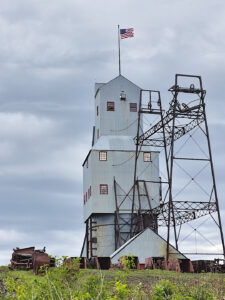
American flag again flies above Quincy Mine
Trending
FRANKLIN TOWNSHIP -- After more than 30 years, the American flag once again flies above the Quincy Mine No. 2 Shaft-Rockouse. The flag was raised on a new pole during a special ceremony on Saturday, June 13,
Quincy Mine Hoist Association (QMHA) Director Tom Wright said the last time the flag was raised atop the shaft-rock house was in the summer of 1996.
Quincy Mine Chief of Interpretation Clayton Gomez said Saturday's event was successful, with an estimated 60 people in attendance, not including those who viewed the raising from other points of the Keweenaw. The event, he said went well, with one exception:
"We may have wished for a little less wind," he said, "but other than that, it was really the culmination of a really good collaborative effort."
The project is a culmination of collaborative spirit that has long characterized the Keweenaw, says a June 6 QMHA press release. The QMHA has worked closely with the engineers of UPEA to develop the project. Installation of the new flagpole, as with the removal of the original, was conducted by REJ Contracting, with generous support and donated services provided by Keweenaw Crane Service. The ceremony's music was provided by the renowned Michigan Tech Pep Band.
The release says since 1908, the steel-clad structure has stood as one of the Copper Country's most recognizable landmarks: A testament to innovation in mining operations, a symbol of the region's industrial heritage, and a monument to the generations of of workers who shaped the landscape.
According to annual reports of the Quincy Mining Company, QMC General Manager Charles Lawton reported construction on the No. 2 Shaft-Rockhouse began on June 20, 1908, and was in operation by the end of the year.
At extra cost, the American Bridge Company installed a flagpole, anchored 10 feet below the roof ridge line. The top of the flagpole stood 50 feet above the peak of the roof.
Last Thursday, Wright said the current flag is 8 feet by 12 feet, the maximum size suggested by the flagpole's manufacturer.
Gomez said company records reveal that Lawton had wanted the original flagpole to support a flag 15 feet by 30 feet.
"I don't know if that ever happened," he said. "The photos that I've seen of the flag on the shaft house, historically, it doesn't look that large."
While photos suggest the flag was not as large as Lawton requested, Gomez said the flag in old photos definitely appear to be larger than the current flag. This may be partially due to differences between the original pole and the new one.
"This pole," he said, "by the time we socket it, is a little bit shorter. This one is about 42 or 43 feet tall. The original was 50 feet."
Additionally, the original pole was constructed of cast iron and cast steel, while the new one is aluminum.
Gomez said the goal of the project was not to replicate the original but to restore an iconic symbol of the American spirit that characterized the Copper Country's industry.
"For the locals, everybody is proud of this area's history, right? But what's hard to convey, what's hard to get across to a larger audience," he said, "is that this is not just regional history, this is American history. So, as we're celebrating America's 250th birthday, it is a really fitting year to put that symbol back up on the pole where it's supposed to be."
Preserving the No. 2 Shaft-Rockouse has been a priority for QMHA since 1987, when the building was completely re-sided to protect its interior. More recently, more than $49,000 was invested in replacing the building's windows, increasing protection from external elements. In 2024, the structure benefited from a $249,000 grant-funded stabilization project ensuring its long-term structural integrity.