
Long-awaited flag pole installed on Quincy Shafthouse
Trending
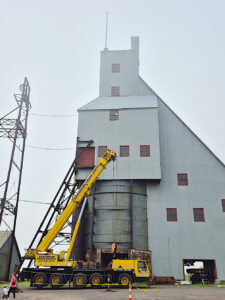
FRANKLIN TOWNSHIP -- After a two-year absence, there is a new flag pole atop the iconic Quincy No. 2 Shafthouse. Due to structural degeneration, the original flagpole, which was installed in 1908, had to be removed.
While the new pole was being constructed, several modifications were added to the roof of the shafthouse for the safety of anyone raising the flag.
Quincy Hoist Association Executive Director Tom Wright said the lanyard for raising the flag on the original pole hung on the outside of the structure, making standing on a platform just below the peak of the roof. Two modern modifications were incorporated to eliminate that danger.
The new flagpole is equipped with an internal lanyard system that will allow for the flag to be raised and lowered safely inside the building from a railed platform beneath a newly constructed hatch installed in the roof.
Other work included stabilizing iron support columns and structural work beneath the roof at the base of the flagpole, which was anchored 10 feet below the roof ridge.
Funding for the project comes from part of a $1.4 million grant received last August to continue restoration work at the No. 2 mine site. The grant is through the Abandoned Mine Lands program, which is through the U.S. Department of Interior,
The Abandoned Mine Land (AML) program addresses physical safety and environmental hazards associated with abandoned hard rock mines on Bureau of Land Management (BLM)-managed public lands, according to the Dept. of Interior. Abandoned mines are those abandoned prior to Jan. 1, 1981, the effective date of BLM's Surface Management regulations issued under authority of the Federal Land Policy and Management Act of 1976.
Wright said he raised the 12-foot-by-8-foot flag for the first time on Tuesday, and the new system performed better than expected.
Wright said his hat is off to Keweenaw Crane Service, who undertook the job of installing the flagpole as a public service to the Keweenaw, adding the company basically only charged for labor.
"We're going to officially raise the flag for the first time this Saturday at 4 p.m., in conjunction with Bridgefest," he said. "The new flag will be visible from Chassell and from as far away as South Range."
The same grant is also funding ongoing preservation work on the No. 2 hoist building, which houses the world-famous Nordberg hoist, the largest four-cylinder, compound steam-powered mine hoist every built. Preservation work on the poured-concrete, iron-framed structure includes removing broken and cracked concrete to expose, repair or replace old steel reinforcing rebar beneath it, before applying new concrete, said Wright.
"Most of the interior work is now complete," he said. "The crews continue working on the exterior of the building."
The Quincy Mine Hoist Association is a dedicated 501(c)(3) nonprofit organization, the primary focus of which lies in preserving and interpreting the history, landscapes, buildings and industrial work experiences associated with the Quincy Mining Company. The Quincy Mining Company operated on the site from 1848 to 1945.