Civic education, media literacy suffer in Michigan
State FOIA laws rank last in U.S.
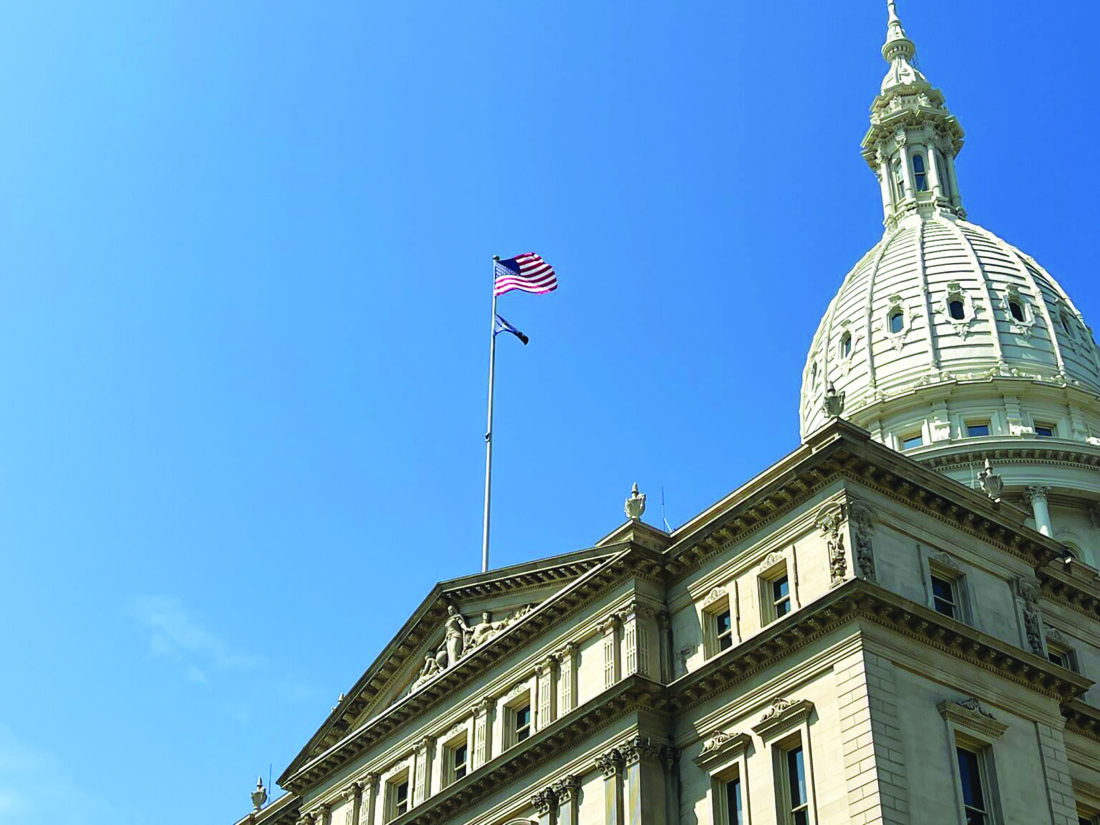
Michigan Advance photo The state capitol in Lansing.
Lansing — Across Michigan, civics and social studies are disappearing from K-12 school curriculums, while children and young adults have more access to social media and the internet disinformation than ever before.
At the same time, efforts to expand Michigan’s Freedom of Information Act remain stalled in Lansing.
Director of the Eastern Michigan University Jiu-Hwa Lo Upshur Institute for Civic Education calls it a “perfect storm” for democracy.
The public’s right to know
FOIA is a fundamental tool for journalists and citizens. Most local and state offices are subject to FOIA. That means government officials must answer requests made for public records in a timely manner and without high fees.
However, in Michigan, these FOIA expectations look a little different. Public records are not available from the office of the governor and the state legislature, restricting access to the public’s ability to understand some government operations.
At Bridge Michigan, a nonprofit organization covering state government policies, FOIA is a valuable resource for its reporting. Joel Kurth, Bridge’s executive editor of impact, emphasized the importance of laws like FOIA that support government transparency.
“We are stridently nonpartisan and not opinionated about anything beyond government transparency and the people’s right to access the basic doings of their government that they pay for,” Kurth said. Bridge’s political coverage goes hand in hand with their mission to inform the public. The news organization collaborates with universities and other outlets to promote dialogue with the community, according to Kurth. “We try to have a virtuous cycle, where the journalism informs the engagement, and the engagement informs the journalism,” Kurth said.
Education marginalized
In the 21st Century, civic engagement has become inextricably linked with technology and media literacy. Brigid Beaubien, the director of Eastern Michigan University’s Jiu-Hwa Lo Upshur Institute for Civic Education, said that the definition of media literacy has evolved since the rise of social media.
As a social studies education professor, Beaubien works with her students on developing strategies for talking about and teaching civics. “We’ve moved so fast in the last 25 years in this world that nobody’s really stopped and thought intentionally about how this should be addressed,” Beaubien said. “When I started in my career, both as a teacher and as a professor, [media literacy] wasn’t even something we really had to think about. We as a society need to focus on building knowledge and critical thinking skills.”
A 2023 Michigan study by social studies leaders found that elementary social studies instruction is severely marginalized due to standardized testing pressures in reading and math. Surveying nearly 1,000 educators, the Michigan Council for the Social Studies, “State of Elementary Social Studies” report revealed limited class time, resources, and professional development for teaching social studies.
Beaubien also highlighted the importance of civility in politics and online, something she said she sees as a core aspect of media literacy and civic education.
“We need to make sure we’re building deliberative dialogue, that people understand what discourse looks like in a way that’s civil and promotes problem solving and not just attacking the other side,” Beaubien said. “I think we really have to tease apart this belief polarization, where when we’re with people who believe the same way we do, our belief about the other side becomes more vehement.”
In the Michigan Legislature, where bills to expand the state’s public information law have stalled in both chambers for nearly a decade, that belief polarization is not uncommon.
Public Policy Manager at the Michigan Press Association Lisa McGraw said that despite public support for FOIA expansion, neither Democrats or Republicans have championed the public’s right to know.
“Everyone, when they’re running for office, says they’re going to do it, and then somehow it doesn’t make it,” McGraw said. “I could never say that any one party has held this up. Often it is the majority that holds it up…because they all know it’s going to apply to them.”
McGraw said she sees that delay as damaging to public trust in the government and media.
“We are suffering a crisis in journalism from a lack of trust, and that gets exponentially bigger when you look at public officials,” McGraw said.
At Delta College, Journalism Professor, Program Coordinator, and Advisor of the Delta Collegiate Crystal McMorris teaches a popular media literacy course. She said that college students make up a big part of the shifting audience of traditional media.
“Students are tending to be more interested in trending videos with 15-second audios than they are in an in-depth investigation,” McMorris said. “The appetite for that kind of news just doesn’t seem to be there with the audience my students are creating for.”
In the digital age and with the increased use of generative artificial intelligence, McMorris said there needs to be a greater emphasis on educating media consumers about accuracy and authenticity.
“Diverse opinions and approaches are what make our country great,” McMorris said. “But when we don’t even have shared facts…I do fear for the future of democracy.”
Diminishing trust in media and government goes hand-in-hand with the lack of civic education students of all levels receive, according to Beaubien.
“I think most public servants go in with the best intentions and I think the two-party system has set up a structure that rewards polarization,” Beaubien said. “At the same time, we’ve reduced social studies in the classroom. It’s like a perfect storm.”
Education
U-M halts DEI plans as Trump administration takes aim at diversity efforts

It’s Reading Month

Jeffers Competes in High School Bowl
2025-26 Semester 1 Honor Rolls
Calumet High School 2025-2026 Semester 1 Honor Roll All A’s Seniors Darin E. Berg, Chaice C. Binder, Claire ...
Citizen Planner Program to be offered again