
Trending
L'ANSE -- Keweenaw Bay Ojibwa Community College has received a $700,000 award from the National Science Foundation NSF) to support a new initiative focused on expanding the college's applied research capacity, according to a press release from the college.
The cross-disciplinary project, titled "Enhancing Academic Experiences within Applied Research, AI Integration, and Workforce Readiness," will bridge the gap between traditional coursework and emerging technological fields. According to a Friday KBOCC release, the program will be led collaboratively by Tim Raymond, Human Studies department chair, and Ruby Alhajjar, Health Sciences department chair.
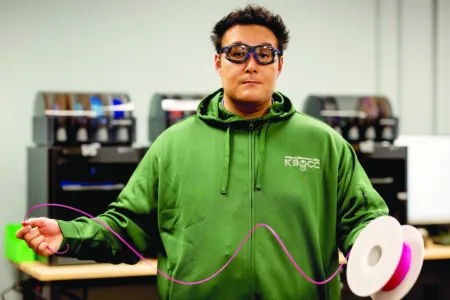
The NSF initiative allows students to gain hands-on experience in multidisciplinary research areas, utilizing KBOCC's Fabrication and Systems Technology Lab as the project's central operational incubator.
Established by Raymond, the FAST Lab sits at the intersection of research, technology, and workforce development. Under the new federal grant, the facility transforms from a traditional workspace into a prototyping hub. Students across human studies and health sciences will move away from isolated technical exercises, instead using 3D printing, artificial intelligence, electronics, and human-centered design to invent and test physical systems.
“This NSF award marks an exciting milestone for KBOCC and our Health Sciences Department as we expand opportunities for students to engage in applied research at the intersection of health sciences, artificial intelligence, biotechnology, and emerging technologies,” Alhajjar said. “Through hands-on learning, course-based undergraduate research experiences, and interdisciplinary collaboration, students will develop the scientific, technical, and problem-solving skills needed to address real-world health and environmental challenges.”
Megan Haataja, dean of Academic Affairs at KBOCC, told the Daily Mining Gazette students will have the chance to move beyond the classroom and participate on hands-on projects utilizing technologies such as 3D printing, prototyping, and artificial intelligence to explore real-world challenges.
"Just as importantly, this funding allows us to create research opportunities that connect STEM and emerging technologies with Indigenous knowledge and the needs of our communities," Haataja said.
"For a small Tribal college, providing students with opportunities to conduct meaningful research, work alongside faculty, and potentially present their findings at national conferences is significant. It gives our students experiences they can carry with them into the workforce, transfer programs, and future STEM careers."