A cloud develops over the copper region
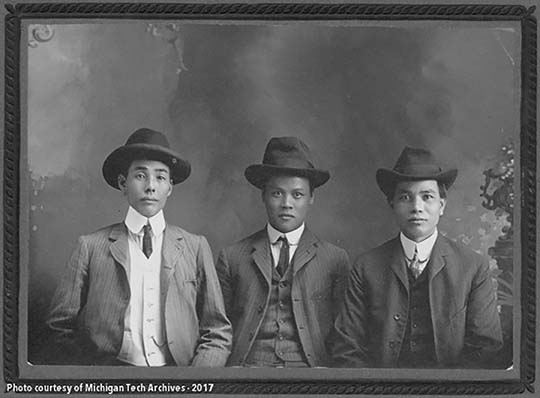
MTU Archives In the late 19th and early 20th centuries, immigrants began arriving in Lake Superior region from Eastern Europe, but as this undated photograph by J.W. Nara demonstrates, not all immigrants were European, nore did every immigrant seek mining work. These three well-dressed Asian gentlemen, according to the MTU Archives photo description, are “Oriental Laundry men.”
While modern technology was, at least theoretically, improving the lives of Copper Country residents, there was something dark brewing, something no one talked about — at least openly — at first. But it was there. Maybe they just could not identify it.
There was, starting the latter half of the 19th century, a gradually growing distrust between the mining companies and their workers. There were many changes occurring in the region as the 20th century approached, both in population demographics and in the companies, as well.
In the early years, mining companies were small, independent ventures. They employed a dozen or so contract workers, an onsite manager — the agent — and maybe a clerk, all living in the small locations. In most instances, at least one of the company directors personally knew the mine agent and the clerk, and the agent knew the men he lived and worked with. They were small, close-knit ventures.
During the winter of 1846-47, John H. Forster was the agent of a mine about 16 miles from Eagle River, where “a few rough German miners and a Frenchman or two” constituted his force, divided among four “Comfortable block-pine cabins.” Writing about it some 40 year later, Forster wrote quite matter-of-factly of eating meals with the population of the tiny settlement.
That gradually changed, however, as many companies dissolved for various reasons. Other companies organized, occupied the locations of earlier locations, or several, and became larger than the early pioneer companies. By the late 19th century, the mining companies had become far more like present-day corporations than like the earlier ventures. Employing hundreds of men, the agents no longer knew their workers on a personal level and more probably, would not have recognized one on a sidewalk.
At the Cliff Mine in 1845, for example, Capt. Edward Jennings was the first agent there, assisted by a clerk or two, and under one of the officers of the Board of Directors. Underground were two head mining captains, one for the day shift and one for the night shift. On the surface, there was the surface captain and his workers.
Just 20 years later, Calumet and Hecla mines were not really like that, even in the beginning. After Edwin Hulbert was replaced by Alexander Agassiz as agent at the mine, the company grew so quickly, and took on so many employees, Agassiz did not have the time to work with and know each contract worker. Three years after the Calumet and Hecla companies merged, they were the largest employer in the region.
“In 1874, we employed 1616 men,” Agassiz said at the annual Board of Directors meeting in Boston. “In 1899, we employed 4607 men.”
By contrast, the Quincy Mining Company, in 1903, reported an average force of 1,624 men for that year. Though about one-fourth the size of C & H’s force, it was a workforce too large to know each man.
By 1900, At C&H, by comparison, was the agent, now called the superintendent or General Manager, with an office full of engineers, geologists, draftsmen, clerks, bookkeepers and others. There was a head mining captain, captains for each shaft, shift bosses, department heads, and on and on and on.
At the later mining corporations, the general manager was so high up the food chain, he was isolated from the contract workers, and few, if any, of them. The class system under which the men in the Eastern offices lived and functioned was extended to the mining locations.
At the Quincy Mining Company, for example, the “officers” at the mine — the agent, head mining captains, clerks, and so on, lived in far superior houses built by the company than those built for the workers, and while the officers’ houses were equipped with steam heat generated from company boilers, along with hot and cold running water in their bathrooms, the workers’ houses had no water connections, nor even a toilet in the basement. Any worker or his family wanting a bath either took it in a metal tub in the kitchen or paid for one at the company bath house.
While the long-established immigrant workers, such as the Cornish, Irish, Welsh and Germans took it all in stride, in the latter half of the 19th century, the ethnic composition of the region began to change. It received close attention from the U.S. Department of Labor’s Bureau of Labor Statistics Bulletin No. 139, Michigan Copper District Strike, published on Feb. 7, 1914.
“The first foreigners employed in the range were Cornishmen, Scotchmen [sis], Irishmen and Germans,” the bulletin stated on p. 144. “They came to the district in the early years of development, and they constituted the greater proportion of the mine workers during the first 30 years (1844-1874). Of these, the Cornishmen or their descendents are now the most numerous.”
The report goes on to state that in the 1870s, “Finlanders, Swedes, and Norwegians began to arrive, and in the eighties Italians. About 1890 Croatians began to come, and they were followed, in the nineties, by other Austrians, and by Hungarians and Poles. The Finlanders are twice as numerous as the mine workers of any other race.”
In 1910, the population of Houghton County was 88,098; Keweenaw County was 7,156; and Ontonagon County was 8,650. Of the population of Houghton County, English comprised 4,459; Germans accounted for 1,723 persons; Ireland only for 799. Immigrants fromFinland, on the other hand, numbered 11,536. Immigrants from the Austrian Empire numbered 3,333.
In short, the migration movement had shifted east. More ethnic groups were coming into the region from eastern European nations. They spoke unfamiliar languages. They dressed funny. Their ways were odd and foreign. Mining companies needed them, but they did not want them, nor did they trust them. In turn, these new Eastern Europeans were aggressive and seemed to believe they had a voice in how middle and upper management should and would operate. It was the beginning of a period that would see increasing hostilities between the workers and their employees.
Graham Jaehnig has a BA of Social Science/History from Michigan Technological University, and an MA in English/Creative Nonfiction Writing from Southern New Hampshire University. He is internationally known for his writing on Cornish immigration to the United States mining districts.