Cora Jeffers
Adams Township educator earned national acclaim
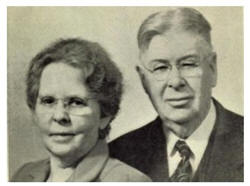
Cora and Fred Jeffers. Photo courtesy Adams Township Schools
PAINESDALE — Cora Jeffers, it can be argued, is among the most underrated women in history. A champion of education, as well as suffrage, she devoted her adult life to teaching and expanding educational opportunities for students. In fact, she earned national acclaim for her dedication, and was even featured in Time Magazine in 1945.
Cora was born Cora Doolittle, on the family farm in Wheatland Township, Hillsdale County, Michigan on April 1, 1871, to Martha and Charles Doolittle. She attended the local grade school, but because there was no high school in her rural neighborhood, Cora earned her high school diploma, at age 16, from a school in Lenawee County’s Hudson Township, which borders Wheatland Township. She then taught school in Hillsdale.
There, she discovered the love of teaching. She applied to the Michigan Normal School, was accepted and excelled.
While in college, she met classmate and future educator, Frederick Jeffers. They both graduated cum laude in 1891, when Cora accepted the principalship of the Sault Ste. Marie high school. Fred was offered the superintendency of the high school in Atlantic Mine.
Cora remained at Sault Ste. Marie for the next three years. She and Fred were married in August, 1894. Cora assumed the principalship at Atlantic Mine that September. They would continue to serve, develop and expand Adams Township Schools for the next 55 years.
“Cora Jeffers was a great teacher; in fact, she was one of the outstanding women educators in America. Her death brought to a conclusion a teaching career which covered almost fifty-nine years of Michigan public school service,” Lorna Weddle wrote in her 1955 article, “Cora Doolittle Jeffers: Outstanding Educator, Was Teacher in U.P.” which appeared in Michigan History Magazine in 1955. On Dec. 1, 1955, the Mining Journal of Marquette reprinted the article.
“Mr. and Mrs. Jeffers, he as superintendent and she as principal, worked with determination and enthusiasm and in 1897 eight students were graduated from their high school,” Weddle wrote. “It was a gala day for the whole community. From then on they worked steadily adding courses to the curriculum, improving the equipment, and raising the standard of the school. Many hundreds of students have been guided through the grades and high school to graduation and to useful lives under the tutelage of the Jeffers.”
As mining declined at the Atlantic Mine in the early 1900s, a new mine, the Champion, had begun operating in 1899, about eight miles from Atlantic. As the Champion proved successful, the community of Painesdale grew around it. Operations were suspended at the Atlantic in 1906 and a new high school was built in Painesdale, which opened in 1909. The same year Cora received an honorary Master of Pedagogy (the method and practice of teaching) from Eastern Michigan University.
The first floor featured large laboratories for physics and chemistry, a large science lecture room, as well as other classrooms. Upstairs included an assembly hall with a skylight and stage, while in in the basement were a gymnasium, kitchen, and dining room.
An expansion of the building in 1934 nearly doubled the size of the building. Funded by a $200,000 grant from the Civil Works Administration, the expansion of two wings, a new gymnasium, and the Copper Country’s first school swimming pool.
Tim Keteri, the current Adams Township Schools superintendent, told the Daily Mining Gazette in 2022 that the pool is credited to the Jeffers.
“”The Jeffers, Fred and Cora, wanted this,” said Keteri, “but I think it was more Cora.”
Keteri was correct. Cora, at the age of 63,became the school’s swimming instructor, even though she couldn’t swim.
“She took up swimming,” Weddle wrote. “Not too long after, the pool was in full use, Mrs. Jeffers was teaching (girls’) swimming and diving.”
In addition to swimming and academic courses, Cora also taught physical education. Weddle wrote that her physical education exhibitions were so beautiful, perfect, and unique that physical education teachers came from miles around to see them and learn from them. In her military marching as many as four hundred students participated, Weddle wrote, all working with an accuracy that military observers said would compare favorable with military marching anywhere.
“The exceptional ability of Mrs. Jeffers to organize and produce programs and entertainment brought favorable attention,” Weddle wrote. “Her work attracted nationwide attention to such an extent that it was described in Time Magazine.”
On Dec. 3, 1945, Time reported the Jeffers, who lived in across the street from the school, like their students to march to classes, be neat, honest, polite, and able to take orders.
“Cora is at her desk every morning at 7. (She has never missed a day.),” Time reported. “She spends an hour cleaning up the mail. From 8 to 8:30 she advises students who have special problems. At 8:30 she conducts a singing class. At 9 she puts 60 to 90 boys & girls through a gym routine that often includes intricate steps from her rich repertory of folk dances.”
She achieved acclaim for her folk dancing and rhythmic work. To teach these, she studied dancing at Harvard and New York and took rhythmic work with the ballet of the Metropolitan Opera Company.
The Sept. 1920 edition of the Michigan publication, Moderator-Topics, stated:
“Mrs. Cora Jeffers, principal of the high school at Painesdale, is known not only as a vigorous high school executive, but also as a great teacher. Her work in the field of physical education stands out as distinctly superior, and is challenging the attention of the country. Mrs. Jeffers bases her instruction in this branch on the folk dance.”
The article goes on to say: “Mrs. Jeffers has certainly contributed something worth while to the cause of education. Her method of instruction was recently demonstrated before the state association at Grand Rapids.”
In addition to teaching, Cora wrote on the topic, publishing a book in 1923, titled Rhythmic Work. It was later used a physical education textbook by the Michigan Department of Public Education.
The Jeffers were also socially progressive. A champion of suffrage, Cora was the first woman in the district to register to vote. Both she and Fred traveled throughout the Copper Country speaking on women’s suffrage.
On Sept. 14, 1912, the Daily Mining Gazette reported on a speaking event at the Amphidrome, in Houghton, where Cora, who was chair of the Houghton County Equal Suffrage Committee, spoke along with her husband, and Judge Patrick O’Brien.
At the event, Cora spoke for half an hour, and said it was the plan of the suffrage committee to “raise money and bring to the Copper Country a number of prominent speakers to speak on the subject.”
On March 29, 1948, at the age of 78, Cora Jeffers passed away, three days before her birthday. Her passing brought to an end 55 years of public education advancement and social justice advocacy not only in Adams Township, but across the state and throughout the nation.
As Lorna Weddle wrote: “One of the remarkable features of Mrs. Jeffers’ career was the way in which she teamed up with her husband so that together they accomplished more than any two working separately could have done.”
In 1949, Northern Michigan College was received the right to grant honorary degrees. The first two persons to be honored with a Doctor of Laws degrees were Cora Jeffers and her husband, Fred.