Lucena Brockway
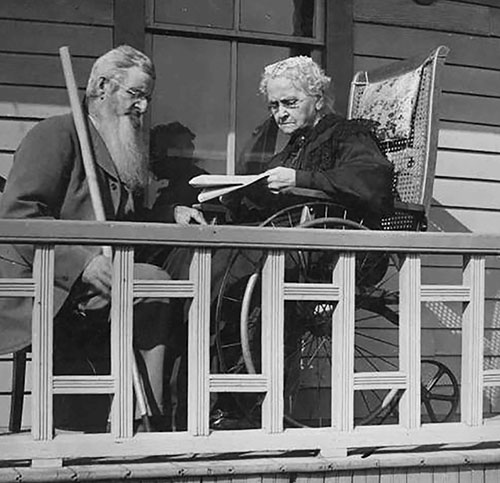
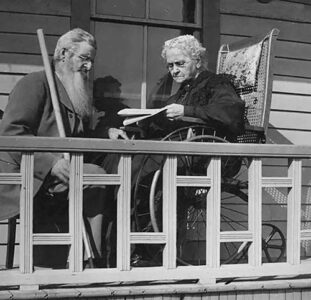
Daniel and Lucena Brockway, in 1898, at their home in Lake Linden. The photo was taken about a year before Lucena passed away.
KEWEENAW COUNTY — History remembers some people for their actions. Others are remembered for their contributions to community or society. Lucena Brockway, a true pioneer of the “Old Northwest,” is remembered for actions done in quiet isolation and words never spoken
Lucena Harris Brockway was born in Eden, Erie County, New York on May 5, 1816. Her father, Dr. James Harris, was a Connecticut Yankee born in 1785. Her mother, Sally Hodge Harris, was born in New York in 1787. She was a teenager when the family moved to Kalamazoo County, Michigan Territory.
It was there that Lucena Harris met and married Daniel Dunbar Brockway in 1836, a year before Michigan became a state, and two years before Daniel’s brother, William, was appointed Methodist minister at the Indian mission in L’Anse. William was influential in Daniel and Lucena locating on the Lake Superior frontier.
Daniel and Lucena moved from Kalamazoo to L’Anse in 1843, when Daniel was appointed government blacksmith and mechanic to the Indian Department of Lake Superior, headquartered at L’Anse.
They arrived at Keweenaw Bay in the summer Copper Harbor became the center of mineral exploration on the Keweenaw Peninsula, when the region was opened to mining by the War Department. The Brockways remained in L’Anse for three years.
Like everybody else on Lake Superior, Daniel Brockway was an opportunist. Opportunity was what brought anyone to the Lake Superior mining district during the region’s pioneer phase.
In May, 1846, the Brockways and their three daughters moved to Copper Harbor. There, they built the first practical hotel, the Brockway House. Lucena began to feel the pressures of her husband’s searches for opportunities. Lucena managed the hotel, tended to the laundry, cooked for the guests, all while taking care of the children, while Daniel was off on his many business ventures.
Three years after opening the hotel in Copper Harbor, Daniel became the agent of the Northwestern Mine (now the Delaware), in 1849. The year 1861 found the Brockways in Eagle River, operating another hotel. Two years later, they were back in Copper Harbor, as partners in a mercantile business with their son-in-law. In 1872, Daniel and his son opened a store at the Cliff Mine. Daniel boasted of owning the Atlas Mine, located between the Cliff and Phoenix, in which he had purchased more than 1,700 shares in 1849. The mine failed.
In 1879, he left Lucena and the children at home while he went to the Black Hills for seven months, searching for gold. That failed. By 1882, the Brockways were living in Phoenix, where Daniel was the agent of the Cliff Mine.
Throughout most of those years, Lucena recorded her day-to-day life in personal diaries. The diaries provide us with a firsthand account of life, death, struggles and hardships faced by many frontier women.
For instance, while managing her domestic duties, as well as the hotel, her diaries reveal times of intense suffering from arthritic pain, as discussed by historian Arthur Thurner in his his book Strangers and Sojourners.
In March, 1866, Lucena, was extremely ill, Thurner wrote. She was diagnosed with what her doctor described as a “slight shock of paralysis and general prostration of the nervous system.” She was frequently ill, Thurner wrote, which he suggested “may have been accompanied by unconscious psychosomatic protest.” Her illness came with intensity, at times, he observed, while at others disappeared quickly.
Either her husband, Daniel, was aware of this, or he didn’t care. About a month after her diagnosis, she wrote that he left for Portage Lake “at 5 a.m. Went unbeknownst to me, the cruelest thing he could do when I was so sick.”
Lucena may have suspected it herself. In March, 1874, Daniel left for business in Houghton and in L’Anse.
Five minutes after he left, she wrote in her diary: “I was taken sick … pretty sick all day (with) symptoms of paralysis again.”
As her children grew up and left home, and Daniel was still roaming the countryside, she was very frequently left alone and isolated for extended periods of time, as her diaries attest.
On July 8, she recorded that with the aid of a crutch and her wheel chair, she managed to get outside in the yard and back. “Pa,” she wrote, had promised to return from Copper Harbor, but was gone for four days. He showed up at dinnertime.
In October, left alone again, she wrote: “I feel lonely enough I can tell you.”
She kept busy. In July, 1878, without help, she picked picked 32 quarts of wild strawberries in four days. She sold berries in season, and sold eggs and butter. In 1882, when she was 66 years old, Thurner reported, she wrote with pride of her 30 hens, which had hatched more than 100 chicks. Within eight months, her chickens had laid more than 2,500 eggs.
She also recorded her typical day in July, 1884:
“I got up before seven o’ clock, built a fire, fed my chickens & hens & pigs, skimmed the milk and chored around generally, made a pie for dinner, read 12 chapters in the bible, and when I got ready to write, Mr. Ed Daniel came –” Throughout the day, several people came by, most at meal time. By the time she had completed her evening chores, it was dark.
Judging by her many diaries, her husband lacked compassion – or consideration – and she resented it. He sold her favorite horse, causing her to have “big cry over it,” she wrote. “I think it was about as shabby a thing as he could well do and I do not get over as easily as he imagines.”
Alone and isolated as she grew older, she began to reflect. In 1884, at the age of 68, she recalled leaving New York for Kalamazoo when she was 18.
“And now, not one left to see this day but me,” she wrote. “A solemn thought is it not?”
Much had changed in the decades since the Brockways arrived at Keweenaw County in 1846. They had arrived at Copper Harbor, escorted by two voyageurs in a birchbark canoe, just as the first military occupation of Fort Wilkins was ending, and the Cliff Mine was entering production. They had witnessed the creation of roads as mining expanded. Lucena and Daniel witnessed the growth of the mining industry and the rise of towns, stamp mills, foundries, railroads and smelters along Torch and Portage lakes. Through much of it, Daniel had sacrificed his wife in his attempts to be part of the development.
As the 20th century approached, it didn’t matter much to Lucena anymore. She had done more than her share in contributing to the opening and growth of the mining district. She was tired.
On March 3, 1899, Lucena passed away at the age of 82, leaving behind Daniel, her children and several diaries she had kept, giving historians today a rich, firsthand account of pioneer life in a copper district.