
UP sees ‘The Ford Boom’
Trending
IRON MOUNTAIN -- For Henry Ford in the early 1900s, the Upper Peninsula wasn't just a place to vacation, it offered opportunity and resources for his growing Ford Motor Company auto manufacturing operation.
Ford, in turn, would put the U.P. -- and the Iron Mountain area, in particular -- on the map as the automotive industry exploded in America.
Ford's first documented visit to Iron Mountain was May 28, 1907. Ford had an aunt, Nancy (Ford) Flaherty, whose husband Thomas designed and constructed shaft houses for the copper and iron mines throughout the Upper Peninsula. Their daughter, Mary Frances "Minnie" Flaherty, married Edward George Kingsford on April 8, 1890.
In 1900, Iron Mountain's population stood at 9,242. But in the 1920s, the Iron Mountain area and much of the Upper Peninsula would be transformed in what was termed the "Ford Boom."
Ford had contacted Edward Kingsford -- his cousin-in-law, then a real estate agent who owned a Ford dealership in Iron Mountain -- about acquiring timberland in the Upper Peninsula.
In early 1920, news surfaced that the Ford Motor Company planned to build a sawmill and factory to make wooden automobile components somewhere in the western Upper Peninsula.
Ford had at the time purchased 430,000 acres of timberland in the area of Lake Michigamme in Iron, Baraga and Marquette counties to provide the company with its own source of wood for manufacturing Ford parts such as wood paneling.
Lumber from the northern woodlands back then was shipped to the company's plants in Detroit, made into parts and then re-shipped to branch assembly plants. Ford's plan was to establish a sawmill and parts factory near the sources of the raw materials and ship the parts directly to the assembly plants.
Ford, together with son Edsel and company general manager C. W. Avery, visited Iron Mountain as a prospective site for a factory on July 7, 1920. Other prospective sites mentioned at the time included Menominee, Marquette and Republic.
By July 16, Ford had decided on Iron Mountain for his sawmill and body parts factory, and the next day Ford engineers arrived in the city and began laying out the site. Work began before the end of July and connection was made to the Chicago & North Western Railway. The company eventually purchased 3,000 acres, Cummings wrote.
In mid-August 1920, the Michigan Iron, Land & Lumber Company was organized by the Ford Motor Company interests for the Iron Mountain sawmill and body plant, as well as the extensive Ford logging operations in the Upper Peninsula. The officers were Henry Ford, president; Edward G. Kingsford, vice-president and assistant treasurer; Edsel Ford, treasurer; and C.B. Longley, secretary. In March 1923, it officially came under the Ford Motor Company name.
The first "body plant" was built in 1921 and went into operation in March 1922. Later in 1922, this plant was enlarged and a second plant added. A third body plant was built in 1923. By March 1924, the three body plants were making 69 different body parts and producing an estimated 350,000 wooden parts per day.
A chemical or distillation plant that converted the waste wood into wood alcohol, wood tar, gas, oil and charcoal -- what would become the Kingsford brand charcoal briquets -- went into operation during September 1924. As the Ford operation expanded, the company built the Ford Dam and Hydroelectric Plant on the Menominee River nearby to provide an adequate power supply. The power plant was completed in June 1924.
By early March 1924, Kingsford's Ford Plant had a total of 52 dry kilns, the largest battery of dry kilns on Earth at the time.
By Nov. 12, 1925, the Iron Mountain plant was listed as employing 7,271 men -- more than any other division of the Ford Company with the exception of the Detroit area.
During 1920, Ford began developing a residential area near Crystal Lake on the company's property just south of Iron Mountain and built 50 houses, the first of many more Ford eventually built. Voters on Aug. 29, 1923, backed establishment of a separate Village of Kingsford, named for Edward G. Kingsford.
A census by city directory workers employed by R. L. Polk & Co. and completed Dec. 10, 1924, revealed a population of 5,106 in Kingsford and 18,349 in Kingsford and Iron Mountain together. For Iron Mountain itself, this represented a population increase of 5,000 in only four years.
Two other noteworthy Ford operations both were in Baraga County.
In 1923, Ford purchased the entire village of Pequaming for $2,850,000 so the already established lumber mill operation could continue to supply lumber for his vehicles. Ford would maintain a summer home, the Hebard-Ford house, for decades in the community.
In 1935, Ford founded the village of Alberta, naming it after the daughter of the superintendent of Ford's Upper Peninsula Operations at the time. He considered the location on Plumbago Creek at U.S. 41 to be ideal for a sawmill.
"The sawmill at Alberta, in Baraga County, was to be the core of Ford Motor Company founder Henry Ford's concept of a model company town. In addition to the Alberta mill facility, Ford also had a dozen or so houses constructed for its employees and their families, along with two schools for the children of the community," Graham Jaehnig wrote in the Sept. 7, 2025, Daily Mining Gazette.
But the "Ford Boom" of the 1920s would start to fade in a few decades.
The Ford Company closed the Kingsford facility in 1951. In its final days, they employed less than 1,000. But the airport still bears the Ford name. And Kingsford High School teams are the Flivvers, a nickname for the Ford Model T that also is the school's logo.
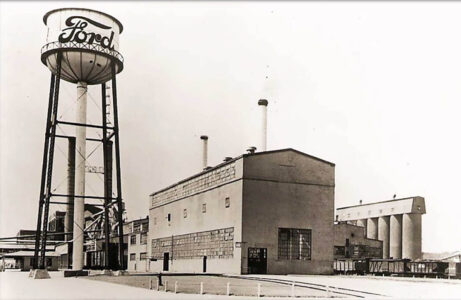
Ford Motor Company sold the town of Pequaming in 1952. It's considered essentially a "ghost town" today, though the water tower on the site still has the Ford Motor Company logo and Ford's former summer home. The house was designated a Michigan State Historic Site in 1979 and listed on the National Register of Historic Places in 1982.
Ford operated the Alberta mill until 1954. The company then donated the facility and 1,700 acres of surrounding forest land to Michigan Technological University. It now is Ford Forestry Center, run by MTU's College of Forest Resources and Environmental Science.
The Committee to Save the Alberta Sawmill had a ribbon-cutting ceremony last September to celebrate reopening the Alberta Sawmill pump house as part of the Baraga County Historical Society Museum.