
Trending
HOUGHTON -- Even with advances in technology, getting weather reports from people on the ground is important.
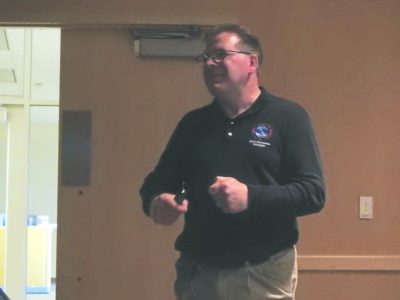
Matt Zika, a meteorologist with the National Weather Service in Negaunee, spoke to about 20 people interested in providing weather updates during a talk in Houghton Tuesday.
Locally, radar reports can be incomplete because of the "Keweenaw shadow." The radar beam has to be aimed over the Huron Mountains, northwest of the Negaunee office. As a result, it will overshoot the tops of snow clouds.
A storm depositing 2 or 3 inches of snow per hour might not show up on radar. That's where observers come in.
"We take that information, we compare it to what we're seeing on radar, we include the reports in any of our successive weather warnings, and people are more apt to respond to those weather warnings when they hear something is already occurring with the storm," he said.
When providing weather reports, the most important information is what, when and where -- for example, quarter-sized hail at 8:25 p.m. in Houghton.
"A lot of times we'll get in real time, people taking the pictures of the hail that's falling out on their deck, and they're giving a location of where they are," Zika said. "Nothing is more valuable than actually truly seeing what it is the person actually is experiencing."
As the climate warms, more extreme weather events are becoming more common, Zika said. The Upper Peninsula has been getting warmer and wetter. Of the 12 warmest years recorded at the station since 1960, nine have come since 2000, Zika said.
That doesn't apply to all months across the board. In 19 of the past 20 Septembers, temperatures have been above normal, Zika said. Over the same span, April or May temperatures have been below normal 15 times.
"I think we can all remember here over the last 10 or 15 years, some crazy April snowstorms and just some lousy months of April temperature-wise," Zika said.
While there wasn't much snow accumulation this April, there was measurable snowfall on 15 of 30 days, Zika said.
Growing seasons, as measured by the distance between the last spring frost and the first fall frost, are also getting longer.
Precipitation has rebounded from drought conditions seen in the early 2000s. From 2000 to 2011, the office saw a precipitation deficit of around 14 to 15 inches combined. Over the past decade, it's seen 52 accumulated inches over the normal amount.
Though not usually on the level of the Father's Day Flood, intense rainfall events are becoming more common in the summer.
"This isn't just a local trend only occurring here in the Upper Peninsula or the Upper Great Lakes," Zika said. "That's across the country as a whole. So we have more instances of these thunderstorms that occur during the summertime that are producing those 2- to 5-inch rain events over a two- to three-hour time period, that then are causing some issues."
In one recent example in Marquette County, 4 inches of rain in the span of an hour caused a washout on County Road 510 between Negaunee and Big Bay.
For about 10 years, the NWS has sent wireless emergency alerts in the case of severe weather events. Up until two years ago, only tornado or flash flood warnings would generate an automatic notice. Since then, they've also added a higher-tier category for severe thunderstorms that have winds of 80 mph and/or baseball-sized hail.
Marginal flash flooding doesn't generate an automatic alert. That is reserved for situations where the NWS anticipates "considerable or catastrophic damage" such as that seen in Houghton in 2018, Zika said.
With the winter finally over (assuming this doesn't jinx it), Zika also presented snowfall totals for the region. The Delaware measuring station recorded the highest in the U.P. at 326.6 inches, followed by Painesdale at 282.6 and Hancock-Quincy at 193.4. The NWS office in Negaunee recorded 204.7 inches, while downtown Marquette received only 106.
They measure every six hours, cleaning off their snowboard after each measurement. Many weather observers are getting readings once a day, during which time the snow compacts, Zika said.
Even weather professionals can be stymied by a strong wind.
"In those cases, then we're walking around in the parking lot trying to figure out the last time the plow came and, and some areas that maybe would give us a representative measurement as to what happened," Zika said.
Reports can be submitted to the National Weather Service in several different ways:
By phone at 1-800-828-8002
On the web at weather.gov/mqt
On Facebook at NWSMarquette
Using the mPING app
On Twitter @NWSMarquette
By emailing nws.marquette@noaa.gov
By ham radio to WX8MQT