
Healthcare for All
Town hall held in Hancock
Trending
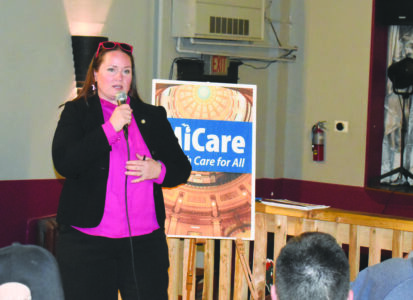
HANCOCK -- State Rep. Carrie Rheingans (D-Ann Arbor) visited the Orpheum Theater in Hancock Wednesday evening to participate in the Healthcare for All Town hall regarding her proposed bill HB 4407, or the MiCare bill. Rheingans came to Hancock by invitation from Michigan United's Keweenaw Against the Oligarchy, with support of Keweenaw Indivisible, Keweenaw Mututal Aid Collective, Houghton County Democratic Party and Baraga County Democratic Party to share what the bill entails and how a statewide single-payer healthcare system would operate.
Michigan United Northern Regional Manager Audrey Gerard invited Rheingans to the area believing the current health care system is unsustainable.
"We can make Michigan a leader for the rest of the country and address our health care crisis by advocating for support of a single-payer system like MiCare," Gerard said. Gerard was one of the introducing speakers before Rheingans spoke, and shared her story of medical debt. Gerard did not have medical insurance when she was 21 years old, and had a medical emergency being diagnosed with sepsis. She was unable to get the care she needed at the facility she was at, and was transferred to St. Mary's in Duluth, Minnesota. She received care, but was given a $100,000 bill when discharged, not including ambulance expenses or ER expenses in Wisconsin.
"For the following months, I spent my days figuring out how to readjust my life and become a millionaire so I could pay off all my debts. After all, I only worked for $11 an hour at a history museum at the time. But I realized I had a choice. I had more agency than I originally thought. My choice was clear," Gerard said. "I could live in shame that this experience happened to me, or I could use my story to move other people to take action. And for all the months I spent in shambles, I started dreaming up ways I could make my private shame a story of public power. I knew that all of this could have been easily avoided if we didn’t live in a for profit health insurance world, and I started posting on social media platforms about my debt."
Gerard was reached out by an organizer from Michigan United to share her story, and then eventually became a member. She worked to connect people virtually from Michigan to create Michigan Community Health Care Committee.
"To this day, this group has had over 600 people work on health care for all. We’ve successfully stopped six House bills trying to privatize Medicaid, and we’re actively fighting to expand Medicaid and Medicare to include more services and expand requirements so that more people can be eligible," Gerard said.
After Gerard spoke, Valorie Troesch from the League of Women Voters of the Copper Country went over medical debt statistics, sharing 90 percent of Americans have health insurance but 68 percent of insured individuals carry medical debt. Troesch also shared the fundraiser Keweenaw Indivisible ran, Stronger Together, in July to raise almost $27,000 to go towards the area's medical debt. After Troesch spoke, Rheingan shared her experience in introducing MiCare, where the bill currently sits and how it would operate if implemented.
Before the town hall began, Rheingans went over bill in detail.
"The MiCare bill would create a health care for all publicly financed payment system that would cover all 10 million Michiganders in Michigan, and make sure that necessary medical expenses are paid for in the variety of care settings that we have today," Rheingans explained. "So this is similar to the idea of Medicare, which is a federal payer that pays for health care for people over 65 and it is financed through the people who are currently working pay a little bit of tax to pay for that health care so it’s publicly financed."
She said MiCare would operate on a state level and with the ever increasing cost of health care for employers and for regular working people, it is time Michiganders get the health care that they deserve with no co pays, no deductibles and no caps or limits. Rheingans shared in the state of Michigan as of 2025, over $80 billion changes hands between patients paying for care with co pays and deductibles to be paid after premiums and health insurance companies pay doctors and other providers.
"And the Congressional Budget Office, the nonpartisan analysis entity in Washington DC, when they analyze this at the national level, they say that there’s 15 to 20 percent in savings if you convert the entire country to have only one publicly financed payment system. And so using that, that means we would spend less on our overall health care in Michigan if we convert to this payment system. So we would have to finance it in a different way than Medicare, because Medicare is funded through only payroll taxes and people’s personal contributions for Medicare Advantage," she said.
Rheingans explained she and her team are still putting the puzzle together of how to change how Michiganders pay for healthcare, since healthcare is paid for in part by Michiganders paying taxes to the federal and state government, paid through premiums with every worker's paycheck and some individuals paying entirely out of pocket. She emphasized the change would be how healthcare is paid, not how it is delivered.
"In the United States of America, how we pay for our healthcare determines how you get your healthcare and how it’s delivered. Americans don’t like that. Michiganders don’t like that," Rheingans said. "We want to be able to go to our doctors that we need and get the care we need without having to fight with an insurance company about whether it should be covered, and that’s something that’s broadly bipartisan. No matter what side of the aisle you’re on, you want to just go get your freaking health care."
Rheingans believes MiCare would simplify the system, pointing out a provider dealing with 20 different health insurance companies all with different negotiations transferring to one would make access easier. She said this would also allow Michiganders seek care early on in getting sick instead of waiting until they are sick and in need of going to the emergency room. The Michigan legislature would oversee how care is paid for, and would ensure it would not pay out so much money, which would make the legislature become preventionists with the goal of people not getting sick with expensive diseases according to Rheingans.
Rheingans also commented on how rural areas would benefit from a change in how healthcare is paid. She explained some rural hospitals and health centers are having to shut down due to in part not having enough patients, which provides the facilities revenue.
"That means that these health centers in these hospitals continue to be bought by private equity firms or for profit organizations, who then realize they can’t make enough money and they just close things. And that’s already happening. We’ve already seen this in Ontonagon," she said. Rheingans also pointed out the maternity ward being shut down in Ironwood and the continued shut downs of those types of services further endanger residents.
While Rheingans took to the stage, she explained there would be federal elements to MiCare, but does not believe the currently federal administration would be supportive.
"But that means we have time to organize and get the bill right here in Michigan, and to get the bills right in in Washington DC, to make sure that once we have an administration that would approve that, we’re ready to go. So that’s part of why we’re on the road and doing three town halls here in the U.P. just this week. So we want to make sure that we’re hearing from you, making changes, making the bill right, so that by the time we have the conditions to make it happen, we’re ready," she said.
Rheingans included she is working with other states and learning from one another, such as Oregon and Colorado. Meanwhile she is continuing to travel and host town hall events to spread the word of her bill and inform Michiganders of its implications. The bill was introduced on April 29, but referred to the Committee on Government Operations the same day. Rheingans believes Michigan House Speaker Matt Hall (R-Richland Township) sent the bill to the committee to kill it. She encouraged everyone who is supportive of MiCare to contact their state representatives and even Rep. Jack Bergman to share their support of the bill.