A golden guardian
Beloved canine offers family hope
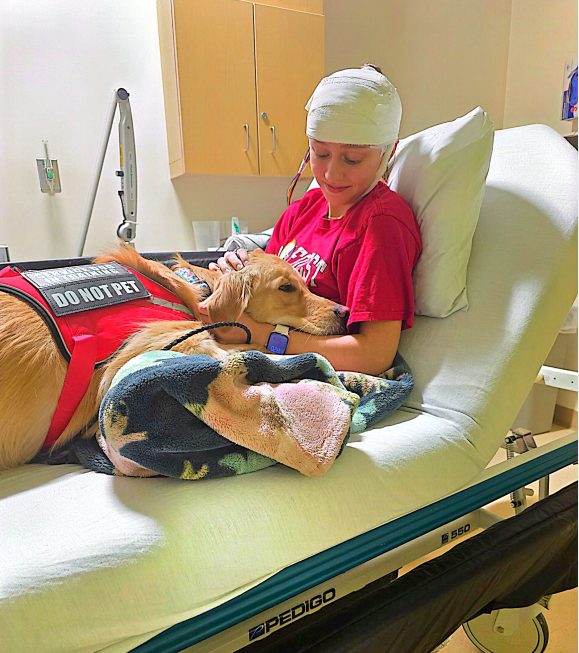
Courtesy photo Vanessa Mabie was diagnosed with functional neurological disorder (FND), a condition that causes seizures, tremors, weakness and more. Annie, Mabie's golden retriever, comforts her while Mabie undergoes testing at the University of Michigan's C.S. Mott Children's Hospital.
ESCANABA – For one Escanaba area teenager, everyday routines most of us take for granted – running errands, going to school, even watching a movie – have become challenging. But with the help of her golden retriever, she faces those obstacles with hope. Vanessa Mabie, 15, was diagnosed with Functional Neurological Disorder (FND) roughly three years ago. With her condition, she suffers from focal aware seizures – where a person stays fully conscious and aware – tremors and more.
“If I’m in the lights or super noisy places, I’ll have an episode. Annie has definitely helped a lot with that, just to keep me focused on one thing so it’s not so overwhelming” Mabie said.
“We just got her for a family dog, but she started alerting of seizures long before we were doing trainings. We have to polish (her skills) and get her certified,” she said.
While Vanessa has experienced symptoms since infancy, her condition worsened after a bout of illness. “Sickness can provoke it and make it worse, so that’s when it got really, really bad,” Mabie said. “It’s not just the seizures. My legs will go numb, I get super fatigued, full body tremors – it’s super painful.”
Annie’s ability to detect Vanessa’s seizures and manage her condition emerged early. Once Annie began exhibiting these skills, Vanessa’s mother, Lisa Mabie, reached out to Dave Johnson, lead trainer and owner of Canine Connection Training in Escanaba. Just two months into training, Annie was already pulling Lisa toward Vanessa before or during an episode. Johnson explained that Annie’s skills wouldn’t be possible without her unbreakable bond to Vanessa.
“I can’t just take any dog and say ‘Okay, you’re going to be a service dog.’ You have to have a strong, strong bond,” said Johnson. He has been working to refine Annie’s abilities, even without yet receiving the full funding for her training.
“Training already started,” Johnson said. “It isn’t the goal to have (Vanessa) sit there and wait for her dog to be trained. She needs it now, and I told them from the first time they walked in here that I’m 100% committed and I’m going to stay that way.”
Part of Annie’s training consists of challenges and rewards, like being tasked with finding Vanessa in a tunnel and being rewarded when she overcomes obstacles to reach Vanessa. Because Vanessa’s episodes can occur anywhere, it is important for Annie to retain this skill.
The retriever can also find Vanessa’s phone in an emergency. Annie will even grab Lisa’s arm and lead her to Vanessa before or during seizures.
Mother and daughter meet with Johnson twice a week to train Annie, and they even have a key to his facility so they can continue practicing on their own. At home, they keep refining Annie’s skills, ensuring she stays sharp and responsive.
While Johnson’s generosity provides crucial support, the costs of Vanessa’s medical care and Annie’s ongoing training at Canine Connection Training remain high. The family is seeking help from the community to cover these expenses. Contributions from local organizations and residents will ensure that Annie can continue providing the life-changing support Vanessa relies on every day.
At home, when Annie is not wearing her service vest, she is described as a “totally regular dog.” But she is always in tune with Vanessa, often signaling her seizures long before they occur.
“(Annie) was asleep on the couch, and I called her to post – that’s where she goes in between my legs when they start to go numb. She laid down, which I thought was weird, but then my legs gave out. She broke my fall so I didn’t hit my head, and she wasn’t in vest, so I was super impressed,” said Vanessa.
Annie then laid her head against Vanessa as she prepared to get up, allowing her to push off for support.
“When Vanessa is having an episode or doesn’t realize she is or is about to, the dog is already starting to escort her to the ground,” noted Johnson. “You don’t want her standing up during these (episodes). She’s been concussed way too many times.”
Annie can also detect physiological changes, such as Vanessa’s elevated heart rate or shallow breathing, highlighting the remarkable abilities of dogs, as Johnson emphasized.
Living with FND means daily life can be unpredictable for Vanessa. While she attended public school during the first two years of experiencing severe symptoms, she now completes her education online, hoping she can eventually tolerate fluorescent lights after more therapy.
To combat the symptoms and manage her condition, Vanessa completes occupational, physical and cognitive therapy as a way to slowly expose her to lights and sound.
To assist the Mabie family, those interested may contact Lisa Mabie at lisarmabie@gmail.com, call Lisa at 906-399-0744 or donate funds to Lisa’s Venmo @Lisa-Mabie-4.
Front Page
A golden guardian
A wild weekend
Dennis Hext retires
A Major accomplishment
Dickinson Board members targeted for recall
IRON MOUNTAIN — The Dickinson County Election Commission will have a clarity hearing Feb. 2, concerning recall ...