Committee rejects some Trump proposals
Cuts would affect MTU
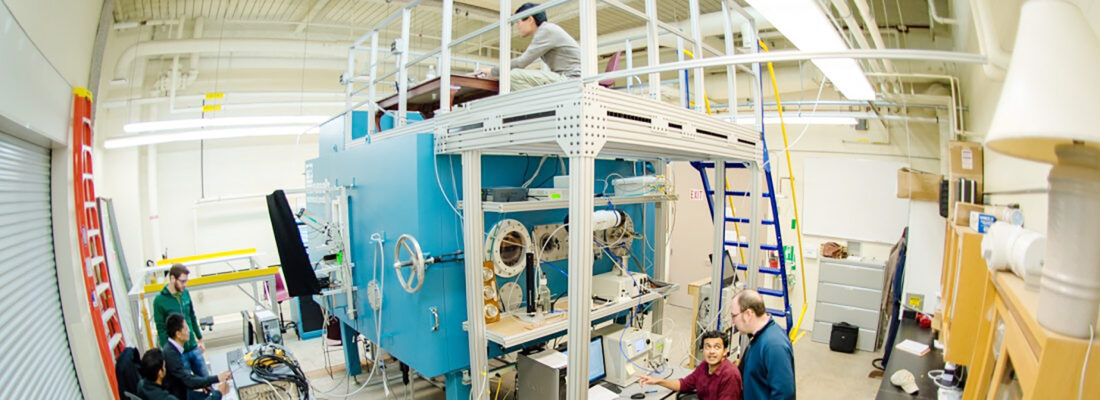
Photo: Michigan Technological University Michigan Tech’s Pi chamber allows researchers generate clouds under just about any conditions that can exist in the well-mixed part of earth's atmosphere.
WASHINGTON — A new congressional “minibus” of three spending bills for 2026 was released by the House and Senate Appropriations Committee on Monday.
The bipartisan spending package would reduce funding for a host of energy and environment programs while rejecting the Trump administration’s requests for even greater cuts, E&E Daily reported on Tuesday.
According to Government Executive (Govexec) on Tuesday, the package would set line-by-line, component-by-component spending levels across the departments of Commerce, Commerce, Energy, Interior and Justice, as well as the Environmental Protection Agency, U.S. Forest Service, NASA and other agencies.
In a Monday statement released by the Appropriations committee, Senator Patty Murray (D-WA), Vice Chair of the Senate Appropriations Committee, said passing the bills will help ensure that Congress, not President Trump and Russ Vought, decides how taxpayer dollars are spent–by once again providing hundreds of detailed spending directives and reasserting congressional control over incredibly important spending decisions.
“It is so important we pass full-year funding bills again and refuse to cede power to this administration,” Murray said in the statement, “and I hope that Republicans will work with us to do that as we pass the remainder of our funding bills.”
The release of the fiscal 2026 measures, Energy-Water, Interior-Environment and Commerce-Justice-Science — marks significant progress for appropriators, who have struggled to coalesce on a strategy to fund the government after passing an initial batch of three funding bills late last year, E&E Daily reported on Tues.
On On Dec. 16, White House Office of Management and Budget Director Russell Vought posted the announcement on X, saying:
“The National Science Foundation (NSF) will be breaking up the National Center for Atmospheric Research (NCAR) in Boulder, Colorado. This facility is one of the largest sources of climate alarmism in the country. A comprehensive review is underway & any vital activities such as weather research will be moved to another entity or location.”
This new minibus may prevent that from happening.
In several instances, the White House had looked to decimate spending on scientific efforts at federal agencies, Govexec said. It proposed gutting the National Science Foundation with a 57% funding cut, but lawmakers agreed to just a 3% trimming. The National Science Foundation (NSF) sponsors the National Center for Atmospheric Research.
The University Corporation for Atmospheric Research (UCAR) is a non-profit consortium of universities that manages the NCAR (National Center for Atmospheric Research), a major research center funded by the NSF, meaning UCAR is the managing organization and NCAR is a key facility it runs, both focusing on Earth system science.
In 2019, Michigan Technological University was approved for UCAR membership.
Will Cantrell, professor of physics and associate provost and dean of the Graduate School at Michigan Tech, said last month NCAR serves as the hub or nexus of much of the atmospheric sciences research in the United States and the world, and funding for NCAR primary comes from the NSF.
“NCAR does the kind of work that makes our understanding of the atmosphere – in other words, the weather, and the climate – it makes it better,” Cantrell said. “Why is it that we can predict the weather the way we can today? A lot of that work came through NCAR.”
Cantrell said several Michigan Tech students have gone on to work at NCAR. “We have research projects that we’re collaborating with people at NCAR to understand things as basic as ‘why does it rain.'”
NCAR, says ucar.edu, is a world-class research center leading, promoting and facilitating innovation in the atmospheric and related Earth and Sun systems sciences.
Forbes reported in December there are many ways NCAR has benefited the national and world. It has solidified U.S. prominence in weather-climate research, trained generations of scientists, and supported societal-changing field experiments. These include research of low-level wind shear that has led to safer flights; advances in radar technology that has resulted in better weather forecasting; and improvements in severe weather safety.
The “minibus” bills will likely move to the House floor for a vote this week, Inside Climate News reported on Tuesday.