Is copper back?
Red metal gaining in popularity
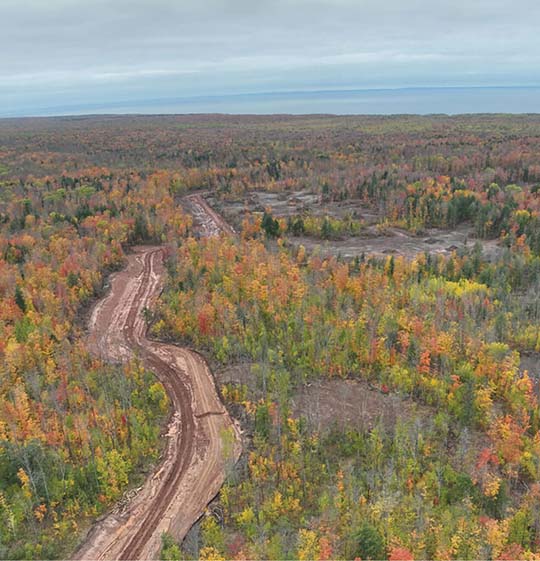
Site of Highland Copper Company’s Copperwood Mine Project, near Wakefield, in Gogebic County. (Courtesy of Highland Copper Company)
WHITE PINE — The potential of Michigan copper mining is returning to the spotlight after a 30-year absence, since the White Pine mine, in Ontonagon County, was closed.
In a statement released Monday, Highland Copper Company announced it completed the sale of its 34% interest in the White Pine North Project to its joint venture partner, Kinterra Copper USA. Kinterra now has full control of White Pine North.
The Project represents the extension of the White Pine mine, which was developed and operated by the historic Copper Range Company from 1953 to 1995.
The proceeds from the White Pine sale, the Monday Highland release said, will be used to fund planned Copperwood Project activities, eliminate the existing debt to Kinterra, pay for the costs of the transaction and for general working capital.
Highland Copper is a Canadian company focused on exploring and developing copper projects in the Upper Peninsula, the company’s website says. The Company also owns surface rights securing access to the Copperwood deposit and providing space for infrastructure at Copperwood as required.
Kinterra Copper USA is an affiliate of private equity firm Kinterra Capital, also a Canadian company, which is actively developing U.S. copper assets to support the energy transition, controlling approximately 14 billion pounds of copper resources.
These statements coincide with a Feb. 2 announcement from the White House introducing Project Vault. Project Vault is a U.S. Strategic Critical Minerals Reserve, a public-private partnership funded by a $10 billion loan from the U.S. Export-Import Bank (EXIM) and nearly $2 billion in private sector capital–will be a physical minerals stockpile for civilian use. Project Vault establishes the U.S. Strategic Critical Minerals Reserve, an independently governed public-private partnership that will store essential raw materials in secure facilities across the United States.
According to the Bipartisan Policy Center, the goal of the stockpile is to protect the private sector from supply disruptions and price volatility.
While a private company could, in theory, build their own individual stockpile, centralizing storage through a government‒backed public‒private partnership provides greater physical security and lowers the cost of holding inventory, the Bipartisan Center says.
The Export-Import Bank of the United States, on Feb. 6, referred to Project Vault as “an unprecedented and uniquely American decentralized approach to strengthen U.S. critical minerals supply chains.”
U.S.Senator Jim Risch (R-Idaho), chairman of the Senate Foreign Relations Committee, said on X (formerly Twitter), that Project Vault will create a new mineral stockpile to reduce the U.S. dependence on China’s market.
“We have to bolster our supply chains,” Risch wrote, “and Project Vault is a step in the right direction.”
Copper is one of dozens of commodities on the 2025 U.S. Geological Survey (USGS) critical minerals list. The Dept of the Interior, through the USGS, published the final 2025 List of Critical Minerals on November 6. It outlines 60 minerals vital to the U.S. economy and national security that face potential risks from disrupted supply chains, according to the USGS website.