Measles making a comeback
Vaccination still the best prevention

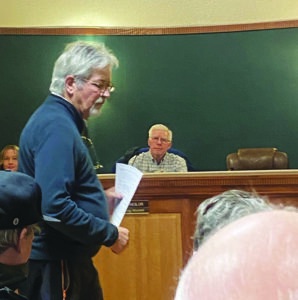
Chelsea Bossert/Daily Mining Gazette Western U.P. Health Department’s Hancock Office is sticking with what they know about measles: get vaccinated and quarantine if exposed to measles.
HANCOCK — What was once one of the deadliest diseases in United States history is making its way back into the public consciousness. Measles (Rubeola) was declared eliminated in 2000, but due to vaccination rates declining and a shift in public awareness, recent outbreaks and exposures occurred in several regions of the country, including Lower Michigan and Wisconsin.
After a scare last year in the Western Upper Peninsula through measles exposures in Marquette County, the Western U.P. Health Department is creating thorough plans in order to prevent the spread of the disease.
According to the Houghton County Quarterly Immunization Report Card released in December and Medical Director of the Western U.P. Health Department, Dr. Robert Van Howe, Houghton County has one of the lowest vaccination rates in the state. Van Howe spoke about how a measles outbreak in Houghton County would be troubling. “Part of our emergency preparedness is: what happens if measles gets here?” he said. ” I think we’re a little more tee-ed up about it because we have such a low vaccination rate. But I’m the medical director for four of the health departments up here, and we’re all doing the same thing. We have to be prepared.”
Houghton County’s procedure for how to handle measles cases is standard across health departments in Michigan. “We quarantine the people who are sick,” Van Howe said. “They are contagious for a couple days before the rash breaks out and about four days after the rash breaks out.”
According to Van Howe, there are different ways of treating measles once someone is sick, including a dose of the Measles, Mumps and Rubeola (MMR) vaccine or a dose of immunoglobulin if one is immunocompromised or too young. If one is not vaccinated, then the only option is a long-term quarantine.
“If you don’t have evidence of immunity and you don’t want to get the vaccine, you don’t want to get the immunoglobulin and you have exposure … you need to quarantine for 21 days until the last case of the outbreak is gone,” he said.
Measles is one of the most transmissible and contagious diseases that health departments have to face. It is also one of the most expensive to treat. Van Howe spoke about how data shows estimations of what it takes financially to end a measles outbreak.
“They looked at the cost of a measles outbreak and the average cost per case is between $24,000 and $50,000,” he said. “And only like a couple thousand of it was treating the individual and giving the vaccine for exposures. The rest of the money is the people taking time from work.”
Van Howe says Michigan Health Departments have been operating as normal, following the science that shows a 97 percent effective rate following two doses of the MMR vaccine. This sentiment is echoed by the State’s Chief Medical Executive Dr. Natasha Bagdasarian. This comes as vaccine rates have been steadily declining over the last few years.
“Statewide, when we look at kids 19 to 35 months of age, we had been seeing about 75 percent of them vaccinated in 2019. And that number declined,” she said. “It first declined during the COVID-19 pandemic because a lot of people weren’t getting in-person healthcare. You know, they weren’t doing preventative care. So the number declined, and it went down to around 70%.”
Bagdasarian and Van Howe both commented on how the CDC and federal officials have given conflicting information that does not follow established science.
“The numbers have declined again in the last year,” Bagdasarian said. “And I think it ties back to some of the confusing messages we’re getting from several partners about vaccines that is not scientifically found.”
Michigan Health Departments are steadfast in following the science and are largely ignoring the recent blowback on vaccines, continuing to tout their effectiveness in preventing measles.
“Michigan [is] unified in their message that we’re sticking with what we did before,” Van Howe said. “Kind of ignoring what the CDC is saying because the science hasn’t changed and so our policy doesn’t need to change either.”