
New attacks
Iran warns major UAE ports to evacuate
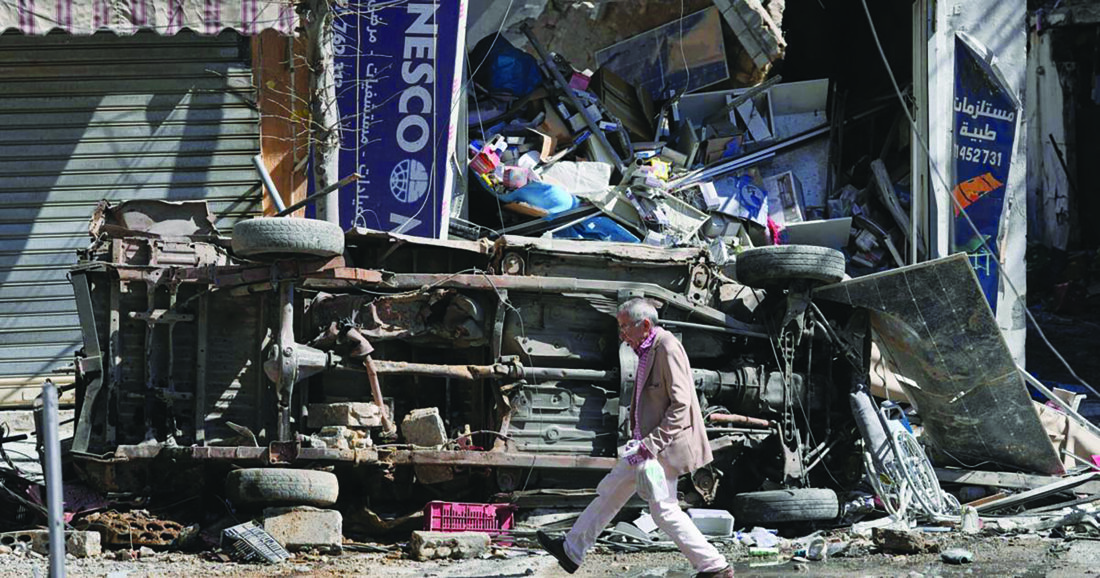
AP Photo/Mohammed Zaatari A man passes by a destroyed car and shop on a commercial street that was hit by Israeli airstrikes in Nabatiyeh town, south Lebanon, Thursday.
Gulf countries reported new attacks Sunday morning, a day after Iran called for the evacuation of three major ports in the United Arab Emirates, threatening for the first time a neighboring country’s non-U.S. assets.
Tehran accused the United States of using “ports, docks and hideouts” in the UAE to launch strikes on Kharg Island, home to the main terminal handling Iran’s oil exports, without providing evidence, as the war showed no signs of ending.
U.S. President Donald Trump said he hoped allies would send warships to secure the vital Strait of Hormuz.
Meanwhile, Israeli strikes have deepened Lebanon’s humanitarian crisis, with more than 800 people killed and over 850,000 displaced.
Israel says the brother of a man who attacked a Michigan synagogue was a Hezbollah commander killed in an airstrike.
The military said it had struck Ibrahim Ghazali — the brother of Lebanese-born Ayman Ghazali, who attacked the synagogue last week — because he managed weapons for a Hezbollah unit that fired rockets at Israel. The Associated Press was not able to verify that Ibrahim Ghazali was a militant. A Lebanese official, who requested anonymity because he could not publicly discuss details of the airstrike, confirmed that Ibrahim Ghazali was killed.
The official told AP that Ghazali’s children, Ali and Fatima, and brother, Kassim, were also killed in the strike that hit their home just after sunset. Authorities have said 41-year-old Ayman Ghazali attacked the Temple Israel synagogue outside Detroit after learning that four of his family members had been killed in an Israeli strike.
U.S. Energy Secretary Chris Wright says he’s been “in dialogue” with some of the countries that Trump hopes will send warships to counter Iran’s efforts to restrict shipping in the Strait of Hormuz. He’s not saying which ones. Asked on NBC’s “Meet the Press” whether shipping through the critical waterway is safe at the moment, Wright responded: “No, it is not.”
He noted that many other countries, especially in Asia, are more dependent than the United States on energy supplies that are shipped through the strait. “So of course the whole world will be united on the need to open Hormuz and clearly we will have the support of other nations to achieve that objective,” he said. Wright said he expected China to “be a constructive partner” in efforts to reopen the strait.
Egypt’s President Abdel Fattah el-Sissi promised “full support and solidarity” in a message to Qatari Emir Sheikh Tamim bin Hamad al-Thani. Foreign minister Badr Abdelatty, who was visiting Qatar on Sunday on the first stop of a tour of the Gulf region, delivered the president’s message. Abdelatty called for a deescalation of hostilities in the region. He said activating a Joint Defense Treaty would “safeguard the security, sovereignty, unity, and territorial integrity of Arab states.”
State media reports that four refrigerated trucks carrying medicine, medical supplies, clothing and food left the capital Ashgabat for Iran on Sunday. The shipment, funded by a charitable foundation, was sent “to the people of the Islamic Republic of Iran, primarily children, as a sign of friendly and fraternal relations,” according to state media. It showed footage of a prayer being recited for the safe delivery of the supplies.
Officials said approximately 250 people from 16 countries have so far crossed into Turkmenistan, an isolated, gas-rich Central Asian nation, which shares a 1,148-kilometer (713-mile) border with Iran.
Turkmenistan maintains one of the strictest visa policies in the world. It provided safe passage to more than 4,000 foreign nationals from 52 countries during the Israel-Iran war last summer.
Wright told NBC’s “Meet the Press” on Sunday that there’s been a “short-term disruption’ to the flow of energy and that “Americans are feeling it right now. Americans will feel it for a few more weeks.” Asked whether the war will be over in a matter of weeks, Wright said: “I think that’s the likely time frame, yes.” He said gas prices will start to come back down after the war is over. “At the end, we will have removed the greatest risk to global energy supplies. We’ll go to a world more abundant in energy, more affordable energy.”
Asked about whether pump prices will fall below $3 per gallon by the summer travel season, Wright said: “there’s a very good chance that’ll be true. There’s no guarantees in war.”
UN Ambassador Mike Waltz says Trump is weighing options to hit Iran’s oil hub
Waltz was asked on CNN Sunday whether the U.S. president was prepared to target oil facilities on Kharg island, which handles 90% of Iran’s crude oil exports, and if so, if he was worried that that could risk even more of an escalation in the war.
“President Trump’s not going to take any options off the table,” Waltz said. “I would certainly think he would maintain that optionality if he wants to take down their their energy infrastructure.”
U.S. Central Command posted on X Saturday that it had struck military targets on the island, but preserved the oil infrastructure.
The United Arab Emirates said it was attacked Sunday by 4 ballistic missiles and 6 drones from Iran
There was no immediate word on damage or casualties.
Latest Iranian missile attack on Israel injures 2 and damages apartment building
It was one of the multiple barrages targeting Israel Sunday. It damaged an apartment building in the central Israeli ultra-Orthodox city of Bnei Brak.
The country’s Magen David Adom rescue services said that one man was injured by glass shrapnel. Photos and video showed a blackened hole in place of the apartment’s windows.
Magen David Adom also said paramedics were treating another man in the nearby city of Ramat Gan who sustained blast injuries. It comes after an earlier barrage hit 23 sites in the Tel Aviv area and injured two people.
Pope Leo XIV on Sunday escalated his appeal for peace by directly addressing the leaders who launched the war.
“On behalf of the Christians of the Middle East and all women and men of good will, I appeal to those responsible for this conflict,” Leo said. “Cease fire so that avenues for dialogue may be reopened. Violence can never lead to the justice, stability, and peace that the people are waiting for.”
While Leo didn’t mention the United States or Israel by name, he mentioned the bombings that targeted a school — an apparent reference to the missile strike on an elementary school in Iran in the opening days of the war that killed over 165 people, many of them children.
The Vatican has highlighted the carnage of the Minab strike, running a photo of the mass grave for the victims on the front page of its official newspaper, L’Osservatore Romano, under the headline “The Face of War.” U.S. officials have said outdated intelligence likely led to the United States launching the strike, and that an investigation is ongoing.
Front Page
New attacks
DMG Print Delivery Suspended Monday Due to Severe Weather
HOUGHTON — Due to severe winter weather and blizzard-like conditions impacting the Upper Peninsula, the Daily ...
‘Long awaited justice’

A job well done

Celebrate youth arts month
