Opponents raise tunnel concerns
Following Line 5 report
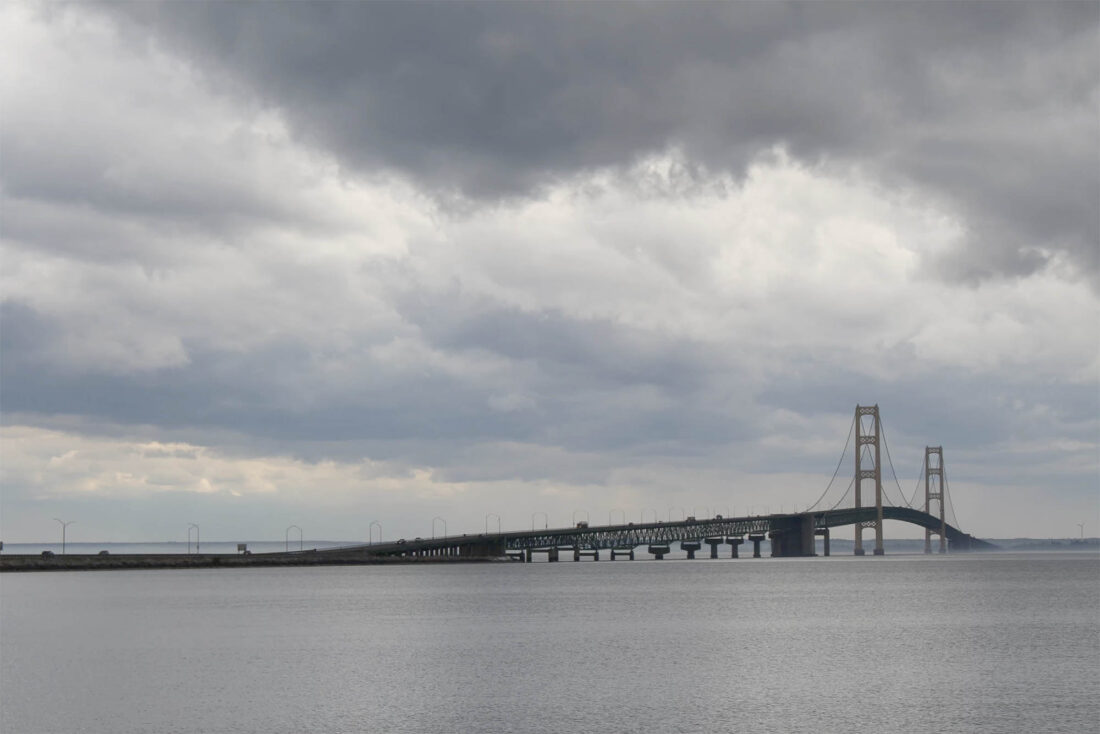
Lexi Krupp/Interlochen Public Radio Enbridge’s Line 5 splits into twin pipelines just west of the Mackinac Bridge, and crosses along the Straits of Mackinac lakebed for 4 miles, from the Upper Peninsula to the Lower Peninsula.
(This story is made possible through a partnership between Interlochen Public Radio and Grist, a nonprofit environmental media organization. This story was published by Bridge Michigan, a nonprofit and nonpartisan news organization. Visit the newsroom online: bridgemi.com.)
The company behind the controversial Line 5 tunnel project in the Straits of Mackinac released a report this month that lays out the potential geologic risks a contractor might see during construction — risks that pipeline opponents say underscore the dangers of the proposed tunnel.
Canadian pipeline company Enbridge Energy submitted its geotechnical baseline report on the project after state permitting agencies requested the document in late 2025. The report itself is from 2022. Enbridge says the report is based on data that was already available publicly.
The company wants to replace the existing dual-pipeline infrastructure in the Straits of Mackinac with a tunnel housing a new segment buried under the lakebed.
Opponents said they’re worried about potentially unsafe conditions indicated by the report, including weak bedrock, high water pressure and dangerous gases beneath the Straits.
“The report raises serious concerns about whether it is possible to safely build a tunnel in the Straits of Mackinac,” said Debbie Chizewer, managing attorney with the legal nonprofit Earthjustice, which is involved in litigation against Line 5.
Brian J. O’Mara, a geological engineer with the consultant group Agate Harbor Advisors LLC, said the report confirms his concerns around poor rock quality, suggesting much of the bedrock won’t be stable for tunneling and could lead to the construction equipment failing.
The report also contains some redacted sentences in sections related to gas conditions and the possible “squeezing” of weak rock under high pressure.
“The report is silent on the risks related to fire, explosions, floods, sinkholes, tunnel collapse and a full-bore rupture release of oil and gas liquids from the pipeline,” O’Mara wrote in an email. He had written in legal filings to permitting agencies about his concerns on the report’s baseline data as early as 2023.
O’Mara notes that he believes the report incorrectly concludes that contractors won’t encounter any gas during tunneling.
Enbridge spokesperson Ryan Duffy said in an email that the geology beneath the Straits is not known to have gas, and that “the question has been thoroughly investigated by Enbridge and independent experts responding to Michigan regulators.”
“The reality is that the new pipeline replacement at the Straits crossing is designed specifically to prevent potential risks to the Great Lakes and its communities,” Duffy said.
Duffy said the “sole purpose” of the report was to inform and negotiate business deals with construction contractors. “Any geotechnical information pertinent to permitting decisions has already been made available to the relevant permitting agencies,” he said.
The report was not included in the case filings for Enbridge’s permit for the project issued by the Michigan Public Service Commission in 2023. That agency declined further comment because an appeal of the permit sits before the Michigan Supreme Court.
Enbridge is still waiting for permits from federal and other state agencies for the proposed project.
The U.S. Army Corps of Engineers reviewed the geotechnical report when it developed the tunnel project’s environmental impact statement, said agency spokesperson Brandon Hubbard. The environmental impact statement said that vibrations from construction equipment during excavation could “cause shifts in the geology.”
A spokesperson for the Michigan Department of Environment, Great Lakes and Energy said the agency requested the geotechnical report from Enbridge in late 2025 as part of their permitting process.
“We are continuing to evaluate the application that was submitted. We will include this document, along with many others posted to the EGLE database, as part of our review,” EGLE spokesperson Scott Dean said in an email.
A decision from EGLE on the permit is expected no later than mid-July.
Front Page
Opponents raise tunnel concerns

Unleashed Potential
UPPCO prepares for April storm
MARQUETTE — The Upper Peninsula Power Company reminds customers and the public that winter weather patterns can ...
Thinking out of the box

A proud distinction