
Taking heat
Forest Service critisized for Ottawa project
Trending
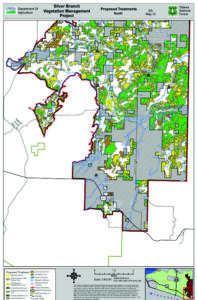
WATERSMEET -- The US Forest Service is proposing a massive project in an Upper Peninsual national forest would log land roughly the size of Detroit, expand gravel mining and build roads, according to a report in Bridge Michigan.
Referred to as the Silver Branch Vegetation Management Project, the Forest Service website says the project includes vegetation management, transportation system modifications, and recreation, fisheries and wildlife improvements on the Watersmeet and Kenton Ranger Districts, covering about 177,772 acres in portions of Iron, Baraga and Houghton counties. Approximately 25,000 acres would be clear-cut with some trees left to provide seeds and animal habitat, according to the Forest Service online planning documents. The project would continue for about 30 years.
However. the proposal is drawing criticism from several groups on several points.
On April 20, Michigan Advance reported the USFS released its draft decision for the project. However, the Environmental Law and Policy Center argues the draft decision does not properly consider its environmental impact, or possible alternatives.
"The Forest Service is clearly wrong to claim this project would not have significant impacts and should not be studied further," Kelly Thayer, the center's senior policy advocate, said in a statement. "The Silver Branch Vegetation Management Project is historically massive, proposing to log across an area of Ottawa National Forest nearly 1.5 times the size of the city of Detroit. It would clear-cut 25,000 acres and log an additional 55,000 acres of national forest lands, impacting wildlife, wilderness, mature and old-growth trees, and the outdoor recreational economy for generations to come. We intend to challenge this decision."
The Environmental Law and Policy Center submitted joint comments to the Forest Service in January, alongside other environmental organizations, Michigan Advance says. Among their concerns were the project's impact on the endangered northern long-ear bat, plans to construct new logging roads and expand two gravel pits in the project area and fears that the logging process could similarly contribute to more intense wildfires.
"Many of these effects would be alone enough to require careful consideration in an environmental impact statement," the joint comments state. "According to the Forest Service's environmental assessment, however, the Silver Branch project would somehow avoid 'significant impacts' altogether--a conclusion the assessment could only reach by arbitrarily disregarding the Service's own record and a number of legally relevant factors, including cumulative effects."
An email from the Environmental Law & Policy Center, along with several other environmental groups, was addressed to the USFS Eastern Region and USFS District Ranger Trevor Hahka, in Watersmeet.
"With the proposed Silver Branch Vegetation Management Project," the email states, "the agency is attempting to authorize an unprecedented amount of logging within the Ottawa National Forest-- logging that would transform nearly 80,000 acres of cherished public land over a thirty-year period.
The email says the USFS approach is arbitrary and unlawful. The Forest Service's persistent refusal to undertake such a review is irreconcilable with the fundamental requirements of the National Environmental Policy Act (NEPA), it says.
"The legal deficiencies of the Forest Service's planned action aren't limited to NEPA. In proposing logging on large portions of the Ottawa that have been designated as "not suitable" for timber harvest, the agency has defied the National Forest Management Act and its own regulations," the email states. "And in failing to undertake formal consultation regarding the Silver Branch project's potential impacts on the region's endangered wolves, the agency has violated the Endangered Species Act."
Steve Garske, invasive species expert and long-time resident of the western Upper Peninsula, published a guest commentary in Bridge Michigan on March 6.
"The project appears to violate the Ottawa (Forest's) own Forest Plan in a number of ways," Garske wrote. "
The Forest Plan designates lands as "suitable" for timber harvest in part based on their ability to support commercial timber harvest without "irreversible resource damage to soils, productivity, or watershed conditions", Garske commented. Lands that are not capable of sustainably producing commercial volumes of timber or that are needed for recreation or preservation of old-growth and wilderness are designated as "not suitable for timber production". Yet the Forest Service proposes to cut roughly 30,000 acres currently designated as "not suitable". This, he wrote, is in spite of the fact that the National Forest Management Act regulations clearly state that "No timber harvest for the purposes of timber production may occur on lands not suited for timber production."
Garske continued, saying the Forest Plan designates 256,000 acres as "remote habitat" for the benefit of sensitive or federally listed species including gray wolf, American marten, northern goshawk, and red-shouldered hawk. Within this area road density is not supposed to exceed 1 mile of road per square mile of National Forest land. The proposed Silver Branch project includes more than 50,000 acres of this Remote Habitat Area (RHA). Yet the draft Environmental Assessment (EA) fails to even mention the RHA. And by presenting only two alternatives for this project (the "No Action" alternative and an "Action" alternative) instead of a "reasonable range" of alternatives, the Forest Service appears to violate the National Environmental Policy Act.