
A fitting farewell
Battery D\'s last visit is this weekend
Trending
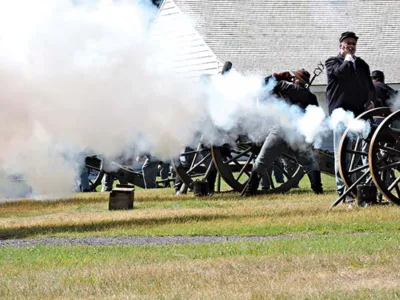
COPPER HARBOR - After 45 years years, Battery D, First Michigan Light Artillery reenactment and living history group will visit the Fort Wilkins for last time this weekend, according to DNR Michigan History Center Historian Barry James said. The battery will encamp this weekend, today, tomorrow and Sunday.
Re-creating the volunteer artillery unit organized at White Pigeon, Mich., in 1861, the group interprets army life of the period, demonstrating artillery drills, period cooking and soldiers' pastimes.
Their encampment will feature costumed interpreters, tents, a depiction of army barracks life, and full-scale artillery pieces, as well as authentically reproduced mess gear, small arms, and other period artifacts.
Demonstrations by battery member include cannon firing demonstrations, medical and undertaking procedure from the Civil War period, along with drills and skits, all drawn from military life of the period.
The three-day encampment has long been one of most popular summer events at the fort.
James said the event, which is filled with family-oriented historical demonstrations, captures the imaginations of visitors all ages.
"The echo of cannon fire rolling down the length of Lake Fanny Hooe is identical to what soldiers at Fort Wilkins once heard more than 175-years ago," he said.
The primary goal of the battery is to offer as accurate account of life in the 1860s as is possible in the 21st century.
The encampment will be open to park visitors from 8 a.m. to dusk today and Saturday and 8 a.m. to 4 p.m. Sunday.
Fort Wilkins is an integral part of the Keweenaw's rich copper heritage.
The military post was constructed under the supervision of West Point graduate Captain Robert Emmet Clary, with ordered to establish the post at Copper Harbor, which was to be named Fort Wilkins, in honor of the Secretary of War, William Wilkins.
Clary, commanding Companies A and B, Fifth United States Infantry, arrived at Copper Harbor on May 27, 1844, along with his command and a small army of civilian construction contractors. Among the first building constructed using logs from the surrounding forest were barracks and quarters to accommodate 105 officers and men. Other buildings erected that summer included, two kitchens, a bakery, a hospital, a blacksmith shop, a store house, an ice house, and a sutler's store.
The post was abandoned two years later, then re-garrisoned by federal infantry from 1867 to 1870.
Today it remains a well-preserved example of a mid-1800s fort, including officers' quarters, soldiers' barracks, married enlisted men's quarters, hospital, workshops, powder magazine, and guardhouse. The grounds include the 1844 Pittsburgh and Boston Mining Company mine sites, the first shafts sunk in the copper region.
Fort Wilkins is a nationally accredited museum administered by the Michigan History Center, an agency within the Department of Natural Resources. Listed on the National Register of Historic Places, the outdoor museum is open daily from 8 a.m. until dusk through mid-October. Admission is by state park passport permit. A fee is charged for the lighthouse boat tour.