
Among worst in the world
Delta County air at \'rare and dangerous levels\'
Trending
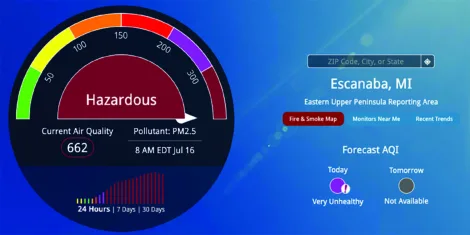
ESCANABA — As of Thursday morning, particle pollution in Delta County areas has a "hazardous" Air Quality Index (AQI) of 662 due to smoke from the raging Canadian wildfires.
An AQI of 662 is extremely rare and signals a dangerous health emergency. Any reading above 301 is considered "hazardous," and an AQI of 662 is six times the AQI level officially considered healthy. AQI values at or below 100 are generally thought of as satisfactory.
An AQI rating of hazardous means everyone should stay indoors and reduce activity levels, according to AirNow.
In comparison, Detroit had an AQI of 518 as of Thursday morning, earning it the No. 1 spot on IQAir's ranking of the most polluted global major cities on Thursday. IQAir is a Swiss air quality technology company.
However, IQAir's list does not account for the AQIs in the Upper Peninsula and Delta County, which rank far worse than Detroit.
Toronto, Canada, earned the No. 2 spot of the IQAir list, with an AQI of 400. Dehli, India, a city subject to a high level of pollution year-round, currently ranks at No. 6 on the IQAir list.
The AQI, established by the U.S. Environmental Protection Agency (EPA), uses a scale from 0 to 301, with air qualities ranked at different tiers. The EPA, in collaboration with other government and private agencies, offers a zip code-level tracking map of current air quality at airnow.gov.
Since levels rarely exceed a value of 200 in the United States, in most cases, the scale only shows the range from 0 to 301.
The Michigan Department of Environment, Great Lakes and Energy (EGLE) issued a statewide air quality alert at midnight Tuesday as thick smoke from ongoing Canadian wildfires elevated fine particulate matter (PM2.5).
The EPA establishes an AQI for five major air pollutants regulated by the Clean Air Act. Each of these pollutants has a national air quality standard set by EPA to protect public health:
• Ground-level ozone
• Particle pollution (also known as particulate matter, including PM2.5 and PM10). This is what is affecting much of the Midwest and Northeast currently.
• Carbon monoxide
• Sulfur dioxide
• Nitrogen dioxide