
Retiring the worn
U.S. flag disposals surge during 250th
Trending
HANCOCK - Flag disposal rates have surged during the Nation’s 250th anniversary. Driven by nationwide “America 250” campaigns, millions of citizens replaced worn flags. This massive turnover resulted in record-breaking retirement ceremonies, including a new world record event in Monroe, Ohio, where 17,169 flags were retired simultaneously.
On July 5, Journal News reported the Old Glory Retirement Foundation held an American flag retirement ceremony celebrating America’s 250th anniversary Saturday, July 4, 2026 at Horsepower Farm in Monroe. The “Ashes of Freedom” event was created with the goal of setting a world record of retiring the most flags at one time and they achieved their goal with 17,169 worn-out flags.
Rules on how to properly fly the flag were established in June 1923, when the National Flag Conference met in Washington, says the U.S. War Department. Its members created the Flag Code, which states that “the flag represents a living country and is itself considered a living thing.”
According to the U.S. Flag Code, disposing of an American flag is a sensitive, yet necessary, action that must be taken if a flag is damaged or weather-beaten.
The US Flag Code states the flag, when it is in such condition that it is no longer a fitting emblem for display, should be destroyed in a dignified way, preferably by burning.
The American Legion passed a resolution about flag retirement ceremonies in 1937, and they’ve been an important ritual ever since. According to the resolution, “The approved method of disposing of unserviceable flags has long been that they be destroyed by burning.”
Every year on June 14, Americans celebrate Flag Day. Not surprisingly, it’s considered the most appropriate day to hold flag disposal ceremonies, which are often held at night.
The American Legion states on its webpage: The Flag Code suggests that when a flag has served its useful purpose, "it should be destroyed, preferably by burning." For individual citizens, this should be done discreetly so the act of destruction is not perceived as a protest or desecration. Many American Legion posts conduct disposal of unserviceable flag ceremonies on June 14, Flag Day. Such ceremonies are particularly dignified and solemn occasions for the retirement of unserviceable flags.
Colonial Flag (colonialflag.org) provides a list of examples of when it it time to retire or replace a flag.
• Fraying along the fly end (the edge farthest from the pole);
• Tears appear in the flag;
• Fading that changes the the looks of the colors;
• Stains that cannot be removed;
• Hardware damage (grommets pull out, torn headers, attachment point fail).
"A flag doesn't have to be ,falling apart, to be past its best," the website states. "For America 250 celebrations, the goal is a flag that looks respectful and presentable from the sidewalk, the parking lot, and the camera lens."
Some flags can be repaired and returned to service, especially for everyday use. For America 250, the standard is higher because the display is often the centerpiece of a ceremony.
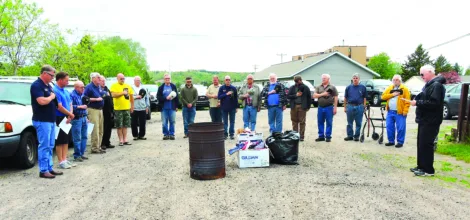
Scott Wagner, commander of American Legion Alfred Erickson Post, in Hancock, said his post conducts a Flag Retirement Ceremony at its West Hancock building. "We have a really nice area for our disposal ceremonies," he said.
The post conducts respectful ceremonies, he said, which consists of burning collected flags in a barrel on the post's property.
Like many veterans posts in the area, Post 186 has a flag drop off box just outside the main doors of its building. The post receives flags from the public as a community service, particularly for people who do not a barrel or other means of burning a worn flag.
"What we really worry about is having the flag hitting the ground," Wagner said. "You can fold it up to put it away, but never let the flag hit the ground."