
Lightning strikes!
Cause of Black River Fire determined
Trending
HOUGHTON -- As fire suppression and containment efforts continue within the Rugged Terrain Complex wildfires in the Upper Peninsula, the Michigan Department of Natural Resources (DNR) has confirmed that a lightning strike was the cause of the Black River Fire.
This determination matches the confirmed cause of the neighboring Craig Lake Fire, while the cause of the Ridge Fire remains under investigation, according to a Sunday evening update from the agency.
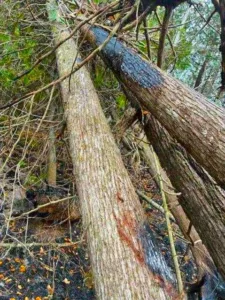
DNR trained wildland fire investigators determined lightning as the cause by cross-referencing recent regional weather data with historical lightning strike maps. Field teams then verified the data on the ground by analyzing specific burn angles and charring patterns high up on tree trunks. As containment of the fire progresses and conditions become safer, investigators use site-specific observations to trace burn patterns back to the origin of the fire, where they can better isolate indicators of cause.
"The way an individual leaf curls or 'freezes' in the heat, the direction the grass stems fall, or the angle of char on tree trunks can lead us back to where the fire started," said Deputy Incident Commander Jennifer Hansen. "We study these details to help determine the cause."
In the Black River Fire, now 70 percent contained, it was the charring pattern on a group of cedar trees, validated by lightning strike mapping, that led investigators to confirm the strike. Lightning was also the cause of the Craig Lake Fire, which has advanced to 90 percent containment. The Ridge Fire cause remains under investigation while crews diligently gain on containment, with recent weekend work increasing containment to 50 percent on the 466-acre footprint.
Containment refers to the status of a wildfire suppression action. It indicates that a control line has been created around a fire -- and any associated fire spots -- that are intended to stop the fire from spreading. Containment can be created by natural features on the landscape like wetlands or rivers, or existing infrastructure including roads or power line clearings. Where those do not exist, firefighters work to establish containment lines using bulldozers and plows, or hand tools in locations too difficult for heavy equipment to access.
The DNR noted that while recent regional rainfall successfully checked active surface flames and halted further environmental spread, crews are spending Monday focusing on equipment maintenance and patrolling perimeter lines. The blazes continue to burn up to two feet deep within the organic forest duff layer, consuming subterranean root structures and causing live green trees to fall without warning.
On Sunday, the DNR provided additional details pertaining to the three complex zones on its social media page, indicating significant breakthroughs across the peninsula. At the Craig Lake site in Baraga County, the DNR has temporarily closed the park north of Craig Lake proper, the Teddy Lake Yurt, and the local segment of the North Country Trail through October 31 to ensure public safety. The remainder of Craig Lake State Park remains fully open to visitors.
Near Marquette, the 466-acre Ridge Fire is located 10 miles northwest of the city, north of the Dead River Basin and west of County Road 510. A "Ready" status continues for residents along North Basin Drive according to the regional "Ready, Set, Go!" safety protocol, and citizens are encouraged to remain prepared in case conditions change. The neighboring Noquemanon Trail system west of the trailhead on County Road 510 remains closed to the public.
For the 350-acre Black River Fire located four miles south of Wakefield, officials are reminding the public to continue avoiding the area to protect emergency safety and to avoid interfering with ongoing active bulldozer and mop-up operations.fd