
Fixing foster care
State has spent $40M, while abuse increases
Trending
Editor’s note: This story was originally published by Bridge Michigan, a nonprofit and nonpartisan news organization. Visit the newsroom online: bridgemi.com.
LANSING -- After 18 years and at least $40 million spent on the court-monitored overhaul of Michigan's child welfare system, abuse and neglect are on the rise in state foster care.
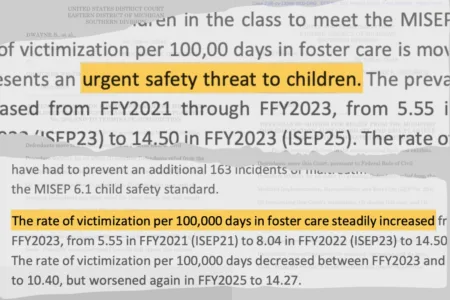
That "represents an urgent safety threat to children," federal court monitors wrote in a recent report, the latest development in the long-running saga.
The warning came as the Whitmer administration seeks to end the oversight, arguing the more than $2 million a year it is spending on those federal monitors would "be far better spent on children and families in Michigan."
The work to reform Michigan's child welfare system began two decades ago, with a 2006 class action lawsuit claiming the system "inflicts numerous harms" on the children it is responsible for protecting.
Those reported harms included maltreatment and neglect for children in foster care, a lack of "basic" healthcare, excessive lengths of stay in the system and frequent changes in their primary caregivers once the state got involved.
Rather than defend itself, the state settled the suit in 2008, agreeing to give federal monitors extensive authority to oversee mandated improvements.
Two administrations and several state health directors later, Michigan has failed to meet 19 of 24 performance measures and is "moving in the wrong direction" when it comes to preventing abuse and neglect of children in state care, federal monitors wrote in their July report.
About 9,200 children were in state care last year, and the monitors cited 447 substantiated abuse or neglect incidents in their July report -- 163 more than the minimum standard. They also reviewed a random sample of 150 state abuse and neglect investigations and found that a third "were not undertaken adequately."
Despite struggles to meet the federal benchmarks, most Michigan children in foster care are safe, according to an expert the state hired as part of the case. Though "initially beneficial," the consent decree governing the foster care program "has become archaic" and is "premised in outdated theories of child welfare," Assistant Attorney General Neil Giovanatti wrote in a June filing.
The state's request to end the federal oversight should "absolutely not" be granted, said state Sen. Jim Runestad, who organized a foster care reform rally at the Michigan Capitol last spring. "The state of Michigan never takes this seriously," he said. "There's always failures in every single audit report I've seen. Colossal failures."
Runestad, a White Lake Republican who also chairs the state Republican Party, said public safety should be the number one priority for governments, and protecting children is the "number one of the number one."
Under the terms of the 2008 consent decree, Michigan is paying for the federal monitors who are tasked with overseeing improvements to the state's child welfare system. Costs connected to the lawsuit and monitoring have exceeded $40 million, according to the state.
In 2025 alone, the state spent about $2.7 million on monitors. But as it seeks to end the federal oversight, Michigan argues it could better serve children and families by using that money to hire an estimated 18 additional "CPS investigators, foster care case managers, or other staff."
Staff shortages were among the initial problems detailed in the 2006 litigation, and the consent decree set specific caseloads standards, which required the state to add staff.
National standards at the time called for one caseworker for every 10 to 15 children in the system. But Michigan caseworkers were sometimes managing 25 to 40 children each, according to the 2006 lawsuit.
Despite adding staff, the state struggled with high turnover rates and inexperience, said Sarah Font, who was hired as a Michigan child welfare worker in 2008 and is now a researcher at Washington University in St. Louis.
During her 2 ½ years with the state, Font said she had three different supervisors, and after just six months on the job, she had new employees shadowing her. Most of her eight-week training was spent on learning the internal data system and applicable laws, and not much time on the investigative process, Font said.
"Parents just don't admit to whatever the allegations are," she said. "You need really strong investigation and observational skills to know what's going on."
The confrontational nature is present in well-run systems, she said, so CPS investigators have to be comfortable walking into someone's home where they're not wanted and facing hostility. Font said it's not uncommon for reviews of child fatalities to show that an investigator was timid or had limited access to the child.
"And that's where, I think, really serious risks or safety issues get missed or unaddressed," Font said.
Child welfare systems are "probably the most difficult public service to operate," said Jill Berrick, a University of California, Berkeley expert who added that a CPS investigator is trying to make the best estimate about a child's safety under difficult circumstances.
"It's a system of scarcity," she said. "There's scarcity of time. There's a scarcity of money. There's a scarcity of great community members stepping forward to be a part of kids' lives."
Michigan's rate of child victimization per day in foster care has exceeded the federal benchmark for abuse and neglect in each of the past three years. But in general, "children in foster care are safe" despite those metrics, Joseph Ryan, a University of Michigan professor, said in his expert report submitted as part of the state's request to end the federal monitoring.
While there were 447 substantiated instances of abuse and neglect in Michigan over the prior year, children were in the foster care system for a collective 3.1 million days. "This translates into one (instance) for approximately every 7,000 days of foster care," Ryan wrote.