Time change affects the body
What Happens when DST starts?
Metro Creative
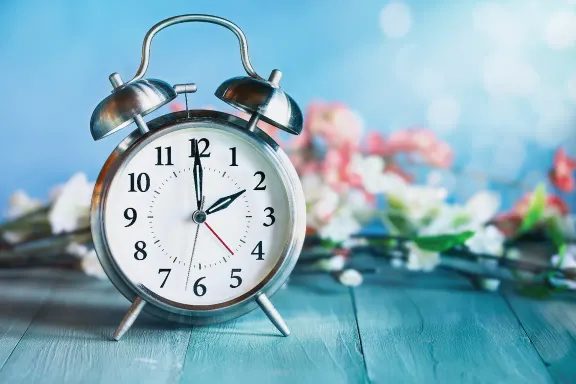
The nation sprang forward over the weekend into Daylight Saving Time (DST), which each year begins on the second Sunday in March. Setting the clock ahead by an hour might not seem like a big deal–but in reality, even this subtle change can take a toll on your body and mind.
According to Health.com, the time change puts your internal clock — which tells you when it’s time to do certain things and is usually aligned with the rising and setting of the sun — in conflict with the clock on the wall. Dr. Sabra Abbott, an associate professor of neurology at the Northwestern University Feinberg School of Medicine said, “You’re dealing with this arbitrary clock that’s telling you it’s a different time than what your body thinks it is.”
That mismatch can have ripple effects on your body and health. Here’s what to expect as Daylight Saving Time is here.
• You’ll Likely Feel Tired. This one is fairly obvious: Setting the clock forward, and thus losing an hour of sleep, may make you feel sleepier than usual the next day. Even if you often change your sleep and wake times depending on your schedule, you may feel extra out of sorts when DST starts, said Jamie Zeitzer, PhD, co-director of the Stanford Medicine Center for Sleep and Circadian Sciences. “Being told to do it makes it less comfortable, as opposed to doing it because you went out last night,” he said. “There’s definitely a psychological component to that.”
• But Maybe Not at Your Usual Bedtime. Fatigue isn’t only an issue on the morning after the time change. “During that first week, everybody ends up somewhat sleep-deprived,” Abbott said. The mismatch between internal and external clocks can have a longer-lasting effect on sleep than simply losing an hour on the night of the time change, she explained. “When you’re trying to go to bed at night, your body is just not quite ready to fall asleep at the clock time that it would fall asleep during standard time,” she said. “It also is not really ready to wake up at the clock time that you would normally wake up during standard time.”
• Attention and Focus May Suffer. Sleep deprivation may lead to difficulties with concentration and focus — one explanation for the often-cited statistic that car crashes are more common than usual on the Monday after DST starts.
• You May Be in a Bad Mood. Your mood may be another casualty of DST-related sleep deprivation. “With that extra hour of sleep loss, people are going to be a little more irascible, a little more depressed,” Zeitzer said. Scientists don’t know exactly why sleep loss has a negative effect on mood, Zeitzer said, but it’s a finding that shows up time and time again in studies.3 “There’s a strong correlation between [sleep loss] and depressive mood,” he said.
• Your Appetite and Cravings Might Change. Sleep deprivation may cause you to feel hungrier and crave sugary or high-fat foods more than usual, studies have found. “Even an hour loss on a single night”–such as at the start of DST–“changes the kinds of foods you’re attracted to,” Zeitzer said. Your body is essentially trying to take in extra energy and fuel to account for the poor rest, he said.
On top of that, you may be hungry at weird times because your body is out of whack. “You’re not going to be hungry at the right time. You’re not going to feel energized at the right time. All of these things are going to be off for you,” Zeitzer said.
Morning light exposure is, in general, your friend, Abbott added. Particularly when DST first starts, mornings may be very dark. Using a light therapy lamp, like those marketed for seasonal affective disorder, may help put some spring in your step.