‘It’s a safe space’
Mobile midwifery clinics meet patients where they are
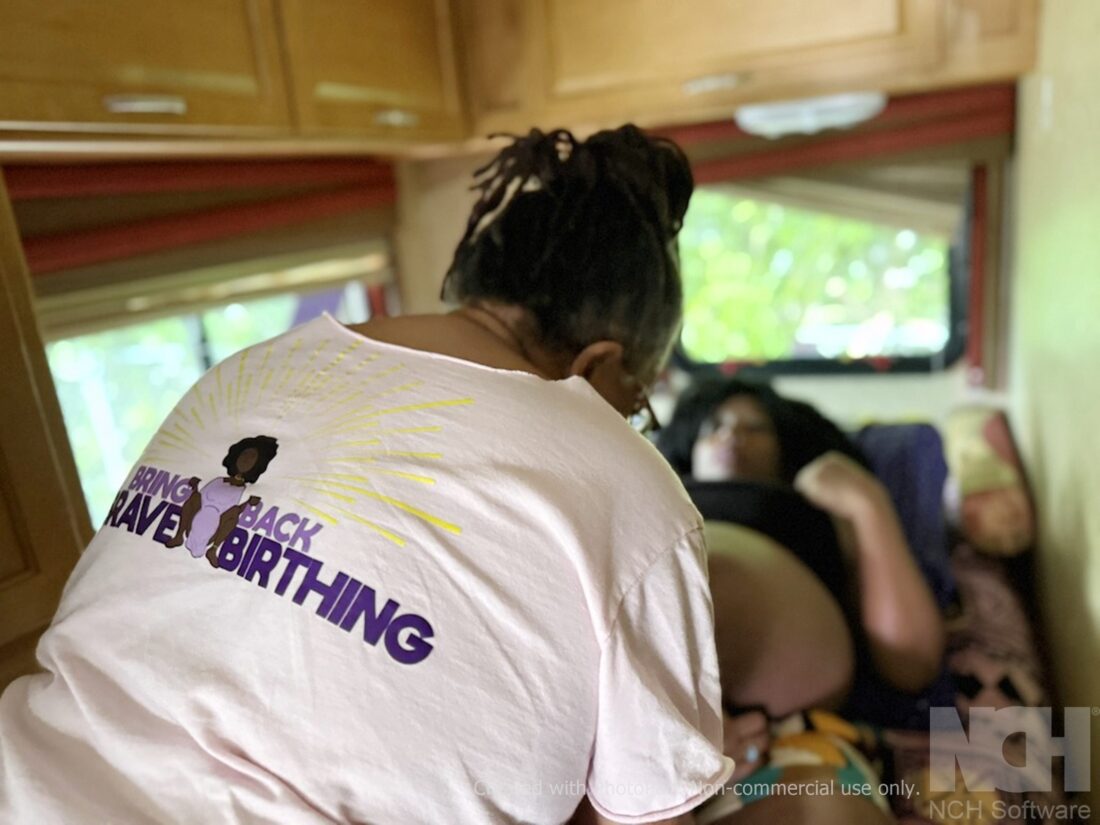
Photo by Nada Hassanein/Stateline Midwife Sheila Simms Watson treats Isis Daaga during a pregnancy checkup at the Southern Birth Justice Network’s mobile midwifery clinic in Miami on March 21.
MIAMI — Midwife Sheila Simms Watson leaned to gently press on the pregnant woman’s belly. Me’Asia Taylor lay on a bed fitted with tie-dyed purple printed sheets in the corner of the RV.
Far from a typical camper, this RV houses a mobile midwifery clinic for prenatal, postpartum and women’s general health care.
“Roll when you’re getting up, and we can help you. You can sit there for a moment, all right, so you’re not lightheaded, not dizzy,” said Watson, whom patients and doulas call “Mama Sheila.”
Run by the Southern Birth Justice Network, the mobile midwifery clinic brings care to majority-Black and Latino neighborhoods across Miami-Dade County several times a month. The clinic aims to offer a more relaxed setting, where women are comfortable and heard, their cultures are integrated, and they can connect with doulas from diverse backgrounds.
On the half-moon bench inside the RV, Watson, a doula and a midwife in training sit with patients. They take blood pressures and draw blood. They ask the women about their lives: How is their mental health and sleep? Do they have support at home? Do they want to give birth at a hospital or birth center with a midwife?
Taylor said pre-eclampsia, a dangerous pregnancy condition, runs in her family. She wanted to make sure she had space and time to express her concerns about her first pregnancy.
Taylor said she wants a midwife for her delivery. Many women of color have reported feeling marginalized or dismissed in medical settings. “I’ve just seen too many people have bad experiences,” Taylor told Watson.
The U.S. has markedly higher maternal mortality and infant mortality rates compared with other high-income countries, and women and babies of color fare the worst. Black women’s maternal death rates are three times higher than those of white women, and American Indian and Alaska Native women’s rates are twice that of white women. Researchers point to implicit bias, less regular access to prenatal care and higher rates of poverty.
OB-GYN shortages and labor and delivery units closing continue to make getting care harder. Last year, more than two dozen hospital labor and delivery units across the nation closed, including some in South Florida. And pregnant patients living miles away, or feeling uneasy about going to the doctor, may even forgo care.
Midwives can help fill gaps, maternal health equity advocates say, and mobile clinics can meet patients where they are.
“It really helps to disrupt this idea that patients must navigate these complex systems to receive care — and instead, (mobile midwifery) reimagines care as something that should be responsive to the needs of patients and should be community-centered,” said Tufts University professor and maternal health scholar Ndidiamaka Amutah-Onukagha.
But mobile units are not as common for midwifery as they are for other areas of care, such as dentistry or family medicine, the American College of Nurse-Midwives told Stateline. Other prenatal mobile outreach efforts in the state include an OB-GYN-run mobile unit by the University of Florida that serves areas around north-central Alachua County and an operation called The Midwife Bus in Central Florida.
To increase access to care, maternal health advocates are also pushing states to change regulations that restrict midwifery. The American College of Nurse-Midwives recently filed a lawsuit against Mississippi for requiring nurse-midwives to have agreements with physicians in order to practice. This week, Jamarah Amani, a midwife and the executive director of the Southern Birth Justice Network, joined other plaintiffs in filing a lawsuit against Georgia over its restrictions. But supporters of the rules say they are meant to protect patients and foster communication between clinicians.
Offering culturally centered prenatal care that women are more inclined to use can help address inequities in maternal health, Amani said. The group trains doulas, offers telehealth, provides referrals such as to mental health therapists, and advocates for equitable policies across the South.
Most of the mobile clinic’s clients — about 70% — are on Medicaid or uninsured, and the clinic is funded through federal and university grants, as well as donations.
“(Midwifery) presents like a luxury concierge-type of service,” Amani said. “Our goal is to really change that and to bring it back to the community in a very grassroots way.”
Preserving tradition
The Southern Birth Justice Network keeps a small drum on a table at a nearby booth. It represents the heartbeat, and ancestral reverence, Amani said. Drums are a universal language, and the instrument is meant to symbolize culture.
For doulas and many midwives like Amani and Watson, bringing their profession to communities today is the continuation of a significant part of Black American heritage.
Health

MDHHS recommends vaccinate early
‘It’s a safe space’
Contract ratified at Aspirus Iron River
IRON RIVER – Employees at Aspirus Iron River have reportedly reached a new contract agreement. A statement ...

Scholarships available
Overestimating microplastics