Seeking a fair valuation
Houghton outlines potential impact of Walmart tax appeal
Garrett Neese/Daily Mining Gazette
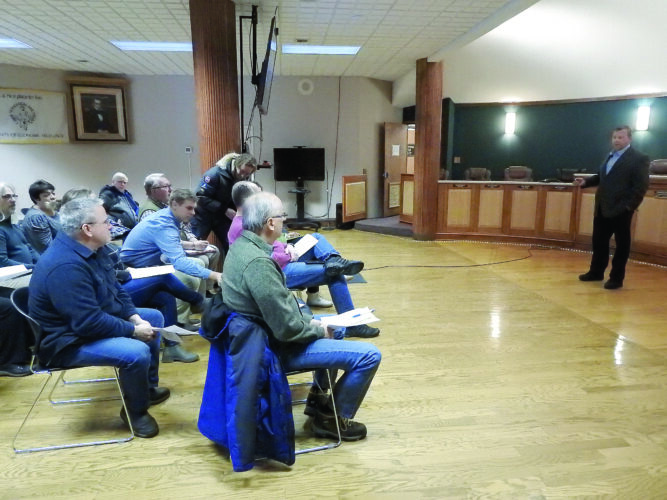
Houghton City Manager Eric Waara addresses an audience including representatives from the city, county and local schools about the potential ramifications of reduced property tax revenue from Walmart on Razorback Drive Thursday.

Garrett Neese/Daily Mining Gazette
Houghton City Manager Eric Waara addresses an audience including representatives from the city, county and local schools about the potential ramifications of reduced property tax revenue from Walmart on Razorback Drive Thursday.
HOUGHTON — Walmart’s effort to lower the valuation of its Houghton store could have dire ramifications for Houghton and other government entities that receive the funds, Houghton City Manager Eric Waara and other local leaders said at a press conference Thursday.
A Michigan Tax Tribunal case would reduce Walmart’s property taxes by about 60%, while also giving them a refund of $1.2 million from six years of back taxes.
“This means something to every organization that receives those taxes, those millages for the library, for the CCISD (Copper Country Intermediate School District), for the schools, for Canal View,” Waara said. “Those all will suffer from that — not only with payback, but then if they get that reduction in value, that’s going to knock X dollars off of everyone’s bottom line going forward.”
Waara and the city’s tax attorney, Tom Dillon, walked the crowd through the history of the city’s development agreement with Walmart, the ongoing tax battle, and the legal theory behind it.
The city has been engaged in a tax dispute with Walmart since 2018, when it first sought a reduction from the previously-agreed-on valuation of $4,678,700.
Walmart is seeking to have the store devalued under the “dark store” theory, in which the building’s value is based on comparing them to the value of vacant buildings.
After 2018’s Father’s Day Flood, Walmart agreed to put the matter on hold; another abeyance came due to COVID.
A five-day Michigan Tax Tribunal hearing is set to begin June 5. If the state tax tribunal rules in favor of Walmart, the company’s annual property tax would drop to close to the value of the store before it expanded to a Supercenter in 2005, Waara said.
“It’s not about them being overtaxed,” Waara said. “This is about them paying their fair share, to support this community that has supported them so well over the last 30 years.”
In addition to the Michigan Tax Tribunal action, the city is suing Walmart in federal court for breach of its development agreement.
Walmart had agreed on the previous valuation in 2005, as part of a development agreement with the city when the building became a Supercenter, Waara said.
The city donated land for the expansion. It also helped Walmart with wetland mitigation, including a conservation easement for the Huron Dam. The city has spent about $300,000 for work, such as state-required water quality monitoring of Huron Creek, which runs through the wetlands, Waara said.
In exchange for the city services, Walmart agreed to pay about double the previous amount of property tax. That agreement had no expiration date, Waara and Dillon said.
There are numerous other “dark store” suits in Michigan and elsewhere. But Houghton’s is the only case Dillon knew of where a company had violated a written agreement on property taxes.
“That development agreement was a contract,” Waara said. “And now they want to pretend that that contract doesn’t exist. And so we’re countersuing them that on the basis of that contract, for them to honor that contract.”
The dark store theory has been around since the 1970s, but became more widely used in the 2000s as big-box stores started going bankrupt, Dillon said. Typically, Michigan big-box stores who have gone through the Michigan Tax Tribunal have reached settlement offers of about $40 per square foot, Dillon said. By contrast, Walmart’s offer is around $20.
“As this case has progressed, their proposals have actually dropped over time,” he said.
In neighboring states, those settlement numbers have been even higher, nearing $80 per square foot in Wisconsin, Dillon said.
Wisconsin’s higher value reflects a different approach to valuation, Dillon said. A recent state Supreme Court decision against Lowe’s analyzed value through the standard of what it would cost them to construct a new building.
“In fact, no other state in the United States has a lower per square foot value than what we’ve seen happening in Michigan,” he said. “And so I think the question that we’re asking is, why? Why should Michigan be any different?”
In a statement Thursday, Walmart said it believed its request to the Tax Tribunal was fair.
“Walmart is committed to the Houghton community, and it is home to many of our associates and customers,” the company said in a statement Thursday. “Walmart is a responsible taxpayer, and like any property owner, we believe our property should be valued just like everyone else’s. When we get a property tax bill, it should reflect the value of the land, brick, and mortar rather than the value of our business operations.”
If Walmart’s request is granted, it would take away from services to the county’s veterans, said Joseph Battisfore, director of the Houghton County Veterans Affairs office. But it would also mean less money for services they and other county residents rely on, from road paving to fire protection, he said.
“As veterans, we’ve paid into the system,” he said. “All of our veterans have paid the price — some their lives and others their health — to pay into this system for others’ sake, and when Walmarts and big box stores are doing this kind of thing, they’re trying to actually not pay their fair share. They’re not trying to be part of a community, they’re trying to actually take money out of people’s hands.”
Houghton-Portage Township Schools Superintendent Anders Hill said the impact of the reduced funding would be felt across the board in the district.
“We maximize what we get and we would lose money, which would mean we would do less for kids,” he said.
Waara said the city had spent about $150,000 in legal fees so far, with more to come. The city is forming a task force to prepare for reductions and to increase public awareness, which will include school administrators, the library and other groups that stand to lose if the lower valuation goes through.
“It would be certainly nice if we weren’t fighting this fight alone, but right now, it’s ours to fight,” he said. “So hopefully, we’ll get some people to join us, too.”