
Brainstorming sessions
Hancock residents make master plan suggestions
Trending
Garrett Neese/Daily Mining Gazette
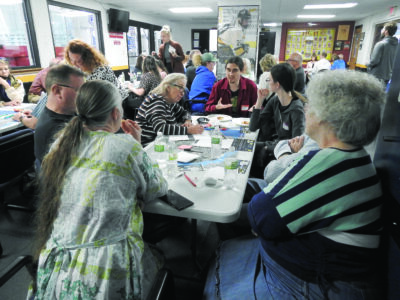
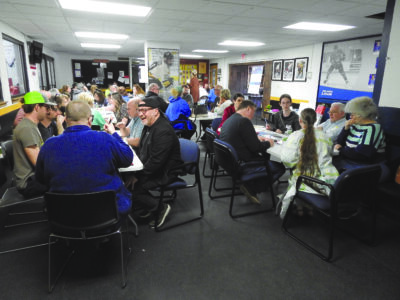
Hancock residents discuss their ideas for the city at the second of two master plan launch parties held by the city to generate input for its five-year master plan update.
Garrett Neese/Daily Mining Gazette
Hancock residents discuss their ideas for the city at the second of two master plan launch parties held by the city to generate input for its five-year master plan update.
HANCOCK -- Hancock residents came up with ideas for the city's future at two master plan public sessions held this week.
Each of the sessions, held Wednesday and Thursday, drew about 40 people. The city is looking for public feedback as it prepares for the update of its five-year master plan, which is hoped to be finalized this fall.
Representatives from the Grand Rapids-based planning firm Progressive AE led each session.
The meetings were divided into two sections. Groups came up with strengths, weaknesses, opportunities and challenges for the city. They then followed that by marking spots on a city map that could be good sites for development.
"The responses from both nights have been a little bit different for each group, which has been really exciting, to get a well-rounded perspective of how they see the community and what they have," said Suzanne Schulz, urban planning practice leader at Progressive AE.
At Thursday's session at the Houghton County Arena, multiple people suggested improving public transit within the city, or combining with neighboring systems to form a regional authority.
Carly Wickstrom, a member of Michigan Technological University's graduate student government, brought up a pilot program where a 15-person van carries students, faculty and staff on a half-hour loop from Hancock to campus.
Ridership had been around 75% capacity for the loops, done three times a day, she said.
"My big idea would be to do that, make it even larger for the public," she said.
The closure of Finlandia University, and the sale of its property, also represented a turning point for the city.
Residents wanted clarity on what would happen to the Jutila Center and the businesses operating out of there. They also saw an opportunity to address the area's need for affordable housing.
"Finlandia Hall has all those rooms, a cafeteria -- it could be ready quickly for a retirement community," said one resident.
People also sought more recreational opportunities, both along the waterfront and in town. Faith Morrison suggested making the city more amenable to four-season biking by building additional trails; many of the existing trails become snowmobile-only in winter. Another resident pointed out the lack of socialization opportunities for single people in the city.
Groups also looked for ways to improve traffic. One proposal included making Quincy Street more pedestrian friendly by moving U.S. 41 to Hancock Street and making it two-way. In one of the night's biggest applause lines, someone suggested adding a stoplight at Gino's, at the intersection of M-203 and U.S. 41.
"I don't know if a stoplight, but at least something like a merge lane, because you can get stuck at that intersection for a long time in the morning," another resident said.
The discussion also captured tradeoffs in maintaining a small-town feel versus bringing in the capital that could lead to more improvements.
One group suggested recruiting Silicon Valley technology firms that were becoming disenchanted by California. Another person worried too much change could turn the city to one like in California or a larger urban area.
"I live in Hancock because I don't like to live in a big city," she said.
"They need the money, so you've got to give a little bit," another resident said.
Schulz compared the firm's role to trying to calibrate a soundboard tuner. The goal is to find a balance between sustainable economic development while also maintaining Hancock's quality of life, she said.
"That's what we're going to try to do with the plan, so that's it's meeting those needs but not getting out of whack one direction or another," she said.
Residents said they were happy with the event.
David Freeze had learned about the event from his wife. He was glad he came, he said.
A daily walker, he'd like to see the city add more boardwalks along the waterfront. He wants to see more parks for the kids where his great-grandchildren can play.
He would also like to see improvements to downtown parking.
"I think it discourages some people because they can't find a place to park, so they say 'Forget it,' go somewhere else, across to Houghton and Walmart," he said.
In addition to hosting the sessions, members of Progressive AE also toured the town.
It's a beautiful area, Schulz said. But the hilly topography and speed of traffic through downtown can also pose problems.
Making sure people feel comfortable walking and shopping can also spur more retail opportunities and investments, she said.
"So what we do is we look both at the public side and the private side," she said. "So what happens in our parks or right of way, or on our waterfront? And what happens on those private development parcels and the investment decisions that are made, and how do we put those things to work together so we can get the change we want to see, where we want it, and how it works?"
Progressive AE will collapse the results from Wednesday and Thursday's sessions into common themes.
The weaknesses and challenges will help them identify the issues that need solving. The strengths and opportunities will help them describe the vision for the city.
"We will have a vision statement and goals that will be reinforced," she said. "Then what we'll be doing is coming back to the community and asking if we got it right ... then we'll develop an action plan on how to get there."