
Trending
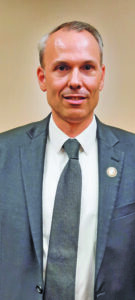
HOUGHTON -- The U.S. attorney serving the Western District of Michigan visited Houghton Friday as part of an Upper Peninsula tour.
Mark Totten has been attorney for the Western District since May 2022. The district includes the U.P. and the western half of the Lower Peninsula.
Friday, he said his office wants not just to focus on the larger population centers downstate, but also on the U.P.
The district includes 11 of the 12 federally recognized Native American tribes in Michigan. He had an annual government-to-government meeting in northern Michigan last week. Next week, he will meet individually with five tribes.
"In between my meeting on Tuesday, and then starting next Monday, I wanted to use that time to try to move throughout northern Lower Michigan, and through at least part of the U.P.," he said. "I like to pretty regularly try to sit down with prosecutors, law enforcement officers ... talk a little bit about their work areas where we overlap, how to build those relationships, and then have these kinds of conversations as well."
On Thursday, he visited with a non-law enforcement partner, the Delta Regional Children's Advocacy Center, which works on child abuse and sexual assault cases.
One of his biggest priorities in office has been combating narcotics. Federal laws largely overlap state laws, in terms of the criminal activity they're reaching, Totten said.
"We are trying to use the limited resources that we have with significantly more severe punishments than the state system has, to try to dismantle large regions-level supply lines that are bringing drugs into the district," he said.
Sentencing just wrapped up on the last case in a 10-person indictment that began when Detroit-area dealers realized they could make a premium selling drugs to the U.P. They built a network that extended to a couple of the tribal reservations, and included meth, fentanyl and other drugs, Totten said.
"Although the quantities were a bit less than what we typically do, and we do have some quantity thresholds that we look at just to make sure we're focused on the bigger cases, we also realize that we're not actually going to see those larger quantities in the Upper Peninsula, in some of our more rural areas," he said. "So we have some flexibility, and we want to be able to have a significant presence up here."
Another focus is protecting children from child exploitation. That includes both child pornography and sextortion, where scammers connect with younger people to solicit compromising images they then try to use as leverage for either more images or money.
The most high-profile case came recently with Jordan DeMay, a Marquette teen who died by suicide after becoming the target of extortion. A group of Nigerians have been charged in the case.
Totten is seeking to have the suspects extradited. In a release sent after Friday's interview, he said he would be making an announcement regarding the case Sunday afternoon.
"It used to be that we would worry about people who might do harm to a child that were proximate, that were near a child, and now the threats can be literally anywhere in the world," he said. "One of the things that we're hoping comes out of this case involving Jordan DeMay is that we send a very strong message that we will go after criminals, wherever they are, when they do those types of things to our kids."
Totten wants to get the message out to young people not to assume people online are who they say they are, and not to send compromising images. In the event they do, there are still people willing to help out, he said. He suggested people call 1-800-CALL-FBI.
"It will very quickly get to the right people, and they investigate everything," he said.
The U.S. attorney's office is also prosecuting national security and domestic violent extremism. One case being prosecuted concerns a man in Pickford who was allegedly threatening a shooting in a synagogue. Locally, a suspect was recently arrested for allegedly defacing Temple Jacob in Hancock with anti-Semitic graffiti.
"We want to do everything that we can especially to protect vulnerable populations that might be the victim of either hate crimes or some type of a threat or malicious activity," he said.
Totten's office is also placing an emphasis on combating violent crime, though those issues don't occur as much in the U.P., he said.
Meeting with local law enforcement officials lets Totten hear about the particular challenges in that area.
Narcotics has been the prime topic of discussion. Meth is still dominating the landscape in the U.P., while fentanyl is more dominant downstate -- both as a standalone substance and being cut into other drugs.
Past patterns indicate it's an emerging threat that "will get worse before it gets better" in the U.P., Totten said.
Cartels have been producing counterfeit pills purported to be Xanax or other medications which are instead laced with high-quality Fentanyl, he said.
"We see people even dying, who maybe are just trying out a drug for the first time," he said. "They don't even know what they're taking, and it hasn't necessarily been that way in the past."
Sextortion has been another frequent topic. Even in cases that the FBI can't get to, they can still be a resource to local law enforcement in training or advice, Totten said.
"We want to be a resource that way in terms of training, in terms of these complex issues that local law enforcement may not encounter that often where maybe FBI has some specialization," he said.
The office also has a renewed focus on civil rights, Totten said. That includes not just hate crimes, but civil complaints. Recently, he settled a civil case where a Muskegon landlord was sexually harassing his tenants.
"We secured what we think is a pretty strong settlement to help address that issue," he said.
Recently, Totten's office hired an assistant attorney dedicated solely to civil rights work. The Western District won the position as part of a competitive process through the DOJ.
"I don't think that most people associate the U.S. Attorney's office with protecting civil rights," he said. "People understand that they prosecute crimes. They don't necessarily think about our work around civil rights, and yet, it's a pretty important part of what we do."