
A garden escapee
Japanese Barberry is a concern
Trending
KEWEENAW -- It is prime season for outdoor recreation in the Keweenaw, but with that comes the risk of getting ticks, and consequently, Lyme disease. But did you know that there is a connection between the transmission of Lyme disease and the commonly planted ornamental invasive shrub Japanese barberry?
What is Japanese Barberry?
Japanese barberry (Berberis thunbergii) is a woody shrub native to Japan and parts of eastern Asia that is invasive in North America and has become established in Michigan, as well as 30 other U.S. states. Like many invasive species, it was initially brought here as an ornamental shrub to adorn garden beds, lawns, and community spaces. However, it has become a common invader of our forests, making its home in the understory and outcompeting beneficial native vegetation.
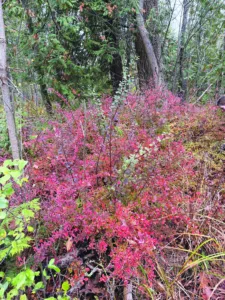
You can identify barberry by its small (1-2 cm) oval or spoon-shaped leaves with smooth edges, sharp spiny branches, and yellow roots and inner stems. In the fall, its foliage turns red, orange, or purple and it produces bright red oval fruits. Certain cultivars of barberry can have purple or even light-green leaves, but they share the same spines and invasive tendencies of their relatives.
The Problem
Japanese barberry is known to "escape" gardens and end up in forests, where it forms dense thickets, outcompeting native species. In the forest it spreads quickly through the growth and rerooting of its branches, known as layering. Additionally, it readily reseeds itself and can be spread beyond landscaped yards by birds and small animals, who eat the berries and excrete the seeds in a new location. In fact, wildlife dispersal is the probable cause for a small barberry infestation that a crew from the Keweenaw Invasive Species Management Area (KISMA) recently discovered (and successfully managed) at a pristine site near Eagle Harbor!
“Finding barberry in an isolated natural area showed me firsthand that it doesn’t stay confined to garden beds, despite what many people believe,” said Troy Tofil, KISMA assistant coordinator reflecting on his crew’s sighting of the invasive shrub. "It also shows that this plant poses a real threat to pristine ecosystems throughout our region."
When barberry enters an ecosystem, it provides little function relative to the resources it takes from native species. According to a fact sheet from the Minnesota Department of Agriculture, deer do not browse barberry because of its painful spines, which leads to them overbrowsing "easier-to-eat" native plants, effectively accelerating the spread of this plant.
A major concern about Japanese barberry is its connection to an increased prevalence of Lyme disease and other tick-borne diseases. A 2010 study found that Japanese barberry monocultures create more humid microclimates, reducing the likelihood that blacklegged ticks (Ixodes scapularis), also known as deer ticks, will dry out and die. These ticks are the primary vectors of the bacterium which causes Lyme disease. The dense, spiny structure of Japanese barberry also provides ideal habitat for small mammals such as the white-footed mouse, a key reservoir for the bacterium. Blacklegged ticks acquire B. burgdorferi by feeding on infected mice and can then transmit the bacterium to humans, dogs, and other animals through subsequent bites.
Compared to forests without Japanese barberry, infested forests were found to have ten times more blacklegged ticks carrying B. burgdorferi. However, removal of barberry bushes can help reverse the increase of Lyme disease in our area. In fact, the study found that managing barberry resulted in a nearly 60% reduction in B. bugdorferi carrying ticks.
Management of Japanese Barberry
Do you have barberry on your property or know someone who does? Luckily it can be straightforward to remove. These are the practices KISMA recommends for managing barberry:
● Wear a layer of cotton gloves under a pair of leather gloves to protect yourself from the sharp spines
● Using a shovel, dig at the base of the plant to uproot as much of it as possible
• Hand pull small plants
• For large plants, you may need to cut off branches first
● Hang plants by their roots from trees to let them dry out, as the roots will reestablish themselves in soil. If there are fruits, move them off-site to a place they won't germinate.
Remove a Shrub & Get Paid!
Through Aug. 12, KISMA is running its annual Barberry Trade Up Days. Anyone who drops off a Japanese barberry shrub or shrubs with roots intact at one of two locations throughout the Keweenaw is eligible for a $10 coupon to a participating native plant retailer. These include Flowers by Sleeman (Houghton), Kismet Gardens (Baraga) and Designs by Nature (Marquette).
Drop off instructions:
● Bring your excavated shrub or shrubs to the designated Barberry Drop-off Site
• For Houghton & Keweenaw county residents, the most convenient site is located at: Michigan Technological University Salt Barn on Cemetery Road
• For Baraga county residents, the most convenient site is located at: 616 Poplar Street, L'Anse, MI 49946
● Place shrubs directly into the designated receptacle, ensuring that the roots and any fruits are completely contained
For any questions, please contact us at kisma.up@gmail.com or visit our website at https://www.mtu.edu/kisma/native-alternatives/