
Life Beyond the Mines
KNHP presentation held Saturday
Trending
CALUMET - The Keweenaw Peninsula is known for its’ copper mining history. Knowledge about that time period is primarily focused on the mining companies and the multitudes of immigrant men who came to work in those mines. Daniel Wallace from the University of Southern California visited Keweenaw National Historical Park (KNHP) Saturday to discuss his work on expanding the understanding of the industrial landscape of the region through public history.
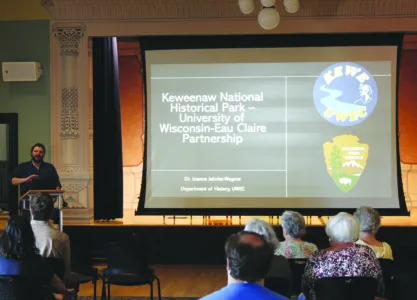
Wallace reflected on his American Conservation Experience - Mellon Humanities Fellowship which has followed two primary avenues. First, he is creating "Keweenaw Histories," a digital edition resource that will house exhibits on everyday places and how they influenced the industrial landscape around them. Second, he has worked with Joanne Jahnke-Wegner from the University of Wisconsin - Eau Claire to get undergraduate and postgraduate students to the Keweenaw for the summer to conduct research complementing the Keweenaw Histories.
The Keweenaw Histories project is "not live online yet," according to Wallace, "but it is close to being so." He proceeded to give the audience a teaser of what to expect when it is available. Five exhibits were highlighted, starting with "Pages and Parlors: The Life of Lucena Brockway."
The exhibit looks at the matron of the Brockway House, utilizing more than three decades Brockway’s diary, now housed in the Michigan Technological University archives. "We can learn from making ‘everydayness’ the point of the story," said Wallace. Letting this primary source guide him, Wallace designed the exhibit around recurring themes from Brockway's writing to paint the picture of what life in the Keweenaw was typically like.
The second exhibit Wallace shared was "The Making of Keweenaw Men and Women," which focuses on specific places and the meanings they had for ordinary people. A Chinese laundry service was one highlight, important to the single male miners who didn't have a wife at home to clean their clothes.
A school train which carried students from Adams and Stanton Townships to the school in Painesdale also caught Wallace's attention. "The same railroad designed to foster the industrial landscape scheduled the lives of the school children," he said.
"Life In the Last Place on Earth" looks at what, besides industry, shaped the history of the area by looking at, in part, land ownership for individuals. "Mother Superior: The Culture of Keweenaw Water" has a focus on the ever-present Lake Superior and other waterways that were important throughout the history of the Keweenaw.
Finally, "The Social Life of Keweenaw Copper" looks into what worlds came into existence because of copper mining. Not only did communities grow and thrive, but a multitude of churches with their own societies sprung up as did fraternal organizations like the Masons and Oddfellows. Wallace also pointed out the growing prevalence of telephones in homes meant copper literally followed people into their homes and this technological advancement helped connect more people and grow societies.
Wallace spoke for 45 minutes about his work and took questions from the audience. After a short break, the audience reconvened to hear how Wallace worked with Jahnke-Wegner to get students up to the Keweenaw for research.
Three such students presented overviews of their findings. Sy Neville has been in the Calumet area for a few summers and talked about his work, "Fraternally Yours: Gender, Identity, and Intimacy in the Keweenaw Copper Country."
Jules Schwar, a student this past summer, shared findings from their research titled "Mutual Aid and Femininity: How Women's Organizations in the Keweenaw Used and Defied Conventional Expectations of Femininity and Domesticity to Benefit Their Communities During the Copper Boom."
Owen Anderson, also in this area this summer, took less of a research role instead working with a local teacher to develop lesson plans. His presentation, "Curriculum Development and National History Day Revitalization," also investigated why schools in the area have declined in participation for National History Day and how they might get students interested once more.
All three students talked about the intersection of their work and Wallace's Keweenaw Histories as well. The common thread throughout was a focus on everyday lives of those who lived and worked here, both in the mines and beyond.
"This work is all about taking the time to notice the lives that have always been there," said Wallace. Amber Kraft, the Interpretation and Education Program Manager at KNHP, said "This program, at the start of National Park Week, highlights the importance of these places that preserve and share important national stories. National Parks belong to the American people. They are also essential to foster a place of inquiry and reflection on where we are as a country and how we got there. That rings especially true as our nation marks its 250th birthday."
In a particularly poignant connection, the talks and Q&A sessions wrapped up just in time for participants to head outside and watch the parade and Big Annie statue unveiling, a celebration of someone who transcended the everyday to become widely known for her labor advocacy.