
A local traffic problem
Houghton/MDOT seeking solution
Trending
HOUGHTON -- The City of Houghton is actively working with the Michigan Department of Transportation (MDOT) to address persistent traffic gridlock along a critical local traffic corridor.
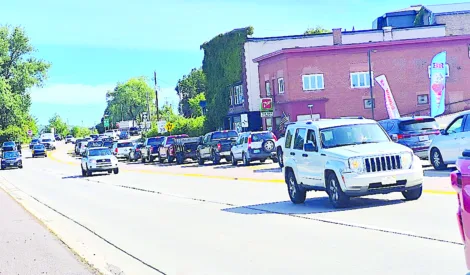
Houghton Police Chief John Donnelly confirmed the city is seeking a solution to the severe traffic congestion stretching from the M-26 and Houghton Canal Road traffic light, past the Yooper Loop and onto the Portage Lake Lift Bridge.
The push for a solution comes amid an increasing surge in traffic accidents along the congested stretch of highway. In just over a two-week period between Aug. 28 and Sept. 13, the Houghton Police Department recorded no less than five two-vehicle crashes along that specific corridor. Much criticism has been heaped locally on the exit from the south end of the Portage Lake Lift Bridge, locally referred to as the Yooper Loop. It begs the question: is the road system's engineering design flawed, or is the problem with driver error.
"Ninety-nine percent of all motor vehicle crashes are driver error," Donnelly said, "but when you see situations where more people are making errors than usual, you have to start asking why this keeps occurring in these places."
The local geography presents unique structural hurdles for traffic engineers and motorists alike.
"If you look at the complexity of trying to navigate two cities, downhill, through bedrock, then get them back and forth on a bridge, we're left with some very difficult challenges, whether its engineering or driver error," Donnelly said. "We have a lot going on there."
A primary focus of the city’s effort with MDOT is resolving the heavy gridlock that backs up from the bridge’s main traffic exchanges.
"We're trying to address the stacking problem that we have on M-26, where vehicles get stacked up (from the Yooper Loop) well past Dunkin Donuts," Donnelly said.
This bumper-to-bumper backup frequently leads to a specific, dangerous traffic pattern when well-meaning drivers attempt to be courteous.
"We have accidents there where people let people through gaps in the inside lane, then they get hit by oncoming vehicles in the other lane," Donnelly explained.
"There's driver error. People have let me through that gap," he said. "I know enough that if I try to shoot that gap, I need to look for the vehicles in the oncoming lanes. It's easy to do, because nobody's in a big hurry to close that gap. We're trying to address that in some areas."
Further down the corridor, the physical layout of the M-26 and Houghton Canal Road intersection additionally complicates matters.
"Then you get the area of the canal road and M-26. The sight distance in all directions is bad," Donnelly said. "Coming off the Canal Road, you come around a curve, then come up to the traffic light."
The intersection has been a point of contention for some time. On May 4, MDOT published a statement indicating the department has been monitoring the location for several years. Traffic counts eventually proved a traffic signal was warranted during the peak summer season. MDOT’s current protocol is to operate the seasonal signal from approximately May until October each year, placing the system into flash mode during the lower-volume winter months.
To help mitigate the poor visibility, Donnelly said MDOT has already raised the physical height of the traffic lights to ensure they can be seen from a greater distance.
"We are actually working with MDOT to try to reduce the bulk of that stacking that's out on M-26," Donnelly said. "The area by that light is going to continue to be a challenge because of that big hill. You have a curvy road going into it, and it leads to people making bad decisions."
Ultimately, the goal is to significantly reduce the vehicle stacking between the Yooper Loop and the traffic light, though options remain limited by the region’s infrastructure.
"We work with MDOT on a regular basis," Donnelly said. "One of our big challenges is a major choke point is always going to be that bridge. That is, how do you get as many vehicles on that bridge at the same time as you can?"
The sheer volume of daily traffic across the bridge highlights the problem.
"You know that bridge takes on 10,000 more vehicles in a day than the Mackinac Bridge," Donnelly said.
State data supports Donnelly’s assessment. The Portage Lake Lift Bridge handles more than 28,000 vehicles on an average day. In contrast, the much larger Mackinac Bridge sees between 10,000 and 20,000 vehicles per day, heavily depending on the season.
Finding a structural alternative remains difficult. The Keweenaw Waterway, which separates the Keweenaw Peninsula from the mainland, stretches 25 miles long--leaving the lift bridge as the single spanning connection for the entire region.