
All Hands!
Isle Royale rescue was a multi-agency success
Trending
DOLLAR BAY -- The recent helicopter hoist of 70-year-old hiker Craig Berg from an Isle Royale swamp on September 12 ended an 11-day survival ordeal, but local officials emphasize that the successful outcome relied heavily on multi-agency logistical coordination efforts for the search.
In a Sept. 15 email to the Daily Mining Gazette, Chief Boatswain’s Mate Cory Gallagher, officer in charge of U.S. Coast Guard Station Portage, said that during the search, the station’s facilities in Dollar Bay functioned as a primary aviation staging hub. From there, aircraft embarked six Michigan State Police (MSP) personnel and two K-9 teams for transport. Concurrently, a Station Portage boat crew operated for more than eight hours on Lake Superior, navigating 6-to-8-foot seas to transport six additional MSP troopers, a K-9 team, a mobile communications unit, and more than 1,000 pounds of specialized search-and-rescue equipment directly to the island.
“The helicopter hoist was certainly the dramatic final piece of the rescue, but a significant amount of work happened behind the scenes to make the search possible,” Gallagher said.
That involved many coordinating agencies. Because Isle Royale is officially within Keweenaw County, the county sheriff's office has jurisdiction there. Sheriff Curt Pennala said personnel from his department, along with the Michigan Department of Natural Resources (DNR), were the first responders to arrive on the island and served as a core part of the coordination team conducting the search.
"The DNR and the sheriff's office were two of the first responding agencies that got involved," Pennala told the Gazette, "then the search got extended beyond that, and that's when the Coast Guard became involved and when MSP got involved, too."
Pennala said in addition to having personnel involved in coordinating the search that focused on their particular areas, other deputies were "boots on the ground" assisting in the search.
"The Michigan State Police had a large number of troopers out there," said Pennala.
He went on to note that the final operation included Isle Royale National Park personnel, the DNR, the sheriff's office, the Michigan State Police Special Operations Division, the U.S. Coast Guard, Station Portage, No One Left Behind Canine Search & Rescue, as well as Wisconsin and Minnesota State Patrol Aviation Resources.
Pennala emphasized the DNR was an essential part of the entire operation, responsible for coordinating the state search efforts, while the sheriff’s office helped organize the search parameters.
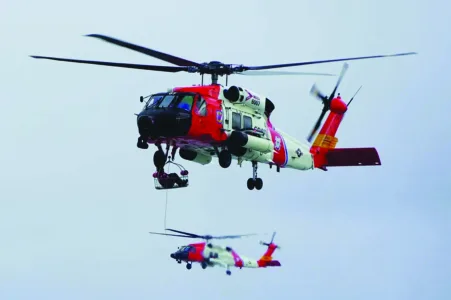
The extensive coordinated search subsequently ended with Berg being located near Intermediate Lake after his cries for help were heard by two nearby kayakers, who relayed his coordinates. An Air Station Traverse City MH-60 Jayhawk helicopter crew executed the final extraction, Gallagher said, transporting Berg to a regional hospital for treatment of dehydration and hypothermia.
According to a Sept. 22 article published by People.com, Berg told the New Zealand Herald he became lost on a trail. After falling into a swamp he described as being like quicksand, he lost his cell phone. Over the next 11 days, the hiker survived on his limited supply of freeze-dried food and by drinking "the most disgusting water that you could imagine."
At times, he recalled only being able to eat every other day due to dwindling supplies, running out of fuel for his camp stove, and drinking from "a little pond that moose drank from."