
Focus of re-industrialization
DOE Assistant Secretary visits
Trending
HOUGHTON -- The western Upper Peninsula is increasingly becoming a focal point for state and federal clean energy and industrial infrastructure investments.
On Tuesday, the U.S. Department of Energy (DOE) announced $117 million in project selections aimed at boosting the competitiveness of domestic industrial sectors. As part of that national release, Michigan Technological University is receiving a $1 million grant to develop a new process to recover usable iron from low-quality iron ore waste.
The funding announcement came before a Michigan Tech campus visit from U.S. Assistant Secretary of Energy Audrey Robertson, who leads the DOE's Office of Critical Minerals and Energy Innovation.
The project, titled "Production of improved DRI (Direct Reduced Iron) feed from diverse iron sources by reductive bioleaching," utilizes microorganisms in constructed wetlands to extract, concentrate, and purify iron from dilute waste materials.
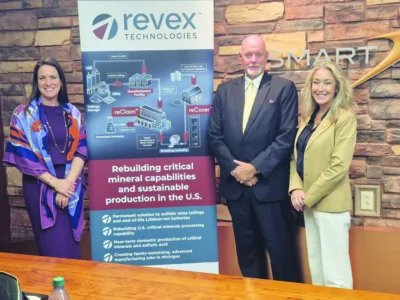
While in Houghton, Robertson also attended a presentation by Houghton-based startup Revex Technologies at the MTEC SmartZone to discuss the federal government’s role in local workforce development.
Robertson's visit follows the DOE's Aug. 7 launch of the PROSPECT (Providing Opportunities for Specialized Education in Critical Technologies) initiative, a $100 million program designed to fix critical worker shortages in America's mining and mineral supply chain.
Michigan Tech can benefit from this push as one of only 14 universities nationwide with an accredited undergraduate mining engineering program. University President Rick Koubek and representatives from the Department of Geological and Mining Engineering and Sciences recently traveled to Washington, D.C., to participate in federal roundtables to help shape the program’s framework.
According to Robertson, the domestic mining sector is facing an immediate talent deficit compared to global competitors.
"There's only 20 undergraduate students at Michigan Tech,” Robertson stated during her presentation at the SmartZone. “There's only 163 that graduated in the country in mining engineering. Three thousand graduated from China this year, and we had 163. So to say we are lagging is an understatement."
Robertson noted that the PROSPECT initiative is designed with aggressive timelines to double the output of mining and mineral processing graduates within two years. To achieve this, half of the program’s funding is dedicated directly to student scholarships and out-of-state tuition assistance.
“This isn't go recruit and have a 10-year window to slowly change the demographics,” Robertson said. “This is like a hard-right turn and give schools, students, parents, communities both an understanding of why we're doing it.”
While Michigan Tech provides the academic foundation, local private entities are moving forward with scaling these technologies into commercial facilities.
Revex Technologies is currently working toward final execution of a separate $145 million DOE grant to construct two processing facilities in partnership with Marquette County's Eagle Mine. The project focuses on reclaiming critical minerals like nickel and lithium from spent batteries and legacy mine tailings.
"Revex is a project looking at recovering critical minerals, nickel, lithium from waste materials--specifically the mine tailings from Champion, and spent lithium-ion batteries," Michael Cleveland, Co-Founder and Chief Operating Officer of Revex Technologies, told The Daily Mining Gazette in a Tuesday morning interview.
Cleveland explained that the process relies on standard, commercialized technologies to minimize traditional extraction footprints. He also noted that federal backing for the project has remained consistent across changing political administrations in Washington.
"We were awarded the grant under the Biden Administration, it was reviewed under the Trump Administration, and we're in the final stages of re-signing the grant," Cleveland said.
Robertson echoed the emphasis on domestic manufacturing security during her presentation.
"Under Trump's leadership, it has been very clear to everyone, and to the president, that we have to re-industrialize America," Robertson said. "And if we don't re-industrialize America, we are going to lose everything that's important to us. We need to not be captive by foreign adversaries.”
A core component of the Revex grant is a mandatory Workforce Success Plan, which commits to hiring 115 employees split roughly evenly between the Humboldt Mill site in Marquette County and a downstream facility in Midland, Michigan. Cleveland described the positions as chemical technician roles, with roughly 70 percent operating as non-exempt and 20 percent as exempt employees.
Cleveland noted that modern reprocessing initiatives allow the region to utilize its geological legacy without repeating historical environmental mistakes.
"It's taking capabilities of what we have and doing it responsibly," Cleveland said. "The old days of taking tailings and dumping them in Torch Lake are gone."
From a local standpoint, Robertson's discussion of the PROSPECT program indicates a larger shift occurring across the Upper Peninsula.
In August, the Michigan Strategic Fund approved a $50 million Strategic Site Readiness Program grant for Highland Copper Company’s Copperwood Project in Gogebic County, allocating $45 million to on-site infrastructure and $5 million to critical upgrades for County Road 519 in Wakefield Township.
While grassroots campaigns like “Protect the Porkies” have active public opposition platforms against regional mining developments based on local environmental and tourism concerns, the sheer volume of incoming state and federal capital suggests a structural shift.
Driven by national security directives to secure the domestic supply chain, Washington and Lansing are increasingly viewing the Upper Peninsula’s mineral resources in broader economic terms. With a quarter-billion dollars in combined public funding already moving into the region, local developments are increasingly tied to a national industrial agenda that extends far beyond local debate.