
Preserving history
Engine No. 1 returns home
Trending
FRANKLIN TOWNSHIP -- Eighty-one years ago, the Quincy Mining Company suspended its mining operations with the hope that the local shafts would one day return to productivity. With that future in mind, company officials stored its fleet of steam locomotives inside the engine house located near the No. 7 Shaft.
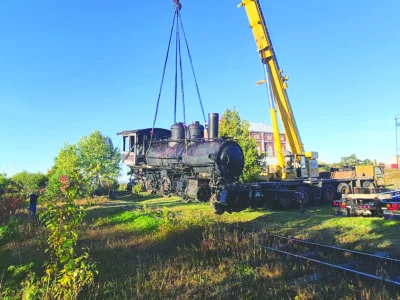
Three decades later, the locomotives were removed from the structure, and three were placed on public display near the Quincy No. 2 Shaft's Nordberg steam hoist house. On Monday morning, Engine No. 1 finally returned to the engine yard to undergo a comprehensive restoration.
The ongoing project to restore the Quincy & Torch Lake Railroad (Q&TLRR) engine yard--along with two steam locomotives and several mining cars--continued this June with structural work completed on the tender of the No. 1 locomotive. The initiative began two years ago under the direction of Chuck Pomazal, a retired civil engineer from the Illinois Department of Transportation.
Pomazal, who is also a model railroad enthusiast, views the historic short-line Q&TLRR as a life-size railroad layout. He and a dedicated crew of six to eight volunteers, all friends who share a deep passion for rail history, have spent the past quarter century preserving the legacy of the Quincy Mining Company’s private line.
Built and owned by the mining company, the short-line railroad did not carry passengers. It served just two industrial purposes: hauling copper rock from the mines down to the company’s stamp mill on Torch Lake, and hauling coal back up the hill from the mill’s wharf to power the mine site.
The arrival of Locomotive No. 1 marks the next major phase for the volunteer crew, coming on the heels of their recently completed restoration of Quincy and Torch Lake Railroad Engine No. 5.
In June, Pomazol said the primary mission for September was have the No.1 engine relocated to its former home in the engine yard.
We’re moving the locomotive from the field up near the Quincy Hoist, where it’s been on display since 1975," Pomazal said Monday morning. "We’re moving it down to the engine house where we have the facilities to begin its restoration and cosmetic overhaul."
The locomotive is a narrow-gauge 2-6-0 locomotive built by the Brooks Locomotive Works, of New York, in 1889. It was named Thomas F. Mason, after the mining company's president. The 56,000-pound locomotive was loaded onto a flatbed trailer via a crane, and transported to the engine yard, returning home after eight decades.
Moving the engine required an industrial crane to lift the 28-ton engine from its display tracks and place it onto a flatbed semi-truck for transit down the hill. Once the restoration is complete, the locomotive will be placed on a newly laid section of track near the historic water tower.
"We’ll sandblast it, paint it, and repair the cab," Pomazal explained. "Then we can set it up on the rails by the water tank and match it with the tender that we’ve just got done restoring."
The presence of the crane allowed the volunteer crew to complete several logistically demanding yard adjustments on Monday.
"While we have the crane here, we can set the tender where we want it," Pomazal said. "We also have a collection of old wheel sets, known as trucks, from some old rock cars. We’re going to move them up on some rails and get them out of our way for the future walking path that will be coming along the side of the building."
Pomazal noted that the initial exterior sandblasting and painting will take place on the tracks directly in front of the engine house before the locomotive is rolled inside for fine detailing.
Pomazol because the work of historical preservation at the Quincy engine yard is done by an all-volunteer group, an estimated completion date has not been established.
"We don’t have a strict timeline because we're a group of volunteers," Pomazal said. "We only get together maybe twice a year for a week at a time, and the scheduling depends entirely on who is available. Most of us are retired, but some people still have to work, and we have to coordinate around those schedules."