
About Proposal 2
Would ban utility and contractor campaign donations
Trending
HOUGHTON COUNTY - Upper Peninsula voters will join electors statewide in deciding the fate of a citizen-initiated November ballot proposal that aims to restrict campaign contributions from regulated utility monopolies and government contractors. Known as Proposal 2, or the “Money Out of Politics” initiative, the measure was placed on the ballot after the nonpartisan organization Michiganders for Money Out of Politics submitted petition signatures to the state Bureau of Elections.
The ballot summary asks voters whether to adopt a law to prohibit campaign contributions from certain regulated utilities and government contractors and apply campaign finance laws and regulations to additional types of political communications. The proposal would prohibit regulated electric and gas utilities, government contractors with over $250,000 in annual public agreements, and individuals or organizations with substantial connections to those entities from making direct or indirect campaign contributions. The ban applies to candidates for governor, attorney general, secretary of state, the state legislature, and certain local offices, as well as to ballot measure committees.
The restriction extends to utility political action committees (PACs), board members, executives, corporate lobbyists, and their immediate family members. Additionally, the measure expands disclosure laws to regulate independent political spending, lowering the annual independent expenditure reporting threshold from $1,000 to $500.01 and mandating clear disclaimers for advertisements utilizing artificial intelligence.
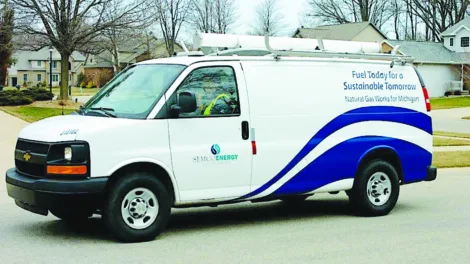
While downstate debate has focused on massive energy corporations like DTE Energy and Consumers Energy, the statutory ban applies directly to all utilities regulated by the Michigan Public Service Commission (MPSC). If approved by a majority of voters, the law would bar regional providers operating across the Upper Peninsula, including SEMCO Energy Gas Company, from making direct or indirect financial contributions to state and local candidate committees.
State election registries show that regional providers are directly involved in state political funding. Bureau of Elections data shows that SEMCO Energy PAC routinely funnels tens of thousands of dollars each cycle directly into candidate committees, targeting lawmakers on the House and Senate energy committees. Historical reports listed the SEMCO Energy PAC 130th on the top 250 Michigan PACs, recording $61,870 during the 2012 cycle and $66,754 during the 2010 cycle. If Proposal 2 passes, SEMCO's PAC, corporate lobbyists, and top executives will be permanently barred from writing these checks. In contrast, state election logs indicate that Upper Peninsula Power Company (UPPCO) does not operate a corporate political action committee or issue candidate contributions on the state ledger.
Supporters argue that political donations from state-regulated utility monopolies grant corporations undue influence over elected officials, contributing to rising consumer utility rates and industrial infrastructure expansions. A Bridge Michigan analysis found that of all 110 members of the state House, an average of just 14 percent of their campaign funds came directly from constituents, while they were mostly funded by political action committees. In 2023, the Energy and Policy Institute found that 119 out of 148 legislators accepted funds from utility PACs. One of the top recipients of DTE and CMS PAC cash is Gov. Gretchen Whitmer, who has received more than $140,000 over her career. Public pushback against these utilities has risen amid a series of rate increases and widespread outages, with a 2025 Citizens Utility Board of Michigan report finding state ratepayers face some of the highest rates in the Midwest for poor service.
The campaign opposing the initiative is led by a ballot question committee called Protect MI Free Speech. Opponents, backed by funding from major regulated utility corporations and business coalitions, contend that the contribution restrictions limit the free speech rights of utility employees and contractors, and could shift political influence toward out-of-state donors and undisclosed dark money groups. Protect MI Free Speech has raised approximately $579,000 from sixteen donors, among them Comcast, CMS Energy (Consumers Energy’s parent), Blue Cross Blue Shield of Michigan, Delta Dental of Michigan, MITA Inc., and Michigan Citizens for Better Health. Its treasurer is Wendy Block, head lobbyist for the Michigan Chamber of Commerce.
The opponents’ arguments state that banning political contributions restricts the right of political association under the First Amendment, an issue courts will ultimately decide through the measure’s severability clause. DTE spokesperson Ryan Lowry and Consumers spokesperson Katie Carey both argue the proposal would shift influence to out-of-state donors and to super PACs the measure cannot reach. In addition, Blue Cross representatives argue that employee PACs are not corporate money, stating its PAC is funded entirely by employees who represent all viewpoints and voluntarily contribute their own money. From a funding perspective, Consumers’ spokespersons have pointed to the proponents’ own use of outside capital, noting the campaign received $115,000 from the California-based Tides Foundation, a donor-advised clearinghouse that does not disclose original sources.