
Making progress
Redridge project manager updates pubic
Trending
STANTON TOWNSHIP -- The Redridge dam will undergo design changes within the next few years in order to meet stringent state regulations, according to the Stanton Township Board. The Board held a special meeting Thursday where a representative from Barr Engineering spoke about the project's new design and a timeline going forward.
Redridge Dam Project Manager Brian Belmore said the goals of the project were increased safety, meeting regulatory standards and environmental responsibility. "Michigan's hazard classification currently calls it [Redridge] a 'significant' rating," he said. "The 'significant' rating was assigned mainly because of the downstream Freda Road and the impact it would cause if that road got washed up."
According to Belmore, the rating falls in between 'low' and 'high' risk, where if the dam were to break, it would impact the surrounding wildlife fisheries, neighboring population and the major arterial roads.
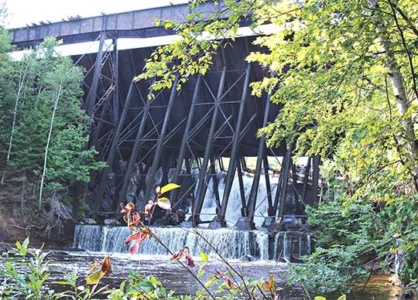
In its current state, the Redridge Dam sits on Salmon Trout River. The steel dam is closer downstream to Lake Superior and the older timber crib is situated upstream, past the steel structure. Specifically, the steel dam was constructed in 1901. According to Belmore, steel was used as opposed to copper or earthworks, as it was a more accessible material and better suited the geologic profile of the area.
Belmore said a preliminary re-design opened two portions of the steel dam in order to meet 2024 state water flow requirements, which required a 1,600 cubic feet per second capacity for a 200-year flood event. The Michigan Department of Environment, Great Lakes and Energy (EGLE) would provide a $278,000 grant for the safety measures. The timber crib would be removed due to its condition.
Then the requirements changed twice within two years. The project now requires a 4,800-6,400 cubic feet per second flow, with a flood-of-record capacity -- which is the 2018 Father's Day Flood.
"The Salmon Trout River has no stream gauges, so there was really no quantitative way to measure was the flow rate actually has been over history," he said. "From photos, they [EGLE] said if we can back-calculate from the debris on the dam... we need to use that information to calculate the flood of record and design for that."
Due to the increasing safety regulations and grant requirements from EGLE, as well as the sea lamprey barrier requirements for a $1.375 million grant from the Great Lakes Fishery Commission (GLFC), the project needed to reconsider its design.
Belmore said the revised design will still remove the timber crib, but it will also not include the historic steel superstructure. "We also had to cut a pretty large square of concrete out of that center section to continue to pass more flow," he said. "Then we added kind of a center low-flow channel and then anything where the concrete was modified will also be resurfaced."
According to Belmore, this new design would extend the life-expectancy of the dam and also meet the more than $1.5 million in grant funding requirements. It also keeps the top trestle, as the township does not own it.
Belmore said EGLE's risk assessment marker would also be moved from "significant" to "low." Belmore wrapped up his presentation and explained the next steps, which includes a timeline for construction bidding, pooling funding and getting the EGLE permits.
According to Belmore, Barr and Stanton Township estimate the project will have a bid package ready for contractors in Q2 2027, after state requirements are met. EGLE comments will be addressed and funding will be monitored through the end of next year.
After the presentation wrapped up, the township held a Q&A with Belmore. One River Street resident asked if the adjacent Freda Road and the surrounding area will have an increased floodplain. Belmore said the culverts under Freda Road mitigate any increase. Former Michigan Tech Civil Engineering Professor Stan Vitton asked if the river's sediment posed an environmental risk, to which Belmore said it did not according to Barr's core studies.
Stanton Township Board Chair Marty Rajala said the board and township residents are supportive of the project taking its next steps. "We're extremely relived to see some progress or some way forward," he said after the meeting. "It's been a thorn in the township's side for many years."
Rajala added the board voted to approve the new design in July. The immediate next steps the project needs to take are meeting with the regulatory agencies (EGLE and GLFC) as well as improving and finalizing the design.