
Remembering Margaret Heafield Hamilton
Girl from Ripley became one of the world’s leading software engineers.
Trending
Margaret Heafield Hamilton, who died late last month at the age of 90, led the development of the on-board flight software for the guidance computer in NASA's Apollo 11 spacecraft, which landed the first men on the moon. She coined the now-ubiquitous term "software."
Margaret was touted worldwide as a pioneer in software engineering. And she grew up right here in Ripley, graduating from Hancock Central High School in 1954.
"That just shows that big ideas can have their roots in small towns," says Sharon Juntunen, who knew the software engineer when she was growing up because Sharon's friend, Katie Heafield, was Margaret's younger sister.
"I knew her as Bunny," Juntunen recalls. Her family's nickname for her was also listed as her nickname in her high school yearbook, preserved in the Michigan Tech Archives.
It seems appropriate. Classmates remember Margaret "Bunny" Heafield as not only a brilliant student, but a fun-loving, sociable girl who loved popular music and hot fudge sundaes.
"She was a little bit mischievous," says her daughter, Lauren Hamilton, a painter who lives in Kingston, New York. Once, when Margaret's parents left her in charge of her four siblings while they were away for a funeral, all the kids ate all week was hot fudge sundaes, Lauren recalls her mother telling her.
"She was pretty and popular, not a math nerd," Lauren says.
Classmate Norbert Verville, who lives in Houghton, remembers Margaret because she was in some of his classes. "She was brilliant," he recalls.
"She was very, very smart," agrees Mary Dale Hauswirth, another classmate who grew up with Margaret in Ripley.
The salutatorian of her graduating class, Margaret not only shone in academics, she was active and well-liked at Hancock Central High School. She served as class secretary her junior year and on the Senior Class Council. At the senior Winter Wonderland dance, Margaret was crowned queen.
She was president of the Literary Club, served on the Student Council and sang soprano in the school choir.
Margaret served as editor of the high school yearbook and jokingly wrote in the senior class will: "I leave the yearbook editorship to any junior who has a large allowance to spend on aspirin."
At Earlham College, where she majored in mathematics and minored in philosophy, Margaret was thrilled to introduce her classmates to the music of Elvis Presley.
In 1965, Margaret was the first female programmer hired to work on the Apollo project, housed at M.I.T.'s Instrumentation Laboratory. She soon was promoted to director of software engineering on the project, which developed the two onboard computers that directed the Apollo flights: one for the command module, which carried the astronauts from Earth, and the other in the lunar module that actually landed on the surface of the moon.
She coined the term "software" and described her team's work as "software engineering," elevating software coding--which had been considered a lesser skill--to the status of computer hardware design.
Margaret was just 32 when her computers safely guided the Apollo 11 spacecraft to its landing on the moon. "I was not concentrating on the mission per se, I was concentrating on the software," she recalled in a 2017 interview with the Computer History Museum. When Apollo 11 actually touched down, she remembered exclaiming: "Look what happened. We did it. It worked.'"
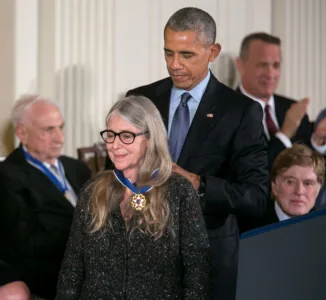
Margaret worked on six lunar landing missions from 1969 to 1972. She also did programming for Skylab, America's first space station and worked on the early design of the space shuttle. She left M.I.T. to found a company, Higher Order Software, in 1976. Ten years later she founded a second firm, Hamilton Technologies. For her pioneering work in the space program, she received the Presidential Medal of Freedom from President Barack Obama in 2016.
Lauren Hamilton remembers accompanying her mother to the M.I.T. software engineering lab when she was a child. Her work ethic was demanding, Lauren recalls. "I would say she was a workaholic," her daughter says. She prided herself on her ability to see a difficult task through to completion, crediting her upbringing in the Copper Country with her heartiness, grit and self-sufficiency. "That's the way we do it in the U.P.," she'd explain.
Lauren visited the Keweenaw with her mother two or three times while she was growing up. "It was beautiful," she recalls.
Growing up in Cambridge, Massachusetts--home to M.I.T.--Lauren came to understand that her mother preferred the abstract, conceptual work of computer programming to computers themselves. She didn't even like using computers, her daughter remarks. "Until she died, she would get frustrated using her laptop, just like most of us," Lauren said.