
Strong like a moose
Study shows good UP calf survival rate
Trending
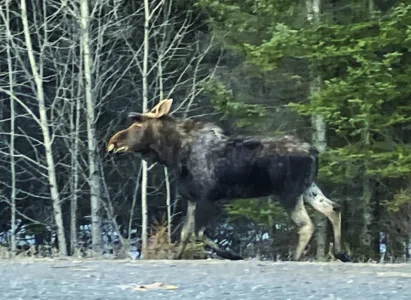
MARQUETTE -- A collaborative wildlife research project in the Upper Peninsula has documented an exceptionally strong first-year survival rate among regional moose calves, significantly outpacing studied populations in neighboring states and Canadian provinces.
Recent reports from the ongoing field study record a 64 percent survival rate among the monitored population, according to a Thursday Department of Natural Resources (DNR) update. In wildlife biology, newborn calf survival rates anywhere above 50 percent are generally considered strong indicators of a stable population framework.
The Upper Peninsula findings contrast similar tracking efforts in northeast Minnesota, where recent estimates put calf survival around 35 percent. Michigan’s 64 percent first-year mark--coupled with field trends indicating a steady trajectory for year two--presents an optimistic sign for the long-term health of the regional moose population, the update says.
The field research is conducted in a partnership between the Keweenaw Bay Indian Community (KBIC) Natural Resources Department (NRD), Northern Michigan University and the Michigan Department of Natural Resources, according to a recent NRD release. To record the data, teams track individual animals within the region using collars, aerial spotter planes, helicopters and snowmobiles, the NRD release says.
During the initial phase of the study, field biologists and tribal resource technicians monitored 22 moose calves born throughout May and June. Systematic tracking reports confirmed that 14 of those collared newborns remained active and thriving within their habitat areas at the end of September.
While early-life predation from black bears and wolves is a natural variable within the ecosystem, the strong survival percentage provides early indications that predator pressure is not acting as a primary limiting factor on calf mortality inside the Michigan range, the DNR says.
According to a KBIC NRD report, historical records confirm that moose have occupied the North American continent for thousands of years, surviving through the glacial era into the period of old-growth white pine forests. However, widespread logging and habitat destruction throughout the western Upper Peninsula eventually led to a severe population decline.
This ecological shift brought new regional diseases to the altered landscape, most notably brain worm transmitted by white-tailed deer, the NRD notes. By the early 1900s, only a handful of native moose remained scattered across the peninsula.
Subsequent reintroduction attempts by the DNR brought varied success, while decades of isolated monitoring on Isle Royale recorded a localized carrying capacity of roughly 1,000 animals. Despite these past attempts, contemporary mainland studies continue to show a persistent stagnation in population numbers.
To locate the underlying environmental constraints, the current research team collects field data focused on animal movement, mortality vectors, calf survival and specific habitat utilization, the NRD says.
“Our goal is to better understand why the moose population has remained stagnant,” said Blake Chosa, wildlife biologist for the KBIC “We're collecting data related to movement, mortality or survival, habitat use and other factors influencing population growth.”
Researchers use low-flying spotter planes to direct ground crews and helicopter capture teams. Technicians use tranquilizer darts on individual moose to apply tracking tools and collect biological samples for lab analysis.
“We were smooth, more prepared and effective,” noted Kyle Seppanen, wildlife coordinator for the KBIC. “We doubled our effort from the previous year."