
Wildfires closer to containment
More than 1,000 acres burned so far
Trending
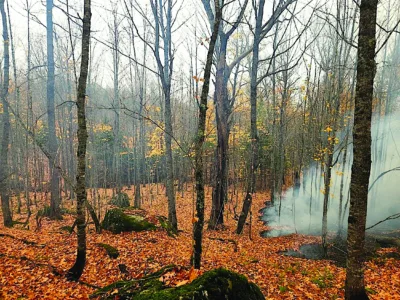
CRAIG LAKE -- Recent rainfall and cooler weather conditions have allowed firefighters to establish initial containment perimeters on two active wildfires in Baraga and Marquette counties. Updated mapping shows the blazes have consumed a combined 1,018 acres.
According to a Wednesday morning update from the Michigan Department of Natural Resources (DNR), the Craig Lake Fire in Baraga County is now estimated at 568 acres, while the Ridge Fire northwest of Marquette holds at an estimated 450 acres. Both fires are reported at 20% containment.
Kerry Heckman, public information officer for the DNR Forest Resources Division, told the Daily Mining Gazette that the Craig Lake fire location remains exceptionally difficult to reach because of its remoteness and severe terrain limitations.
"A lot of that is just us getting access into (the area) for us to able to determine the exact size of the fire, which obviously affects the containment percentage," Heckman said. "It's not that the fire was super active yesterday or today, it's just that we're able to get more accurate information."
Heckman noted that the rock outcroppings and lack of established road infrastructure have completely restricted heavy vehicular operations.
"Because of the difficulty with access, most of the work that's been done on that has just been by hand, because we can't get equipment in there," Heckman said. "So, a lot of it's been hiking back in and using leaf blowers and hand-held equipment to get down to bare mineral soil to establish a containment line."
Due to the isolated location of the Craig Lake basin, state officials confirmed that no structures are currently threatened and no evacuations have been ordered for that specific site.
"So, it's a lighter touch as far as fire suppression goes because of that, and luckily, because it's so remote we don't have to worry about structures being threatened or ordering evacuations," Heckman said.
Precipitation over the region provided a brief logistical advantage to the ground crews, though field commanders noted that additional moisture is required to completely extinguish the subterranean hot spots.
"We did get about 6/10 of an inch, so we did get a little bit on the fire," Heckman said. "Certainly, any little bit helps, at least it helps knock back the fire activity, so it gives us a chance to try to get ahead on things while the water's working in our favor, but, yeah, we could have used a lot more for sure."
While the initial cause was listed as under investigation on Tuesday, a subsequent statement released by the DNR on Wednesday confirmed that lightning strikes fanned by weekend winds ignited the Craig Lake blaze. Heckman said that delayed ignition is a common characteristic of regional backcountry duff fires.
"Lightning strikes can skulk around in the ground for quite a long time and burn low," Heckman said, "but it takes wind before it starts an actual fire."
State investigators subsequently determined that the lightning smoldered undetected in the soil until dry conditions and sudden surface winds fanned the hidden embers into an active wildfire. The cause of the neighboring Ridge Fire remains under investigation.
In Marquette County, the Sheriff's Office has officially lifted the precautionary evacuation orders for residents along County Road 510 after fire activity subsided. Evacuation readiness for residents along North Basin Drive was concurrently downgraded from “Set” back to “Ready” status. The evacuation center at the Negaunee Township Hall remains available for residents affected by smoke conditions, while the Noquemanon Trail system remains closed west of the County Road 510 trailhead to keep the public clear of active operations.
A shift in wind direction has driven heavy smoke from both burn sites southward, prompting the Michigan Department of Environment, Great Lakes, and Energy (EGLE) to issue an active air quality alert for Baraga, Marquette, Iron, Dickinson, and Menominee counties. A five-nautical-mile Temporary Flight Restriction (TFR) remains in effect below 3,500 feet over both fire zones, and all civilian drone use remains strictly grounded to prevent an immediate suspension of aerial firefighting operations.
According to the DNR, both fires were initially spotted by a DNR pilot on Friday, Oct. 9, with the Craig Lake Fire discovered at 1:48 p.m. and the Ridge Fire discovered at 3:55 p.m.